A park for blossoming wealth
|
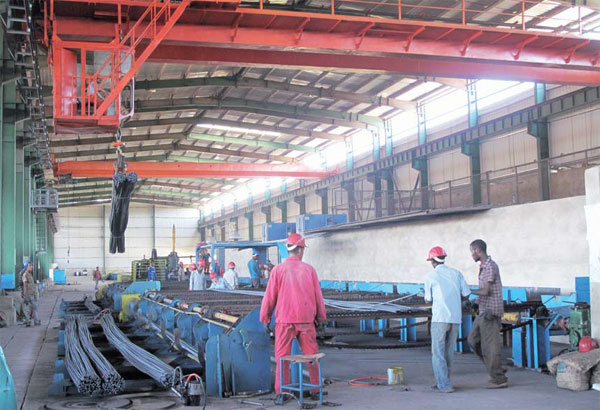
Employees at a plant in Eastern Industrial Park in Addis Ababa. There are 11 buildings covering 110,000 square meters and a wastewater processing plant in the park. Photos by Wang Chao / China Daily |
A Chinese firm is seeing the seeds of an ambitious project begin to sprout In Addis Ababa
The Versace sunglasses seem to be an almost permanent fixture on Lu Qixin. This particular day when he takes them off, to have his photo taken, the imprint of the frames on his skin is almost as clear as his eyes, nose and mouth.
Lu, 47, is the deputy director of Eastern Industrial Park, 30 kilometers from the Ethiopian capital, Addis Ababa, but today he is our chauffeur and guide on a tour of the park.
Lu is the younger brother of Lu Qiyuan, director of the park and also head of a private company, Qiyuan Group, in Jiangsu province, whose principal business is equipment molding.
As Lu junior drives us hither and thither, barely speaking a word, the message comes through that Qiyuan Group, the company that runs the park, is, just like Lu's glasses, here to stay.
For one thing, by the end of last year, Qiyuan Group had spent more than $80 million on the park. And for another, a wide range of companies, including a biscuit maker, a clothes maker, a shoemaker, the Chinese auto company Lifan and the Anglo-Dutch consumer goods giant Unilever NV have signed up to rent space there.
The park is also the biggest of its kind in Ethiopia into which foreign investment has been poured.
One of the solid planks under all of this is government backing, the result of an agreement between Ethiopia and China in 2006, after which the private Qiyuan Group won the tender to build the park, covering 5 hectares.
The helping hand of the state notwithstanding, Lu says that because the company is private it may have advantages over state companies in overseas projects.
"First, they are not subject to the suspicions that state companies have to put up with, that they are somehow doing their government's bidding. Second, rising labor prices in China that make attractive profits ever more elusive mean such companies are highly motivated to go out looking for new opportunities."
In 2011, the park attracted its first big tenant, Huajian, one of the biggest shoemaking companies in China. Now construction of 11 buildings covering 110,000 square meters has been completed, and there is a wastewater processing plant, too.
But finishing the infrastructure is not enough, and to make the park a paying proposition, more tenants are needed. The company has held promotional events annually in recent years in East China, including Jiangsu, Zhejiang and Fujian provinces, and in Southeast Asia, where the pressure of rising labor costs is also increasing.
By the end of last year a medium-sized textile company from China that makes jeans, a company from Addis Ababa that makes biscuits, and Unilever had signed contracts for space in the park. Unilever will start operating there in June, making shampoo in premises covering 5,000 sq m.
What is helping draw the likes of Unilever to the park are tariff exemption agreements between Ethiopia and many European countries, and generous income tax breaks. Labor-intensive companies and those that export more than 80 percent of their products pay no income tax for up to seven years, and electricity is cheaper than outside the park.
Yin Tianjun, president of Lifan Motors Ethiopia, says the company moved into the park about a year ago. Before that it had a plant on the outskirts of Addis Ababa that was dogged by electricity outages.
"Having a cluster of companies here is a bit like having collective bargaining, and the government can assure better utilities supply," Yin says.
"Even if there is a power outage, the park has a backup generator to sustain our production."
By the end of the year the park will officially become a destination port, meaning the government will post custom officers there to deal with import and export issues. Products will then be able to be sent directly abroad, saving the hassle of sending them through ports.
Recently, Qiyuan landed another big fish, a Vietnamese textiles company, Lu says. It will be the largest foreign company in the park. It plans to move its whole industry chain to the park, including spinning, weaving and clothes-making. Once it starts operating it will employ at least 30,000 local workers, Lu says.
The park itself has a small management team, and Qiyuan employs about 50 Chinese managers. The others are contract workers from Addis Ababa or nearby villages.
Lu Qixin says Qiyuan has been surprised by the success of the park, the original aim of which was simply to test the waters. Now it is growing so quickly that this is putting a strain on the company's cash flow, he says.
It relies on rent from companies for most of its revenue, and a smaller portion from the China Eastern Hotel, an economy establishment that it runs in Addis Ababa and whose customers are mostly Chinese migrants.
In the industrial park, rent for each building is 2 million yuan ($323,000) a year, Lu says.
"That means that even if all 11 spots are taken, we take in only 22 million a year, meaning it takes us four to five years just to break even. So we would prefer to sell the plots to manufacturers so we can recoup our outlay sooner."
Alleviating that worry for the Lu brothers is the fact that the company is eligible to receive a grant of about 200 million yuan from China's Ministry of Commerce this year, as part of a program to encourage Chinese companies to set up operations overseas.
"If we get this money on time, it will greatly relieve the pressure on us," Lu says.
Sisay Gemechu, Ethiopia's state minister of industry, says that while many Chinese construction companies are in the country, more are needed. The government plans to build another three industrial parks in Addis Ababa, he says.
"We have formulated policies to encourage private business to invest in Ethiopia, like Eastern Industrial Park. And we welcome not only trade companies, but also manufacturing businesses."
The industrial park is critical for Ethiopia's economic transition, Sisay says. "It means a number of industries and companies can come and get the services in one stop that might not be available outside the park.
"We are glad that even as we are eager to work with Chinese investors, China has its going-out push."
The company is looking for other sources of revenue, including a five-star hotel in Addis Ababa, for which building permission has just been granted, and residential apartments next to it. These projects are due to be completed by 2017.
"We will do the residential apartments first so when Chinese companies send people here there will be somewhere for them to stay," Lu says.
Contact the writers through wangchao@chinadaily.com.cn