Creating a whole new Chinese art history
|
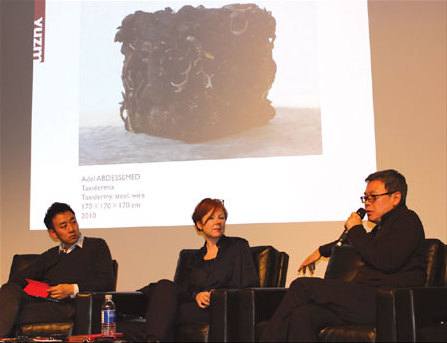
Lu Xun (left), co-founder of Sifang Art Museum in Nanjing, Karen Smith (center), director of OCT Contemporary Art Terminal in Xi'an, and Budi Tek, founder of Yuz Museum in Shanghai, discuss China's museum boom at Armory Focus: China on Saturday at Pier 92 & 94 in New York City. Liu Lian / China Daily |
When Jerome Cohen walked into a lecture hall at the Central Academy of Fine Arts in Beijing in 1979, he was not expecting what awaited him - hundreds of people gathered studying slides of Willem de Kooning, Jackson Pollock, and other modern artists, projected on the wall. As the 83-year-old professor of law at New York University now recalled: "It was one of the most amazing experiences I've ever had."
"This was the first talk anybody had ever given [there] about American art and the first talk given by an American," said Cohen. The episode revealed to him the hunger of the Chinese for art and their eagerness to learn about contemporary Western artists - he called it a prelude to the "remarkable flourishing of contemporary Chinese art that couldn't have been anticipated in 1979".
Cohen's sentiments on the vast interests and shifting landscape of contemporary art in China were shared with more than 40 artists, journalists, scholars, curators and gallery owners from around the world in a two-day symposium entitled Armory Focus: China, a program of panels that aimed to elucidate and clarify the state of contemporary art in China today, at the 2014 Armory Show in New York City.
"The (Chinese) government stated this is the golden age for its creative community during the Third Plenum last year," said Adrian Cheng, founder and chairman of K11 Art Foundation, adding that the country had laid out a map to advance creative industry and culture.
"Two billion RMB in funding was set up by the Party's Central Committee to subsidize production of creative art work," said Cheng. "There was also funding set aside to build museums."
The government's initiative to increase museums in China has triggered a boom in exhibition space in recent years. "There are now nearly 4,000 museums in China, compared with 25 museums in 1945," said Fiammetta Rocco, culture editor of The Economist.
"That might be only a quarter of the number of museums in America, but you have to place it in context to understand the magnitude of what is happening in China," said Jeffrey Johnson, founder of China Megacities Lab at the Graduate School of Architecture, Panning and Preservation at Columbia University.
Last year alone, 451 new museums opened in China, according to the China Museum Association. By comparison, there were about 30 new museums built each year during a boom of new museums in the US in early 1990s.
"We are talking about 15 to 20 years," Johnson said, "we've seen this phenomenon in the US and Japan before, but never at this speed and scope."
Besides the rapid pace of growth in number, Chinese museums also grew huge in scale. "One has to be iconic," said Johnson. "They are no longer architecture projects. You have to approach the projects as urbanism - on the scale of the city."
The colossal spaces begged the question for many panelists: What do you fill them with? What happens in these vast spaces?
"In many cases architects were charged with constructing a museum without basically a real client, without a curator, without a director of a museum," said Johnson. "They were asked to design a museum without a collection necessarily determined either."
The Western art world has evolved as an ecological system over hundreds of years, in terms of how the scholarship, institutions, museums, magazines, critics, curators and non-profits relate to the market and how they fit into each other, said Colin Chinnery, artistic director of Wuhan Art Terminus (WH.A.T.).
"But in China, art has become another investment vehicle after real estate," he added. "The investment side of art grew much faster than the scholarship and the critics alike - the artistic side. Whereas one side grows dramatically, growth of the other side takes time."
Entrepreneurism is one option, as there is no incentive for individuals or corporations in China to donate money to independent institutions for tax incentives, said Chinnery, "institutions therefore have to have their longevity in mind". WH.A.T. developed a commercial arm - an "art salon" - to support its art sector.
"One thing that often strikes me is the incredible curiosity of Chinese people to learn, from the artists to ordinary people. That's how contemporary art evolved," said Karen Smith, director of OCT Contemporary Art Terminal in Xi'an.
"The audience of the future is the young now," Smith said. "There was not an independent youth culture in China, but we have it now. One big goal for us is to develop audiences - we provide a context where people can come to look at what is being done by artists and get the conversation going. And somehow it will be part of the system that in the years to come will be what we call art history."
lianliu@chinadailyusa.com