Bolt from the blue as pigeons race eastward
It's a coo! The Chinese take over a famed Belgian bird tradition
A Belgian bird called Bolt was recently sold for a world record price of 310,000 euros ($425,000), the price of a desirable residence in Brussels.
Named after Jamaica's Olympic gold-medal sprinter Usain Bolt, the racing pigeon was bought by a Chinese businessman at an auction held by the Belgian pigeon traders' association, Pigeon Paradise.
The sale reflects the sport's past and its future. For if Belgium is regarded as the age-old breeding home of racing pigeons, then China is the new center of global demand. It is not only fine wines and luxury cars that the new class of wealthy Chinese are spending their money on.
But, as a source at the association points out, with pigeons there is one huge advantage: "One bottle of wine remains one bottle, but a nice pigeon will have children and grandchildren."
What started as a working-class pastime across Belgium and western Europe a century ago has now become big business. Evidence of this came most recently when Chinese customs officials impounded 1,200 racing pigeons, including the recently retired Bolt, bought by Chinese fanciers at the auction the association organized.
Each pigeon was declared at only 99 euros. Chinese import duties are levied at 10 percent of the value of goods, with further valued-added tax of 13 percent. That means China was due 75,000 euros for the breeding Bolt alone.
Bolt was eventually released but 800 of the birds have been detained by Chinese authorities.
The import duties row highlights China's rapidly growing fascination with racing pigeons, in particular, those bred in Belgium. A couple of years ago, Chinese buyers acquired a 218-bird colony in Belgium for a world record 1.3 million euros. Earlier this year a Chinese industrialist paid 250,000 euros for a racing pigeon called Special Blue.
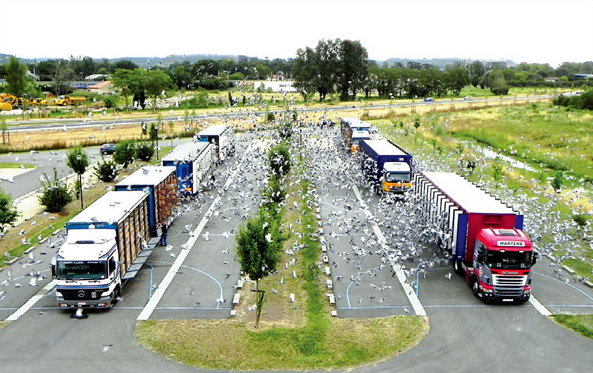
In the sport, specially bred and trained pigeons are released from a specific location and race back to their home loft. Because it would be too expensive to lose them, the top birds bought in Belgium are usually not raced in China, but their offspring are.
"Belgian racing pigeons have a reputation as being the best in the world," says Martin Martens, the association's editorial and handling expert. "Belgian pigeon fanciers are specialized in several disciplines - speed, short middle-distance, great middle-distance, long-distance and great long-distance. You don't see this in other European countries.
"In the Netherlands, for instance, they build up the distance week by week, then come back to a shorter distance. One week later they again go for a longer distance. Most of them are not specialized in one kind of distance. In Belgium every fancier can race his favorite distance every week.
"That's why you can find real specialists or pigeons that are specialized for a certain distance or race."
This, he says, makes competition standards higher in Belgium.
"We also have our national races from the great middle-distance to Barcelona. There are 30 national and six international races where every fancier can compete."
These races are very popular and get publicity worldwide. There are weekly reports and videos about the winners.
"Chinese fanciers are the biggest buyers of our national winners," Martens says. "They follow the national races closely and our ace birds are very famous in China. Every year, most of these transfer to China.
"So you could say that our pigeons have become as an important export product as Belgian beer, chocolate or chips."
The riches and glamor now on offer contrast with the sport's relatively humble beginnings.
Pigeon breeding and racing, which first took root in China during the Ming Dynasty (1368-1644), has become a source of income and a status symbol for the country's new rich, as well as a popular hobby. But its boom in China contrasts sharply with its relative decline in Belgium.
Sun Yang, deputy director of the Beijing Changping district racing pigeon association, says China is now home to at least 300,000 pigeon fanciers. One recent race in Beijing offered 23 million yuan ($3.8 million) in prize money.
Membership of pigeon federations in China has soared over the past 12 to 15 years and, for top pigeons, prices have increased two to threefold in 10 years, Martens says.
Its popularity in China is attributed in part to Gordon Chiu, one of the country's most talented pigeon fanciers. As a boy, Chiu spent countless hours with the pigeons his uncle kept on the balcony of his Shanghai apartment.
Chiu has pursued his hobby since the 1970s with "unbridled enthusiasm". In 1979, he took part in the first super long-distance race, in which 581 pigeons set off from three different provinces. Only 75 completed the epic 2,430-kilometer race but Chiu's pigeon was one of them.
Chiu is among the Chinese businessmen who have bought pigeons from Pigeon Paradise's auction house. It is a sign of the importance of the Chinese market that its website has been translated into Mandarin.
However, the downside to the "Chinese invasion" is that pigeon fanciers in Belgium are unable to compete with the high prices being paid.
Speaking recently at the second world pigeon fair in Kortrijk, Belgium, Frenchman Gilles Vanneuville complained: "It's daf. It's killing the sport. How do you expect a young person to start out?"
His concerns are shared by a compatriot, Marcel Candenir, from Lille, who says: "I find it too expensive. To pay 200,000 euros for a pigeon is not a normal price."
There have also been problems of theft from Belgian breeders, and racketeering.
Some, like Marc De Cock, who owns 600 pigeons in Temse, northern Belgium, have gone to extreme lengths to protect their prized possessions.
He has invested heavily in security for his birds, some of which are worth 100,000 euros. Watched by 15 video cameras, they have their own shower and solarium and are treated like top sports champions.
De Cock, who is looking to sell many of his birds to Asian customer, says: "The Chinese attach a lot of importance to prestige. Even if they don't want to breed them, or race them, they want to buy a luxury pigeon much like an art collector would like to buy a Rubens or a Rembrandt."
Belgium takes the sport, and birds in general, seriously. At Lede, in East Flanders, there is a museum dedicated to the hobby. There is even a finch-singing competition, recently recognized in the register of Flemish cultural heritage.
But the decline of pigeon racing in the country is reflected in figures. In the 1950s, the country had more than 250,000 official members in the Royal Pigeon Federation. Now there are only 30,000.
The current Chinese duty case has certainly ruffled feathers, but the association's chief executive, Nikolaas Gyselbrecht, who recently flew to Beijing to help negotiate the release of Bolt and some of the pigeons held by Chinese authorities, remains optimistic about the sport's future.
He hopes that incident will be an isolated one in what is otherwise seen as renewed international interest in the sport.
Contact the writer at martinbanks2009@gmail.com
For China Daily
|
More than 20,000 pigeons are released at the start of a race in Flanders, Belgium. Chinese racing pigeon fanciers have become big buyers of Pigeon Paradise, a Belgian pigeon traders' association. Provided to China Daily |