


Birth policy change key to economy
Reform | Mike Bastin
The recent announcement of a slight relaxation in China's one-child policy is certainly the most significant change since the policy was introduced more than three decades ago.
The shift will mainly affect urban dwellers, where a couple will soon be allowed to have a second child if either parent is an only child.
|
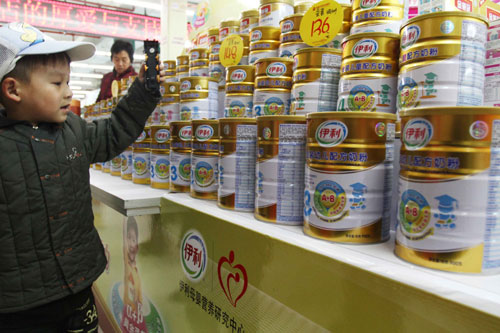
A child helps his parents shop for milk powder in a supermarket in Xuchang, Henan province. Provided to China Daily |
Previously, both parents had to be from one-child families.
Many expect a substantial increase in births as a result, with estimates of between 15 and 20 million people becoming eligible to have two children.
Early indications are that approximately 50 to 60 percent of these people are eager to take advantage of this new opportunity.
Increased societal and family harmony and togetherness are often cited as key reasons behind this announcement, but another key factor is the imbalanced labor market.
The traditional preference for a male birth, combined with the one-child policy, has led to the world's most skewed gender ratio at birth.
Last year, according to official sources, the ratio was 117.7 boys for every 100 girls. In comparison, the majority of societies do not exceed a ratio of 107 to 100.
As a result, there may be up to 25.4 million more males in the under-15 cohort and possibly 51.5 million overall across mainland China.
The recent announcement should lead to some sort of reduction in this dangerously unbalanced ratio, especially if a Chinese couple's first child is a girl.
The natural preference for boys, largely because of the male continuing the family name, and a mixed gender cohort should, therefore, lead to more couples trying for a second child if their first is female. But the chances of this second child turning out to be female are also high.
China's labor market, therefore, should become more evenly balanced between males and females, which can only be a good thing. Chinese businesses, more specifically the managers of these businesses, remain mostly male-dominated.
Many are of the view that this contributes considerably to an overly autocratic, conservative business culture where there is little or no opportunity for teamwork and innovation. Yet studies done across cultures and over many years suggest strongly that female managers and leaders usually create a more progressive, consensual, less aggressive and more tolerant, flexible and open business culture, seen by many as far more suitable for the current and future business environment.
Chinese companies need far more female managers and leaders, and this slight shift in the one-child policy should help in this direction.
China's aging population also represents another worrying demographic trend. Official sources reveal that the average life expectancy in China rose to 74.83 in 2010, a level 3.43 years higher than just a decade earlier. By 2015, this figure is expected to have increased by one more year.
To remain competitive internationally, the size of China's workforce is critical.
Extant research studies indicate that, on the assumption that implementation of the policy takes place in 2015, China's population will proceed to peak at 1.401 to 1.412 billion in 2026 to 2029, compared with a peak range of 1.392 to 1.41 billion in 2023 to 2025, should the one-child policy remain unchanged.
In a nutshell, the policy change should result in an additional 9 million births over the first decade or so after implementation. A relatively small population increase, but an increase nonetheless.
And, crucially, some sort of counter against the unstoppable aging population.
Not that this policy alone will be sufficient to ensure a workforce of critical mass and an increasingly modern, democratic business culture inside Chinese businesses, but it certainly provides a timely nudge in the right direction.
The author is a visiting professor at the University of International Business and Economics in Beijing and a senior lecturer on marketing at Southampton Solent University's School of Business. The views do not necessarily reflect those of China Daily.















