Organic is the watchword for tea growers
Western health sensitivities help transform industry in remote county into china's successful environmentally-friendly tea growing area
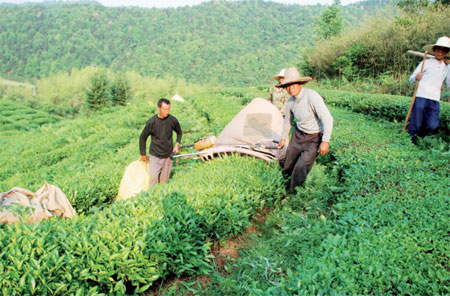
After a winding 40-minute drive along a zigzag country road, you climb through a lane lined with osmanthus bushes that give off a sweet scent, and finally reach the green-tea plantation of Jin Linsheng, glistening with morning dew and embroidered with thousands of spider webs.
"This is no ordinary green tea; it's organic, with no pesticides or chemicals," Jin says.
"See the spider webs? The more there are, the better the plantation's micro-ecology, the better the tea leaves will be."
Just as Western brands have conquered Chinese palates with coffee, Chinese organic tea growers like Jin in Wuyuan county, Jiangxi province, are now looking to cash in on Western tastes and health sensitivities.
Wuyuan, which is widely regarded as having some of the most beautiful countryside in China, plans to expand planting of organic green tea not only because of growing orders from overseas, but also because of awareness of food safety at home.
Qiu Jinyin, head of the Wuyuan Tea Bureau, says Wuyuan organic tea planting has been steady and has been unable to meet growing demand, with some companies still working on orders from last spring.
This year the county decided to gradually turn all its tea growing into organic operations and increase the growing area from its present 11,300 hectares to 13,000 hectares within eight years. Qiu says he expects the plantations will then produce 20,000 tons of organic green tea a year with a turnover of 10 billion yuan ($1.65 billion; 1.2 billion euros).
"We believe making organic green tea is the way forward for Wuyuan, because people's concerns about their health can only grow, and green consumption will continue to rise," Qiu says.
European market research company Euromonitor International says sales of organic green tea have risen greatly in the continent in recent years.
Last year the market in Europe was worth $31.7 million (23.5 million euros), it says. Germany ranked the highest at $13.2 million, about 21 percent higher than four years earlier, followed by France at $5.3 million and Britain at $3.4 million, both of whose sales were about a third higher than they had been four years earlier.
Diana Cowland, a health and wellness analyst with Euromonitor International, says more people in Europe are drinking green tea, and the demand for organic products generally is high because people look favorably on the reduced use or non-use of herbicides and pesticides, and like the fact that the tea is approved by recognized bodies.
Wuyuan is located at a latitude favorable to good soil and rain considered ideal for growing green tea, and many plantations can be found in the surrounding mountains, often shrouded in mist. Because of its remoteness, historical lack of transport and tea growers' traditional ways of planting, the leaves are very clean.
The China Tea Marketing Association says that last year Wuyuan county's green tea plantations covered about 11,300 hectares, producing 10,100 tons of tea valued at 1.36 billion yuan. Of that, 4,100 tons were organic, and about 2,400 were exported to Europe, with a value of $15 million.
"Figures are hard to come by, but the Wuyuan organic green tea market undoubtedly accounts for more than half of the EU market," says Yao Jingbo, deputy general-secretary of the association.
Tea used to be a pillar industry for Wuyuan and has a long history there. During the Ming and Qing dynasties (1368-1911), about 2,500 kilograms of Wuyuan green tea is said to have been served to royal families every year, and some was exported to Britain. Tea dances, songs and opera in the area were well-known throughout China, says Yu Xinzu, deputy general-secretary of Wuyuan Tea Association.
However, after the founding of New China in 1949, the planned economy system meant Wuyuan's green tea could not be sold domestically, most of it going to Europe and Africa, but only through an external seller and under the name China Green Tea.
"We weren't allowed to sell the tea ourselves," Qiu says. "Even visitors to Wuyuan who wanted to take tea home as gifts were only allowed to take 1 kilogram," Qiu says.
It was an easy time for Wuyuan because tea growers did not have to worry about marketing. However, after the reform and opening-up began, growers did not know how to deal with the open market, says Hong Peng, president of Jiangxi Wuyuan Dazhangshan Organic Food Co Ltd.
Hong says that lack of a brand weakened Wuyuan green tea's competitiveness as it went up against domestic big names including Longjing in Hangzhou, Zhejiang province, and Tieguanyin in Anxi, Fujian province. Overseas, Wuyuan tea was virtually unknown.
"For some time we blindly followed what other places were doing," Hong says.
"We sold beauty-slimming tea, health-preserving tea, whatever was popular in the market."
Changes came in the early 1990s when China adopted the concept of green food and standardized, trademarks and certification accordingly. In 1996, 53 hectares of tea-growing areas in Wuyuan Dazhangshan were given the green food trademark, the first of its kind in China's tea industry.
In 1997, Wuyuan green tea appeared at a trade fair in Frankfurt, and eventually the company sought certification for its products in the EU, which was granted. In the same year Hong's company received an order for 200 kilograms of organic green tea from Germany; the following year order was for 600,000 kilograms.
Other tea companies in the county then gradually built connections with overseas markets. Hong says his organic tea plants cover 600 hectares, of which he exports about 1,000 tons a year, about 80 percent to Europe, and the rest to the US.
Hong, who graduated from Wuyuan Tea School, says that in the early days Wuyuan growers were so ignorant of the tea industry outside China that they had no idea of how much to charge.
Yu Guangzhong, president of Wuyuan Xitou Organic Tea Co, Ltd, says that with China's very strong tea culture, tea is ideal for expensive gifts that symbolize status, meaning there are many people willing to spend thousands of dollars on a kilogram of tea.
Prices for tea leaves, depending on matters such as whether it consists of one bud or two, or what time of year it is picked, differ widely. However, cut tea is considered valueless in China, Yu says.
"At first, many people thought Westerners were richer, so they sold them the highest-quality tea, which turned out to be a mistake.
"Most Westerners use tea bags holding cut tea as long as they are deemed healthy. So the tea usually costs dozens of yuan a kilogram. They also like to mix tea with things like fruit and ginger."
Yu has 133 hectares of organic tea bushes, and their export value is put at about $3.2 million. About 80 percent of his products go to the EU and the US, and the rest to Australia and Southeast Asia. The European market has been steady in recent years, but orders from the US have been rising about 20 percent a year, Yu says.
But successfully switching to organic growing and marketing is not easy.
For one thing, many countries require producers to obtain special certification to market food as organic within their borders, so it needs to be produced in a way that complies with organic standards set by national governments and international organizations.
"So to sell organic tea, the garden, the processing and the final products all need to meet organic standards and get certification from the target market," Yu says.
However, for Wuyuan land that is unpolluted and suitable for growing organic green tea, an essential ingredient in receiving such certification, is limited. While more farmers are adopting modern agricultural methods, chemical fertilizers have been used in some areas, putting the air and soil in surrounding areas at risk.
The Wuyuan government is now offering 3 million yuan a year in subsidies to encourage farmers to stop using fertilizer and switch plantations to organic growing, but making that transition takes at least three years.
Labor costs in Wuyuan have been rising, too, a blow to organic tea growing, which can be labor intensive.
Meanwhile, Wuyuan is also one of China's favorite rural tourism destinations, meaning the work on offer makes it even more difficult to keep people doing arduous tea-growing work or to attract new employees. Huang Tong, president of Wuyuan Z. G. S. Tea Industries Co Ltd, says he has been forced to raise pay 15 percent a year to keep workers.
Certification costs, in the tens of thousands of yuan a year, are also a heavy burden for many tea farmers and companies.
Wuyuan has more than 500 tea companies, and dozens are planting tea using organic methods, but only about 10 companies receive organic certification in a year.
Wu Changbin, who has been planting tea for 33 years, is one of those who has no certification. He says he uses a natural biological chain in his 13 hectares and sells his product overseas, fortunate that his customers trust him enough not to ask for certification.
Many other companies are looking to diversify their markets and shift to other booming markets, where demand is huge and prices are high, such as Africa.
Yao Jingbo says that for the past few years Chinese green tea prices exported to Africa have risen 7 percent to 15 percent a year, and there is a market in the continent for some of the most expensive tea.
"Green tea is very appropriate for Africans as it helps metabolism in hot weather," says Huang Tong of Wuyuan Z.G.S. Tea Industries.
"Many Africans like strong tea. In China a bag could hold 3 grams, but there it will probably be 25 grams, which means demand is high."
Huang's company now exports about 400 tons of green tea to Europe, half of it organic; about 3,000 tons goes to North Africa. The prices of organic green are about 15% to 20% higher than the ordinary green tea, he says.
Jin Linsheng, president of Wuyuan Linsheng Industries Ltd, who started planting organic tea in 1997, has chosen to stick with the Chinese market. Of his 800 tons of green tea a year, only 20 tons are exported, the rest being sold under the brand Linsheng at prices ranging from dozens of yuan to thousands of yuan for 500g.
"The Chinese market is still the most important, and I want to build a brand here before going overseas," he says.
Jin says he believes organic is the right direction but that it is important for Wuyuan to build a name. Since creating the Linsheng brand in 2002, he has been printing "from China's organic tea county" on all product packages.
|
Tea farmers pick tea leaves in Wuyuan, Jiangxi province. More than half of the European market has been accounted for by Wuyuan organic green tea over the past decade. Provided to China Daily |