


Vaccine switch to prevent paralysis
 |
|
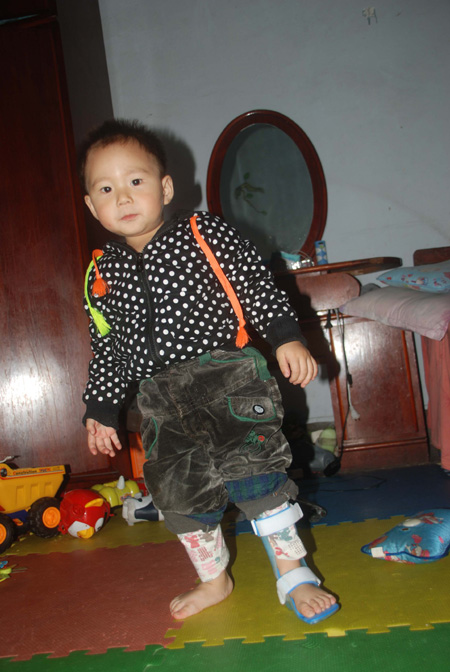
Yu Han, Xia Maoqiu and Tu Tao's 2-year-old son, practices walking wearing a leg brace. Huang Zhiling / China Daily |
Introduction of new treatment will make rare reaction a thing of the past
Xia Maoqiu knows his son Yu Han is one in a million - he was diagnosed last year.
The 2-year-old is among the small number of children in China who have suffered a negative reaction to the oral polio vaccine, which has helped eradicate the disease.
Health specialists say only about a dozen cases of the condition - vaccine-associated paralytic polio - occur every year.
"According to the Health and Family Planning Commission, only one out of every 1 million children who take the vaccine has an abnormal response," Xia said.
His son, who is believed to be the first child in Sichuan province affected, received the oral vaccine at a clinic in Chongzhou in October 2011 but was back in hospital a month later with a fever.
"After he recovered and was back home, we noticed something strange during bath time," said Tu Tao, the boy's mother. "His left leg was turned inward and he was feeble. I asked him to walk a few steps, but he kept falling."
Unhappy with an initial diagnosis by local medics, Xia and Tu contacted the Chinese Medical Association in Chengdu, where experts confirmed the oral vaccine had caused the paralysis.
Since then, the toddler has undergone more than 1,000 acupuncture treatments, and the family has seen its savings of 200,000 yuan ($33,000) disappear, despite receiving 178,000 yuan in compensation from the Sichuan provincial government.
"Yet his leg is no better than when we discovered the problem," Xia said.
Although rare, China is working to make the condition a thing of the past.
The country has set a goal to introduce the inactivated polio vaccine, which does not pose a risk of paralysis, into its routine immunization program in two years, and officials say an application has already been filed with the State Food and Drug Administration for mass production and use of the first domestically made IPV.
"The oral vaccine has helped China eliminate polio, and now we're preparing to introduce IPV, which is in line with the international standard and can better protect against the polio infection," said Shen Qi, deputy director of the National Institutes for Food and Drug Control's Institute for Biological Product Control.
Strategic plan
Polio, or poliomyelitis, is a virus that infects the brain and spinal cord, mostly in children under 5. One in every 200 cases leads to paralysis, usually of the legs.
The World Health Organization is requesting countries that use only the oral vaccine introduce at least one dose of the inactivated vaccine before October 2015.
Polio immunization usually includes four doses administered at different times.
IPV, which is injected rather than swallowed, can help prevent vaccine-associated paralytic polio from subsequent doses of OPV when given in a combined schedule, according to Lance Rodewald, team leader of the WHO China Office Expanded Program on Immunization.
Since its launch at the 1988 World Health Assembly, the Global Polio Eradication Initiative has reduced the global incidence of polio by more than 99 percent, and the number of countries with endemic polio from 125 to three. The WHO recognized China's polio free status in 2000.
In May, the assembly approved the Polio Endgame Strategic Plan, which requests global withdrawal of the oral vaccine in a coordinated manner.
Worldwide, most of the vaccine in use is oral, yet more than 60 countries and regions have introduced IPV. Some only use IPV, while some use both.
"Eventually all use of OPV (the oral vaccine) will be ended in China and the world," Rodewald said. "However, there will be a few years in which both IPV and OPV are likely to be used together."
It is critical, he said, that polio vaccination coverage remains high in China, as it shares borders with Pakistan and Afghanistan, where polio remains endemic.
An outbreak of polio reportedly imported from abroad hit the Xinjiang Uygur autonomous region in 2011. Twenty-one cases were detected between August and October that year, killing one and leaving 17 people paralyzed, including eight children.
"That outbreak was the first to come from abroad since 2000, and the risk remains as viruses know no boundaries," warned Luo Huiming, deputy director of the Chinese Center for Disease Control and Prevention's National Immunization Program.
Che Yanchun, director of science and technology at the Chinese Academy of Medical Sciences' Institute of Medical Biology, said in February it applied for a license to produce and use IPV after clinical trials.
"To eliminate polio thoroughly, we can't depend solely on foreign products. We must have a homegrown IPV," she said.
However, Rodewald said China faces challenges in introducing an IPV.
The supply will need to be sufficient for all children to receive at least one dose, he said, while the increase in injections will put pressure on public health workers.
Shen at the Institute for Biological Product Control also said there is a cost implication. According to her, one dose of the oral vaccine costs less than 1 yuan, "but IPV is far more expensive."
Contact the writers at shanjuan@chinadaily.com.cn and huangzhiling@chinadaily.com.cn















