


Hawaii's wide open spaces
The cowboy still roams free in Maui's Upcountry
At the Oskie Rice Arena, the Friday night lights hung in the damp, cool Hawaiian air. Beaming through Maui's notorious red clay dust, the lights served as a backdrop to one of the Upcountry's biggest events.
On the metal bleachers, families were bundled against their idea of the cold: a winter chill that sank just below 15 degrees Celsius. There was Portuguese soup and Puerto Rican stew at the family-run concession stands, where the handwritten menus were scrawled in thick felt marker, crossed through as the "onolicious" fried ice cream or pork with tofu and macaroni ran out.
Children treated the bleachers as a jungle gym, climbing and dangling and hopping from bench to bench. On the highest bleacher, a girl with sun-streaked hair and sun-kissed skin popped up like a mischievous gopher. She shrieked, giggled and monkeyed away. On the grass, behind the arena's wire-and-post fence, a little boy in a tan cowboy hat paced in black cowboy boots with tiny silver spurs.
|
In the interior of Maui, a cowboy culture prevails, with weekly line dances, rodeos and working cattle ranches. Hawaiians learned cowboy's skills from Mexicans. Photograph by Marco Garcia for The New York Times |
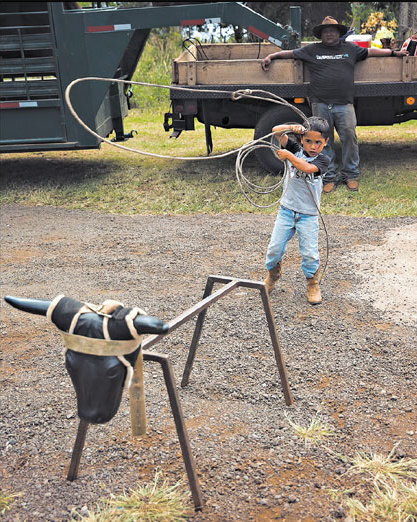
The rodeo was about to begin.
When most people picture Maui, they see surfers sliding down mammoth waves, bays crowded with sailboats and waterfalls alongside the ragged, verdant Hana Highway. But the Upcountry, which sweeps across the island's interior and climbs the volcanic foothills of Haleakala, is another Hawaii. Instead of beaches, surf shacks and shaved ice stands, the region has chilled air; sprawling, multigenerational cattle ranches; and a paniolo - Hawaiian cowboy - tradition that precedes its mainland American counterpart by half a century.
"They were running horses up here," a trail guide said, "when they were still settling the Midwest."
In the Upcountry, Hawaiian culture is cowboy culture. There are weekly line dances at the local community center, an annual Independence Day rodeo that draws local kids home, and working cattle ranches like Ulupalakua (established in 1845), where the ranch store serves sandwiches stacked with fresh beef, elk burgers and smoky barbecued Kalua pork.
In paniolo towns like Makawao, Kula and Pukalani, faded Western facades have found second lives as art galleries, sushi joints, proud "locavore" bistros and the odd New Age shop selling wind chimes and Tibetan imports. But the ranches and their traditions endure.
It's a history that began in the 1790s, when the British explorer Captain George Vancouver gave a handful of longhorn cattle to King Kamehameha I, the first ruler of a unified Hawaii. The king put a kapu - an order of protection that is both sacred and legal - on the animals, forbidding them from being slaughtered. The longhorns took surprisingly well to the island and they multiplied; by the early 1820s, the stampeding cattle were tearing through towns and devouring crops.
In 1832, Kamehameha III, the king's son, brought in vaqueros, skilled horsemen of Spanish descent, from Mexico (paniolo is thought to derive from espanoles, or Spaniards) to contain the swelling herds. The cowboys taught the Hawaiians the skills of their trade. These skills, and the lifestyle that goes with them, are still in evidence on Maui's half-dozen or so surviving ranches.
At family-owned Ulupalakua, said Ilima Loomis, the author of two books on the paniolo who lives in nearby Haiku: "They still have cowboys on their payroll living in the ranch housing." That's old school. During plantation days, that's how it was. You lived in ranch houses and you'd buy your flour, your beans, your salted pork or whatever at the ranch store.
Many outsiders see the Upcountry only once: they pass through it on the obligatory drive to Haleakala's summit, a winding 35-kilometer crawl above the clouds and the tree line to red rock and shimmering, orb-shaped silversword plants.
Amid all the volcanic anticipation, the beauty of the Upcountry - eucalyptus giants, lavender gardens, grazing steers and sloping pastureland - is easily missed.
The New York Times















