


Scientists capture secrets held in a whale's breath
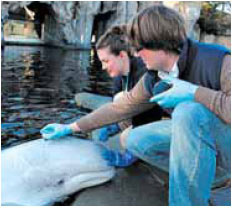
MYSTIC, Connecticut - On her trainer's command, an alabaster-skinned beluga whale named Naku placed her chin on the deck of her pool and exhaled several times, emitting a hollow "chuff" sound with each breath. The vapor rose into a petri dish a researcher held over her blowhole.
Those drops contain a wealth of information. Researchers at Mystic Aquarium and elsewhere are learning how to use the breath, or "blow," of whales and dolphins to extract and measure hormones, microorganisms, DNA and the byproducts of metabolism.
Their goal is not only to improve the health of captive cetaceans, but also to develop a powerful, unobtrusive technique for studying them. While blood is the gold standard, it can be hard to obtain. New studies describe advances in breath analysis, which may prove to be the next best thing.
"I suspect that everything that's in the blood is in the blow, just at much lower concentration, a little harder to measure," said Kathleen Hunt, a research scientist at the New England Aquarium in Boston.
Trainers and veterinarians working with whales and dolphins routinely smell their breath. Normal dolphin breath has a fishy smell; rotten-egg scents signal digestive problems, and sweet ones indicate bacterial pneumonia, according to Sam Ridgway, a veterinarian and neurobiologist at the National Marine Mammal Foundation in San Diego.
"In terms of what we normally do with wildlife - restraint and capture and collecting samples - this is as noninvasive as you can get," Karina Acevedo-Whitehouse, a molecular epidemiologist at the Autonomous University of Queretaro in Mexico, said of collecting blow samples.
Now, scientists at Mystic Aquarium are studying reproductive and stress hormones, as well as DNA, in the breath of Naku and her three poolmates. Not only do the four belugas blow on demand, they also allow researchers to draw blood and collect fecal samples. They open their jaws for saliva swabbings in exchange for fish or some pats on their tongues.
Being able to compare results from all four bodily fluids is a huge advantage in working out study methods, said Tracy Romano, the project's leader.
In San Diego, scientists at the National Marine Mammal Foundation are studying a group of dolphins trained for the United States Navy. Their breath has already yielded hundreds of compounds - a fortune in molecules.
 |
|
Lindsey Nelson and Justin Richard working with Naku, a beluga, to get a sample of her breath in a petri dish. Rebecca Kessler |
"There's a tremendous amount of room for discovery," said the study's director, Cristina Davis, a chemical sensing expert at the University of California, Davis.
Great whales are not so easily studied. Blow testing, along with new techniques for analyzing skin and blubber biopsies, feces and photographs should help identify stressors, according to a paper published in the journal Conservation Physiology.
Dr. Hunt of the New England Aquarium, the paper's lead author, and her team went to the Bay of Fundy to streamline the system for collecting blow from North Atlantic right whales.
The Mystic technique, placing petri dishes over blowholes, was not an option. Her team settled on a cutoff plastic bottle stuffed with tulle at the end of a pole.
The team found hormones that may indicate the animals' maturity and reproductive status - along with cortisol, a hormone that tends to rise in conditions of stress and is considered a critical measure of a population's health.
In a paper set for publication this month in Marine Mammal Science, Dr. Hunt's team reports that a simple, portable, low-cost test can detect hormones in blow, which should open the field to any curious whale scientist.
The New York Times















