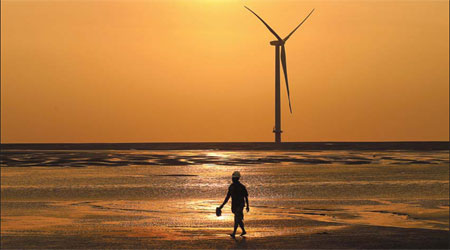
New-energy solutions blowing in the wind
Green development is facing a series of obstacles
More than seven years after China's Renewable Energy Law took effect, renewable energy companies are making huge contributions to the reduction of air pollution.
The act was aimed at promoting the use of non-fossil fuel energy, but the companies, which include wind farms and biomass energy plants, are also suffering huge financial losses.
From January to July, Huaneng Taobei Wind Farm in Baicheng, Jilin province, generated 134.75 million kilowatt-hours of wind power. In the same period it lost 72.48 million kWh of unused wind power, resulting in a loss of almost 40 million yuan ($6.5 million; 4.8 million euros).
The wind farm's average annual utilization hours, the time during which it is running at full capacity, reached just 1,425 hours last year, but its break-even figure is about 1,560 hours.
During the first half of this year the farm averaged 813 utilization hours, the lowest in the country, and it is likely to continue to lose money, chief engineer Zhang Weilong says.
The farm's owner, China Huaneng Group, is debating whether to begin building the fourth phase. The previous three phases cost between 1.3 and 1.4 billion yuan.
Chen Xin, manager of the wind farm's pre-project department, speaking at a media event called A Century of Action for Environmental Journalism in China, said: "We'd rather put the project on hold, as the more wind turbines we build, the more money we lose."
The company's losses were caused by an oversupply of electricity in Jilin. Although the province had total installed power capacity of 26 million kilowatts last year, the maximum demand for power was just 8.6 million kW.
In winter, especially after midnight from January to March when the wind blows most strongly, wind turbines are shut down to ensure the power already generated by combined heat and power generators will be used to provide sufficient heat for residential, industrial and commercial use, a process known as curtailing power.
"Several years ago when provincial government officials were making plans for the development of heating measures during winter, they didn't leave any room for the growth of new energy," says Zheng Jianlin, deputy director of the Jilin provincial energy bureau.
The province's installed power capacity doubled between 2006 and 2010 to more than 20 million kW. During that period, the local government encouraged state-owned enterprises to build power plants in the province to boost the growth of gross domestic product, but failed to take the provincial demand for electricity into account. It will take three to five years to adjust the discrepancy between supply and demand, Zheng says.
One solution would be to use long-distance transmission lines to deliver surplus wind power from the west of Jilin, where wind resources are rich, to regions where energy consumption is high.
The central government has permitted preparatory work for construction of several 500,000 kW conversion stations in cities such as Baicheng and Songyuan, but the project is still awaiting official approval.
"We earnestly hope that the central government will help us build an extra-high-voltage transmission line to carry power from Jilin to North and East China," Zheng says.
Compared with the power grid, wind power projects have a much faster approval procedure and a shorter construction time. That means the development of the power grid has been unable to keep pace with the growth of wind farms.
To ensure that construction and operation are in step, wind farm developers have increased preliminary communications with power grid companies regarding their plans for wind energy projects.
"In the past, China's power grid was designed to serve conventional energy resources such as coal, but in the future, it should be changed to serve new energy," Zheng says. "High-level national officials must be farsighted when developing new energy and make systematic adjustments to the relevant technologies, policies, pricing systems and the power grid."
In addition to transmitting wind-generated power to other regions, Jilin is also trying to increase its own electricity consumption by using curtailed wind power for heating. Datang Xiangyang Wind Power Generation Co is now testing a heating station in Taonan, northwestern Jilin.
The station replaced a coal-fired boiler that had a generating capacity of 20 metric tons of steam an hour, with nine electric thermal storage heaters, which consumed 27 million kWhs of curtailed wind power during a five-month heating season, a move that saved 8,000 tons of coal and reduced carbon dioxide emissions by 35,000 tons.
Despite significant environmental benefits, the station lost 10 to 20 million yuan every year because the residential heating price in Taonan remained at about 27 yuan a sq m, while the cost of generating heat using electricity was much higher, says Zhang Xuezheng, Party secretary of Datang Xiangyang Wind Power Generation Co.
Moreover, the company had to generate heat with electricity bought from the State Grid Corp at an average price of more than 0.5 yuan a kWh, almost the same as the post-tax price of the company's on-grid wind power.
"The government compensated our company by allowing us to produce more electricity, so the profits from the generation of wind power just about covered the losses we incurred from supplying heat," Zhang says.
Only when the government breaks the constraints on the prices of electricity and heating will renewable energy companies be willing to fully develop public interest projects, such as the use of curtailed wind power to replace coal-fired heating, he says.
Installed capacity of power generation in China totaled 1.14 billion kW last year, the National Energy Administration says, including 62.37 million kilowatts of wind power, which surpassed nuclear as the third largest source of electricity after thermal and hydropower in the country.
China has an enormous domestic wind energy resource that is estimated at between 700 gigawatts and 1,200 gW exploitable capacity onshore and offshore, the Global Wind Energy Council says.
Over the past four years, the top-10 wind turbine manufacturers have dominated the Chinese market with more than 80 percent of the market share. Only two international manufacturers, both from Europe, were listed among the top 10 turbine makers in the Chinese wind market in 2012.
Gamesa, Spain's biggest wind turbine maker, was ranked No 8 and accounted for 3.8 percent of the market share, and Denmark's Vestas was ranked No 10, contributing 3.2 percent of the share, said the council's Global Wind Report, Annual Market Update 2012.
Gamesa has operated in China since 2000, installing more than 3,000 turbines at more than 60 sites across the country. Last year it sold 2,119 megawatts of electric output and China, its global production and supply hub outside Spain, accounted for 10 percent of the total sales. As a wind farm developer, Gamesa's cumulative installations in China had reached 3,253 mW by the end of last year.
Vestas installed China's first wind turbines in Shandong province in 1986. Today it has invested more than 3.5 billion yuan in China and has its largest integrated manufacturing complex globally in Tianjin, a metropolis in northern China. By June 30, the company had installed more than 4,000 mW of clean energy across 14 provinces of the country.
Although European companies like Gamesa and Vestas are firmly established in China, the market share of international turbine manufacturers still continues to fall as a result of cut-throat competition on prices. The Chinese wind power industry is suffering from manufacturing overcapacity, which is driving the industry into fierce competition, the Global Wind Energy Council says.
The annual report of Gamesa said that China's contribution to the company declined significantly last year. After accounting for almost a quarter of its sales in 2011, the country contributed barely 10 percent last year due to grid connection problems and delays in approving wind projects.
Because of the saturated Chinese wind turbine market, plunging prices and curtailment of electricity generation, European and Chinese turbine makers are prepared to battle in new markets like Africa, Latin America and Asia outside China and India. However, figures the global wind industry are still primarily determined by the three major markets in Europe, the US and China.
Just like wind farms, biomass power plants are also plagued by high costs and low prices. Last year the Jilin Gongzhuling biomass project generated more than 200 million kWh of electricity but made a profit of only 0.0133 yuan a kWh. Fuel costs accounted for about 70 percent of the on-grid price for electricity generated from biomass, or 0.75 yuan a kWh, including a benchmark electricity price of 0.41 yuan and a subsidy of 0.34 yuan.
The Ministry of Finance was also tardy with subsidy payments to National Gongzhuling Bio Energy Co Ltd, the project's main investor. National Gongzhuling did not receive the monthly subsidies for last year until January this year and is still awaiting the money for April to June. The situation has forced the company to rely on working capital loans to pay local farmers to collect straw, said Du Jiang, deputy general manager of the company.
Because of the oversupply of electricity in Jilin, the Gongzhuling biomass project cut power generation by 13 million kWh from January to July, causing a fall in revenues of 9.75 million yuan.
According to the Renewable Energy Law, power grid enterprises should buy all the grid-connected power generated through renewable energy within the range of their power grids. However, in practice, none of the provincial governments has enforced the law strictly, says Zheng of the Jilin provincial energy bureau.
"We don't need government subsidies or policies, but we do want effective enforcement of the renewable energy law," says Zhang of Datang Xiangyang Wind Power Generation Co.
Zheng says: "Given that the law has proved difficult to implement, the National Development and Reform Commission should adopt a policy to specify the proportion of power generated with renewable energy - let's say 10 percent of China's total electricity consumption - as soon as possible. In this way, renewable energy will still have plenty of room to develop."
jiangxueqing@chinadaily.com.cn
|
A wind farm at Rudong in Jiangsu province. Xu Congjun / for China Daily |