


Little room for growth among high-end hotels
|
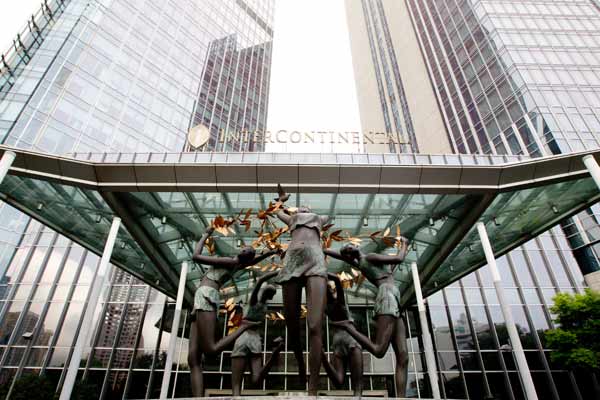
The InterContinental Hotel in Zhabei district, Shanghai. The average daily rate of InterContinental Hotels Group Plc in China fell by 1.2 percent in the first half, its interim results show. Provided to China Daily |
The high-end hotel market has become saturated in China, with industry-wide declines in average occupancy and daily rates this year.
In the first quarter, the average daily rate for five-star hotels slid 6.15 percent year-on-year, while the average occupancy rate was down by 7.8 percentage points, according to the National Tourism Administration.
"This year is very challenging for the industry," said Sun Jian, chief development officer for China of InterContinental Hotels Group Plc.
The group's average daily rate in China fell 1.2 percent in the first half, its interim results show.
"We worked very hard to hold the decline to only 1 percent, but it was still a surprise, as we never saw a decline in the China market before," he added.
There are simply too many high-end hotels in the nation, industry sources said.
In the first half, the supply of hotel rooms went up, as did demand. But demand only increased 1.4 percent while supply increased 4.3 percent, said He Wen, business development manager in China for STR Global, an international hotel industry data and analysis provider.
High-end and luxury hotels will account for the largest part of the future new supply in China, He said.
A slowing domestic economy is weighing on the sector.
"The hotel industry is directly affected by the macroeconomic situation," said Zhu Chaolun, vice-president of the China hotel and tourism real estate department of Jones Lang LaSalle Inc, a real estate services firm based in Chicago.
Zhu said that business travel declines as economic growth decelerates, which cuts demand for hotel rooms, especially at the higher end.
Most luxury hotels in China cannot attain an occupancy rate of 70 percent, which is the break-even point for the hotel industry, he said.
Statistics from the NTA show that the average occupancy rate for five-star hotels was only 50.1 percent in the first quarter.
"Luxury hotels usually don't like to cut rates, as they want to maintain their market position," Zhu said. "So the occupancy rate declined."
A government drive against luxury consumption using public funds in 2012 had an adverse effect on luxury hotels, many of which depend heavily on food and beverage services. Some luxury hotels' catering income contracted by 20 to 30 percent in the first quarter of 2013, some business insiders said.
To counter the decline, some luxury hotels launched buffet and group-purchasing services to get more from the lower and middle segments of the market.
The structure of China's hotel industry is unhealthy, Zhu said, as high-end and budget hotels outnumber middle-level hotels.
As of July, high-end facilities accounted for 56 percent of China's hotel rooms and budget hotels took up 22.6 percent, according to STR Global.
"The main clientele of hotels should be middle class," said James Lyu, executive director of the Hong Kong Hotels Association. Lyu said that four-star facilities should be the most numerous.
Hilton Hotel and Resorts planed to bring Hilton Garden Inn to China, which is the group's four-star hotel brand, and the first Hilton Garden Inn hotel will be opened in Shenzhen, Guangdong province, by the end of this year.
However, high-end hotel operators are still optimistic about China's market over the long term and are still adding new rooms.
Usually, hotel operators sign long-term management contracts with property owners, so they have to look beyond current market demand.
"We have very longstanding contracts and with that, we feel very comfortable and confident about this market," said Rainer Stampfer, regional vice-president and general manager of the Four Seasons Hotel chain in China.
Stampfer said Four Seasons does not worry about excess supply, as it builds hotels for the next 20, 40 or even 80 years.
Four Seasons Hotel Inc, which runs seven hotels in China currently, is building six new hotels in China in the next four years.
Even for the shorter term, international hotel operators are pinning their hopes on the China market, because compared with the world at large, China's economic growth is still very healthy.
China's economy is recovering, although growth is slower than in previous years, said Arne Sorenson, chief executive officer of Marriott International Inc.
Marriott International plans to increase its hotels in China from 61 at present to 121 in the next four years.
China's urbanization and fast-growing tourism industry also offer encouragement to high-end hotel operators.
Local governments' support is an important factor in the luxury hotel sector's growth in China, as well. Some cities, seeking to burnish their international image, woo global luxury hotel chains.
"Local governments want to upgrade the image of their cities and prefer big international hotel brands," said Sebastien Mariette, general manager of Kempinski hotels in Wuxi and Yixing, Jiangsu province.
Mariette said that almost 99 percent of the customers at his hotel in Yixing are Chinese and it is difficult to sell rooms in the city, although the food and beverage business is successful.
"Sometimes, cities only need a four- or three-star hotel, but the government offers incentives to attract luxury hotel brands," said Zhu. But government support is not part of the hotel industry's business model and cannot be for long, Zhu said, since the government doesn't care about whether the hotels can make a profit.
wangwen@chinadaily.com.cn















