


For the love of Africa
Family and friends think they're mad not to retire, but Li Songshan and Han Rong are busy with an African culture center inspired by a lifetime in Tanzania and a collection of Makonde carvings. Meng Jing describes their amazing life on another continent.
Li Songshan is thinking about the 12,000 pieces of African art he and his wife spent more than 30 years collecting, before handing them over to a museum so others could enjoy the art they love: "It was like marrying off our own daughter. It's hard but you still want her to end up with someone good, someone who deserves her."
Li, 71, and his wife Han Rong, 68, have a lot more behind them than just that art collection - they have their relationship with the African continent that began about 50 years ago.
|
Li Songshan and wife Han Rong gradually become the largest traders in Tanzania and, as their wealth grew, so does their woodcarving collection. Photos provided to China Daily |
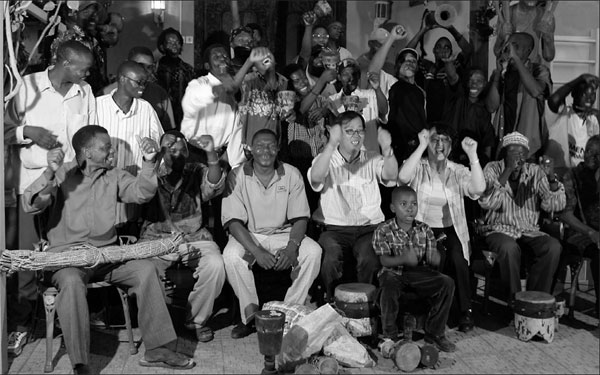
They have also dreamed about an African culture center they're now working on, African Tribe, about 30 kilometers from Beijing's downtown. It has 13 buildings on 1,000 square meters of ground and will be China's first private collection of African culture and art open to the public.
This all began back in the late 1960s, when the central government sent them to study Swahili to strengthen ties with developing and socialist countries. Then, according to Li, "China had no more than 200 Swahili speakers and learning the language was seen as an important way to improve communications. And, even though we knew nothing of the language, we felt it a privilege to be the chosen."
By the late 1970s, after two years of study and three years translating Chinese literature into Swahili and compiling a Chinese-Swahili dictionary, Li was sent to Tanzania as an interpreter, then as a Culture Ministry representative. His wife joined him in the 1980s and they turned their attention to African culture, especially Makonde woodcarvings.
"For many foreigners, these were mere souvenirs, but for us they were true artistic expressions used for worshipping their ancestors," Li explains. Speaking the language allowed them to communicate with the artists and the more they understood the history of the art, the more interested they became.
That interest developed into collecting, and they would spend most of their leisure time in markets looking for new carvings. By the time the Chinese government called them back to China in the late '80s, they had hundreds of the sculptures.
Unfortunately they found that Swahili wasn't the hot language it used to be, having been replaced with English, which the government had begun concentrating on, even in dealing with Africa. So it seemed they had two options - stay in China and forget about their former lives or leave China and continue their adventure. For two people who had spent half their lives studying Swahili and working in Africa, it wasn't a difficult decision.
They took all their savings - about $4,000 and, in 1990, boarded a plane for Tanzania, determined to work in that culture again. It proved a huge challenge. Han says that after renting an apartment, buying a car and registering their company, in half a year they had almost no money left.
Things started to turn around the next year, when a Shanghai company asked for help in selling 3,000 bicycles to Tanzania, where there was an immense demand. Problem was no one had the dollars to pay for them because of the big demand for foreign currency. Getting their hands on enough dollars was the key to clinching the deal.
The two spent almost a month loitering around outside a local bank to find the person in charge of currency exchanges."We'd skip lunch to get a chance to talk to the guy and in the end he gave us up to $130,000, which was a huge amount at that time," Han says.
With their Chinese business ties and the demand for Chinese imports, the couple gradually became the largest traders in Tanzania and, as their wealth grew, so did their woodcarving collection.
In 1994, they bought the largest wood production factory in southern Tanzania and got a license to harvest trees, and became the only collectors there who could provide raw materials for artists. This pushed them to found a National Woodcarving Association and their connections helped them convince top Makonde artisans to join the organization.
"Many of the artists had never had a chance to work on large pieces of ebony, because they couldn't afford it," Han says, "and we were able to get them top-quality materials and buy their work so they didn't need to worry about how to make a living."
In 2008, they packed their collection and shipped it to China, hoping to make those artists better known. Originally they had thought of setting up their own museum, but abandoned that in favor of giving 12,000 pieces to a museum in Changchun, in Jilin province. It now bears their name and opened to the public in 2011 as China's first museum focused on foreign artwork.
Now, the couple are thinking of that new, African Tribe, project and, though construction work will not be finished until May, they already have big plans. Han explains, "We were the first generation of Chinese workers in Africa and want people to know that Africa is more than just natural resources. We hope to get more Chinese youngsters to focus on life in Africa, as we did decades ago."
Li jokes about how the spending on the center may take their very last penny and how "families and friends think we're out of our minds every time we make a major decision like this".
Then, more philosophically, he concludes, "Life's not about what you have, it's about what you can give. And getting Chinese more interested in the culture and art of that beautiful land is the best thing we can give."
Contact the writer at mengjing@chinadaily.com.cn.















