A drop of France in China
A bevy of wine makers have put Yantai on the map as the Bordeaux of the east
The next time you walk into your local supermarket in Europe, you may well see bottles of wine produced in a place called Yantai, China, flying off the shelves and out the door.
Given that China is now the world's sixth-biggest wine producer, making more than Chile, and with more land under vines, perhaps that supermarket scene should not be too surprising.
But more wine critics are giving high ratings to Chinese wines. Reputed wine merchants such as Berry Bros & Rudd in London are now importing wines from Changyu Wines of Yantai, one of China's oldest and largest wineries.
Robert Beynat, the head of Vinexpo, the world's biggest wine fair, says China's growing domestic production has put it in the mainstream of wine-producing countries.
"By next year we expect them to produce more, ahead of Australia, Chile and a lot of countries," Agence France-Presse quoted Beynat as saying. "We are very happy about that. Why? Because the more a country produces, the more wine a country drinks, and the more it drinks, the more it imports. This is the story of America 50 years ago."
In a country where grapes were once mainly used to make juice, years of hard work seem to be paying off, even if the quality of some wines still leaves a lot to be desired.
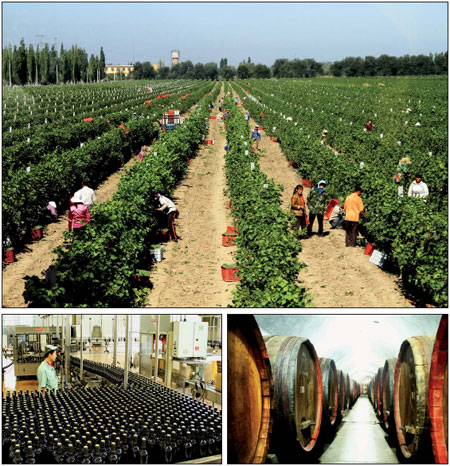
Yantai, a coastal city in Shandong province where Chinese brands such as Changyu, Junding, Great Wall and Grand Dragon are located, is China's answer to France's Bordeaux winemaking region.
There are 152 wine makers there, on a total of 20,000 hectares, and they had total revenue of 22.74 billion yuan ($3.7 billion; 2.75 billion euros) in 2011.
Yantai's wine makers, accounting for 30 percent of Chinese wine enterprises, rank number one every year in China in output and value, and of the top 10 Chinese wine companies, six are from Yantai, the Yantai Grape and Wine Bureau says.
Yi Fenghuang, the bureau head, says Yantai has natural advantages other places cannot compete with. "Wines made here are often served at banquets and international summits, such as the opening ceremony of the Shanghai World Expo in 2010, and the welcoming banquet of the BRICS summit in Hainan last year."
Last summer, the British supermarket Waitrose added a Chinese wine and a Brazilian wine to its collection at a promotional event during the Olympics, and Chateau Changyu cabernet gernischt was chosen.
It sells for 9.99 pounds ($16; 12 euros) a bottle.
The Changyu Wine Group, is the oldest and biggest in China, founded during the Qing Dynasty (1644-1911) by Zhang Bishi, an overseas Chinese from Indonesia, more than 100 years ago. It is now state-owned.
It has a French-style chateau, the Chateau Changyu-Castel on the outskirts of Yantai, which was jointly paid for by Changyu Pioneer Wine Co Ltd and the Castel Group of France, both top international wine producers.
Changyu, which has an annual production capacity of 300,000 metric tons, has enjoyed rising gross margins: 79 percent in 2011 on sales of 90,000 metric tons of red and white wine. Its alcoholic drinks portfolio includes brandy, sparkling wine, Chinese health liquor and imported wines.
Sun Jian, deputy general manager of Changyu, says more than 3,000 shops in Europe stock Changyu wines because they have a flavor and aroma unlike wines from anywhere else.
In May, Berry Bros & Rudd, a supplier to the royal family, announced it would stock four wines produced by Changyu, including Chateau Changyu Moser XV at 39 pounds a bottle and three ice wines, the Gold, Blue and Black Label, at 19 pounds, 35 pounds and 65 pounds. The initial shipment of 600 bottles of Chateau Changyu Moser XV is already sold out.
But the company's ambitions do not stop with a few bottles. It is determined to create a new wine culture in Yantai by setting up an international wineopolis, and developments are thick and fast on the ground.
The project is called Yantai Changyu International Wine City and is expected to cover 4 square kilometers, with building costs put at 6 billion yuan.
It will be home to a European-style village, a national vine and wine research institute, international wine trading center, two chateaux: one for wine production (Chateau Tinlot) and one for brandy production (Chateau Koyac) and vineyards.
The wine city will also include a "wine production" center covering 220,000 square meters. It will be equipped with 15 advanced production lines imported from Europe and is expected to be one of the world's largest wine and brandy production plants, with estimated annual production of 400,000 tons.
Sales of wine in China reached $11 billion (8.5 billion euros) last year. In recent years, sales have grown more than 20 percent a year. This year the sales target is 10.5 billion euros, and in 2018 that is forecast to rise to 24 billion euros.
The wine city is due to be completed in 2016 but the company is yet to announce when the project will break ground.
Changyu is not the only one in the region producing high-quality wines.
Shen Yi, sales manager of Grand Dragon, which has one of the largest organic wineries in Asia, says the company has invested more than 500 million yuan to set up a 4,000-hectare organic vineyard.
"To produce organic wines is our strategy to penetrate the market, because more people are paying attention to their health," Shen says. "But unlike imported high-priced organic wines, the price of our wines is reasonable, because of relatively low labor costs."
"In 10 years the top-level wineries will be organic."
Guo Songquan, a wine expert in China, says Yantai's wine industry has developed quickly, considering it was virtually non-existent 10 years ago and that domestic wine industry has had to start from the scratch.
"You can see our own wine schools, fine wine exchange, wine museums and wine theme parks. The pace has been incredible, but it will still take some time before Chinese wines really please Western palates."
|
Yantai, a coastal city in Shandong province where Chinese brands such as Changyu, Junding, Great Wall and Grand Dragon are located, is China's answer to France's Bordeaux winemaking region. The region's wine makers account for 30 percent of Chinese wine enterprises. Photos Provided to China Daily |