


Shaky markets need confident BRICS
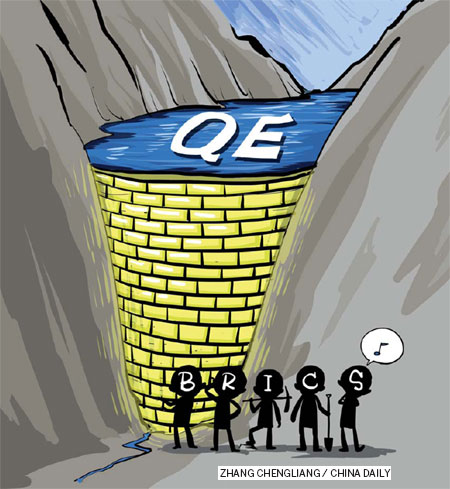
Emerging nations must reduce dependence on US dollar and work to build a cohesive monetary force
When the US Federal Reserve launched its second round of quantitative easing in 2010 it was widely criticized by emerging economies such as China, India and Brazil. These nations felt that by irresponsibly boosting global liquidity, the US was trying to solve its economic problems by transferring them to others.
Interestingly enough, when the US announced a "tapering" of its QE policy a few months ago, these same countries once again started complaining. This time, they said the US actions would cause a massive capital outflow from the emerging markets, drain liquidity and harm investor confidence.
On the surface, it may appear strange that the emerging markets are so critical of the US actions. It seems that they are unhappy no matter whether the US launches or halts QE.
This sort of contradictory thinking is, however, well justified, because they are not complaining about the US launching or quitting QE. What they are actually upset about is the global aftermath caused by the sudden changes in US monetary policy.
This also provides new clues to a scenario in which the US continues to dominate the global financial system with the help of its currency as the global major settlement and reserve unit.
Emerging economies account for more than 75 percent of global foreign exchange reserves, with China holding one-third of the total. Though emerging economies are creditors of developed nations, they still have very little say in global financial matters. In other words, they still have to take cues from US monetary policies to design their monetary policies.
Historically, when the US started to massively tighten its home liquidity, developing countries felt the pinch and sometimes slipped into financial crises.
The Latin American crisis in the 1980s, the Mexican crisis in 1994, the Asian Financial Crisis in 1997 and the Argentina financial meltdown in 2000 were all closely connected with monetary policy changes in the US.
History looks set to repeat itself.
With the US signaling its intention to end bond purchases, emerging markets saw massive capital outflows, asset deflation and currency depreciation.
India is one of the emerging economies that has suffered the most with the rupee falling by about 18 percent against the US dollar since May and becoming the worst performing Asian currency so far this year.
Since the second quarter, most of the other emerging economies have also slowed down significantly. For example, the Indonesian economy grew 5.81 percent in the second quarter, the fourth consecutive quarter of a slowdown.
Capital shortage has also become a major problem in most of the emerging economies.
Since mid-May, when the US announced the QE exit policy, the capital markets in emerging economies have seen value erosion of over $1.5 trillion, reflecting the huge capital outflow. China, known for its massive money pool and a high economic growth rate, saw its foreign exchange purchases decline in June and July, an indication that the Asian nation is facing capital outflow pressures.
Although the yuan continued to appreciate against the greenback, the pace is apparently slowing. A disparity between onshore and offshore yuan prices also sheds light on the downward pressure on the Chinese currency.
All these suggest that emerging markets, as a whole, are heading for a difficult time, if not a crisis.
Therefore, it is not a surprise to see the BRICS nations - Brazil, Russia, India, China and South Africa - getting jittery over US ending its QE program.
It is against this backdrop that representatives of the world's emerging markets stepped up their efforts to set up a fighting fund, or what they call the Contingent Agreement Fund, during the G20 Leaders Summit in St Petersburg, Russia, this month.
The $100 billion fund, which has got assurances from the five BRICS members, is in the final stages of being established and is expected to be a firewall and an alternative to the International Monetary Fund.
The agreement to set up the BRICS fund was signed in March, and a final agreement is expected during the BRICS summit in Brazil next year.
But BRICS leaders' high-profile reaffirmation of the commitment to, and their announcement of the details of, the fund are a clear demonstration that they are eager to restore confidence in the shaky emerging markets.
The move came in time and will prove effective.
As the current crisis the emerging economies are facing is technically a liquidity difficulty, the $100 billion reserve can more than help in restoring market confidence.
Indeed, the current international capital migration from developing markets to developed ones is mostly based on speculation and expectation. If emerging markets can withstand the initial pains and prove their resilience, capital will flow back. In this sense, the size of the reserve is big enough to cope with a financial crisis so long as it does not evolve into a regional one like the Asian Financial Crisis in 1997.
But the significance of the BRICS fund does not stop at this.
The fund is supposed to supplement, if not replace, the IMF, where the US wields veto power. It reflects emerging economies' efforts to challenge the world financial system dominated by the US.
On that path, there are a few more things BRICS nations can consider pressing ahead with.
First, the use of local currencies must be promoted to reduce reliance on the US dollar.
China's wish to push for the internationalization of its currency is determined. The yuan is now among the world's top 10 most-traded currencies in the past decade. At the same time, it is also important for the BRICS nations to become a collective monetary force.
This goal is expected to be gained through measures like earmarking a part of the $100 billion Contingent Agreement Fund in local currencies, expanding bilateral currency swap deals, extending swap deals from a bilateral level to a multilateral level, and pushing for BRICS currencies' role in the IMF's special drawing rights.
Second, the BRICS nations must promote financial cooperation with other emerging economies.
Past experience has shown that countries are more aware of the need for financial coordination and reforms when a crisis strikes.
For example, the Chiang Mai Initiative, a multilateral currency swap arrangement grouping of the Association of Southeast Asian Nations, China, Japan and South Korea, was initiated during the vortex of the Asian Financial Crisis and finally took shape in 2010.
The current crisis haunting emerging economies offers a golden opportunity to expand regional and even global coordination among them. BRICS, as the major representative of emerging markets, could do its bit by including other nations. The ASEAN, prompted by the US move to end QE, may also extend support.
Third, the current difficulty offers a chance for BRICS to improve their financial systems and help cut their leveraging levels.
Ample global money supplies under the US QE greatly boosted leveraging levels in emerging economies, increased investor appetite for risks and dampened their incentive to reform the financial systems.
It is time to curb asset bubbles and dependence on credit growth to increase the sustainability of their economies.
Compared with developed economies, BRICS nations' financial systems still have restrictions on aspects such as interest rates, foreign exchange rates, capital controls and investment curbs.
It is also time for BRICS nations to work closer to marketization of their financial systems. This is an important move if BRICS really wants to break the US monopoly of the global financial regime.
After all, we cannot expect a country with many restrictions on its financial system to shape the global order, just as no one will be convinced that the yuan can successfully become a global currency when it is not fully convertible.
The author is a financial analyst in Shanghai. The views do not necessarily reflect those of China Daily.















