


Children with HIV live in fear of discovery
|
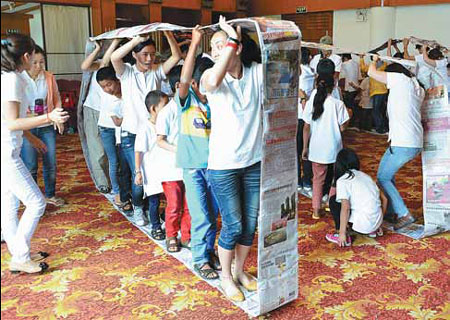
Children with HIV/AIDS play games at a summer camp last week in Kunming, Yunnan province. Some 30 children aged 10 to 15 participated in the camp. Provided to China Daily |
The tall, 15-year-old girl with a ponytail, originally from a mountain village in Yunnan province, now goes to middle school in a county three hours from home by bus.
"It's hard taking medicine twice a day because I have to hide it from others," she said, her hands pinching the strap of her bag.
Every day at 8:10 am, during the morning reading session, she swallows three antiretroviral therapy pills.
"I take the medicine behind the book without drinking water because I don't want my classmates to see," she said.
At first, her mother said it was just tuberculosis and told her the truth last year when she had a boyfriend.
"I learned that I got the virus from her and began to hate her," she recalled.
But the hatred didn't last long as she saw her mother working so hard selling fruit to support her education.
"I don't want to think or know much about the disease - it might make me feel desperate," she said.
"I'm a bit worried that my condition might affect a future relationship," she said.
Yin Zuyan, Feifei's doctor, said she feels at a loss, particularly when young patients like Feifei ask her about relationships. "Becoming a teenager and entering puberty, naturally they are longing for a relationship. It is extremely hard to give any advice," she said.
Moreover, other mental problems like depression and anxiety tend to arise when the patients enter their teens, she said.
"They begin to formally identify the disease and its potential effect then, which might worsen their adolescent rebellion," said HIV/AIDS expert Zhao Yan.
Zhao Yan, deputy director of the AIDS treatment and care division of the National Center for AIDS and Sexually Transmitted Disease Control and Prevention, said effective AIDS treatment is more than medication: Proper and timely mental counseling is equally important, especially for children.
To date, China has 8,000 children living with HIV/AIDS across the mainland, about 1.2 percent of the cases, statistics from the center showed. Most got the virus from their mothers.
Regional studies showed mental problems are on rise among young sufferers, said Xiao Jinsong, associate professor of psychology and neurology at Wuhan University.
Some of them suffer depression when they grow older and learn more about their status and related social discrimination, he said.
"It is easy for them to get twisted ideas of themselves, which might pose a challenge to their own health and social stability," he said.
Zhao agreed, adding that many teenagers decline to take medicine without proper mental intervention.
Worse, some who become sexually active hide their status from partners, "which might spread the virus," she added.
Since 2004 when China brought in child patient treatment, "we have constantly realized how important such supplementary procedures like mental support and the proper way to inform them of the disease are for effective and successful therapy," Zhao said.
But she conceded that such comprehensive services were not currently available due to restraints in funding and talent.
Li Bin, minister of the National Health and Family Planning Commission, said on Tuesday at a summer camp in Beijing for children affected by HIV/AIDS that more resources would be rallied to take better care of child sufferers.
First lady Peng Liyuan, who is also the image ambassador of the National Health and Family Planning Commission for HIV/AIDS control and prevention, and Margaret Chan, director-general of WHO, also attended the opening of the camp.
At the camp, 12-year-old Gao Jun, who was infected via mother-to-child transmission, was excited about the various activities for him to do.
At age 4, he starred in the Oscar-winning documentary The Blood of Yingzhou District, when he had just lost parents to AIDS and appeared quite introverted.
"I can hardly connect that poor little boy - who refused to listen, talk, or even just look at others - to the smiling teenage boy today," said Zhang Ying, director of the Fuyang AIDS Orphan Salvation Association, where Gao lives now.
According to Zhao Yan, more than 20 percent of China's HIV-positive children have lost parents to AIDS.
"They are in great need of mental support for healthy growth, both physically and mentally," she said, adding regional pilot projects have addressed that need issue.
Mental Support
A summer camp for HIV-positive children aged 10 to 15 last week in Kunming, Yunnan province, focused on their mental health.
The camp, held by the Chinese Association of Sexually Transmitted Disease and AIDS Prevention and Control and the pharmaceutical company AbbVie, is the first of its kind to focus mainly on the health of such children, said Shen Jie, deputy director of the association.
"Unlike the commonly seen sightseeing type, the camp aims to inform the children in a proper way of the disease they suffer from, help them correctly identify their status and better handle negative feelings," she said.
Xiao Jie, an eleven-year-old from the Guangxi Zhuang autonomous region, was never told about her condition, though she's been on medication for four years.
Her teacher, surnamed Li, said the girl did in fact know a little bit about her condition but never recognized that in public.
"It's typical of the sense of denial that they tend to develop entering their teens," she said.
According to Li, it requires great expertise in mental health to properly inform children of their condition. "That should usually happen after they reach 10, but China has no guidelines for that," she noted.
Jiajia, 10, from Guangxi, said she felt relaxed at the camp because "we all have HIV, so I don't have to hide anything".
Outside the camp, however, "I need to stay on high alert, mainly to hide my disease," she said, adding that she always takes the medicine in secret.















