


Hilton hotels go business class
|
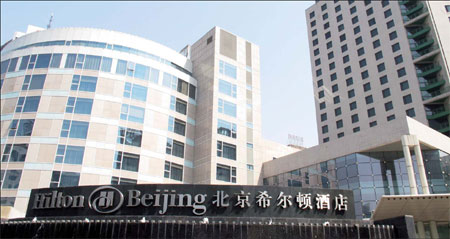
With only four of its 10 hotel brands present in China at the moment, Hilton Worldwide is working on introducing more to China. Provided to China Daily |
Us hospitality chain embarks on rapid expansion to catch up with global peers
Hilton Group, the US-based hospitality chain, is launching a mid-scale brand called Hilton Garden Inn in China to cater to the needs of the fast-growing number of business travelers.
Francis Lee Wee-Hau, senior vice-president of development, Greater China and Mongolia, for Hilton Worldwide, says the brand will be launched in five Chinese cities - Lijiang, Chengdu, Harbin, Dandong and Huzhou - will be expanded later to more second and third-tier cities.
Meanwhile, the group is also planning to open the doors of its contemporary luxury hotel in downtown Beijing later this year. The hotel, the company's fifth Conrad hotel in China under the Hilton Hotel & Resorts brand, is part of the group's expansion strategy to cash in on the fast-growing and lucrative Chinese tourism market.
"Across the 289 rooms in the hotel, we have 'smart luxury' as our core philosophy," says Alex Kassantly, general manager of Beijing Conrad Hotel.
Hilton Hotels & Resorts is also on track to achieve its ambition of expanding its presence from the current 32 hotels on the Chinese mainland with more than 12,000 rooms to more than 150 properties with 55,000 rooms in the next several years, he added. By 2015, the group will have hotels in 75 cities across the country.
Yang Honghao, a researcher with the China Tourism Academy, said in a report on China's hotel industry that the country has 60,000 hotels with 14,000 given star rating. By the end of 2010, nearly 70 international hospitality brands from 41 countries and regions had entered the Chinese market, managing about 20 percent of the country's top-end hotels and taking 80 percent of the profits, according to Yang.
With only four of its 10 brands present in China, Hilton Worldwide is working on introducing more brands to China.
The variety of brands will suit the rising needs of the Chinese travelers, says Bruce Mckenzie, senior vice-president, operations of greater China and Mongolia, Hilton Worldwide, adding: "We plan to open around 10 properties this year (in China) and expect to accelerate the pace of growth moving forward."
Hilton's rapid development in the country is in contrast with the slowdown of other international brands during the global economic recovery.
The Chinese hotel market has been showing the strain, especially in the luxury and five-star markets, according to Horwath HTL China, a hotel, tourism and leisure consultancy.
It says the burgeoning demand and the incredible demographic advantages in a country the size of China will help ease operating conditions and improve performance across other markets.
Unlike other international hotel brands, Hilton has often been termed a laggard in China. The company is, however, unperturbed by the tag and has set its sights on remote regions in China, which have few high-end hotels currently, rather than popular or top destinations such as Sanya city in Hainan island.
"There is no doubt that the hospitality industry has been affected by the economic environment, but that crisis also means an opportunity," Mckenzie says.
According to him, opportunities are still aplenty in China as room supply is still lower than demand. His confidence also comes from the government's plan to increase residents' income during the next seven years.
"Higher personal income means more travel, both domestic and international, requiring more hotels in both business and leisure destinations," Mckenzie says.
As the second biggest market for InterContinental Hotels Group after the United States, China is expected to have the same number of hotel rooms as the United States by 2025, said Richard Solomons, chief executive of IHG.
In 2012, the group saw its businesses in China growing rapidly, with operating profit up 21 percent. Of its 1,053 properties under development globally, more than half are based in China. Last year the hotel group created luxury hotel brand HUALUXE hotels and resorts specifically for the Chinese with a plan to reach 100 cities across China.
"It is easy to come in and put hotels everywhere," says Solomons. "But we turned down more deals than those we signed in China. We have to get a real understanding of what drives growth and success. We need to understand what is right for long-term development."
The fact that Chinese customers have a bigger expectation for value also requires hoteliers to position their brands more clearly, he says.
At the same time, it is also important for the hoteliers to play the local card to make their businesses successful as more than half of the revenue comes not from room rents but meeting and weddings, says Solomons.
"I think we want to become a Chinese business and eventually say our Chinese business is bigger than our American business," he says.
But one of the major challenges for China's hotel industry is human resources. "Human capital is a key factor that supports Hilton's expansion in the Chinese market," says Mckenzie.
But China's labor market lends itself to a shorter-than-average employee retention rate, as well as fierce competition for trained and qualified service personnel, says Mckenzie.
Hospitality companies need to invest more in building human capital and grooming the talent required to manage expanded operations, he says.
IHG also considers the biggest shortage is people. "The hospitality business is not about the building but the experience," says Solomons, chief executive of IHG. "To get the right people in right training and encourage them to stay on in the industry is important," he says.
Contact the writers at wangwen@chinadaily.com.cn and wangzhuoqiong@chinadaily.com.cn















