


Arctic: A land of opportunity
|
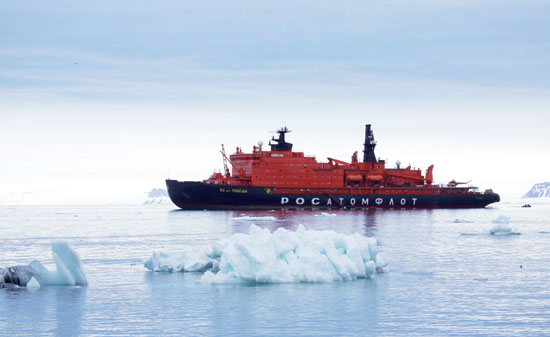 A Russian ice-breaking vessel in the Arctic. Extreme climate conditions in the region, such as fog, low temperatures, icing up and long nights, mean that shipping companies will have to make further investments in new ice-capable vessels with enhanced hulls. This will boost business for Chinese shipbuilders, said Remi Eriksen, chief executive officer of maritime and oil and gas with the Norway-based Det Norske Veritas. Provided to China Daily |
It offers possibilities for shipping as well as oil, gas exploration ventures
Shrinking sea ice in the Arctic, opening up the region to increased human activities, will provide business opportunities for Chinese companies in the shipping, oil and gas industries, said a senior official from one of the world's leading shipping industry classification societies.
The latest research data show the Arctic ice is melting at an unprecedented speed. With its temperature rising at a rate twice that of elsewhere in the world, the region is expected to be ice-free within the next decades.
Scientific expeditions also confirmed the Arctic shipping routes are opening for longer periods in the summer than before. If this trend continues, shipping routes traversing the region will face increasing traffic in the near future.
Plying the Arctic routes, shipping companies could cut the sailing time between Asia and Europe by almost one-third. This would in turn reduce their fuel costs, which have been increasing steadily in recent years.
However, extreme climate conditions in the Arctic region, such as fog, low temperature, icing and long nights, mean that shipping companies would have to make further investments in new ice-capable vessels with enhanced hulls.
This would boost business for Chinese shipbuilders, said Remi Eriksen, chief executive officer of maritime and oil and gas from the Norway-based Det Norske Veritas.
"The vessels required by the Arctic routes would need enhancement and adjustments in certain parts, such as the hull and propeller system," Eriksen said.
"This represents new opportunities for Chinese shipbuilders," he added.
Shipping companies are indeed intrigued by the prospect of using the Arctic routes. But so far they have generally adopted a wait-and-see approach.
Maersk Line, the container operator arm at the Danish shipping conglomerate AP-Moller Maersk, whose container fleet carries the largest cargo volume on the Asia-Europe line, said it doesn't see any "immediate commercial possibilities in the Arctic routes".
But it also said it will continue "monitoring development and discussions on the subject and will get engaged whenever relevant", the company said in an emailed interview.
Among Chinese shipping companies, only the State-owned China Ocean Shipping (Group) Co showed interest. In September 2012, COSCO Chairman Wei Jiafu paid a visit to Iceland and discussed cooperation in developing the Arctic routes.
But since then the company released no further plans for the new shipping routes and "had little intention of making any immediate movement", according to a source within the company.
Chinese shipbuilders, meanwhile, are also keeping a close eye on the market activities. China Shipbuilding Industry Corp, one of the country's two biggest shipbuilding conglomerates and the Chinese navy's main contractor, said so far there has been no significant growth in orders for ice-breakers or ice-capable cargo vessels.
"But we are ready with all the designs and facilities. Whenever there is an order, we can start manufacturing immediately," the company told China Daily in an exclusive interview.
The oil and gas industry is another sector that is likely to benefit from the retreating ice sheet. The Arctic is believed to contain one fifth of the world's undiscovered hydrocarbon resources. More than 80 percent of this is believed to be located in offshore waters less than 500 meters deep. There are currently about a dozen ongoing oil projects in the Arctic region but no Chinese companies are participating in any, according to Det Norske Veritas data.
But they are coming. During Chinese President Xi Jinping's visit to Moscow, Russian oil giant Rosneft signed an agreement with its Chinese counterpart China National Petroleum Corp to enhance cooperation in Russia's Arctic territory.
"There are still chances for Chinese oil companies to participate in the Arctic region," Eriksen from Det Norske Veritas said.
"Compared with companies in the Arctic states, Chinese companies have little experience of operating in the Arctic region. But they generally have strong finances and they could team up with current Arctic players and invest in the development of key technologies," he added.
A need to cooperate in the Arctic will also help other companies from Arctic states to strengthen their ties with Chinese partners. Statoil ASA, the Norwegian oil and gas company, may be a case in point. The company has been operating in China for many years but achieved no substantial expansion in the Chinese market, a market source said.
"Now Chinese oil companies would consider working with Statoil if they want to tap into the Arctic resources. Statoil has advanced offshore drilling technology," the source said.
Yet despite the oil industry's enthusiasm, the grim fact remains that in the near term investment in Arctic oil may not be profitable. Oil consumption may still increase in most emerging markets but that might not be the case with developed economies. Other sources of energy such as bio-fuel and shale oil will also affect demand, according to a research note from the Economist Intelligent Unit.
In the meantime, any accident that may occur during the projects, especially an oil spill, will cause grave consequences, given the fragile ecosystem and harsh environment in the Arctic region. Current technologies are unable to respond properly and effectively if oil spills occur there. As environmental regulation is expected to become stricter, operational costs for oil companies will also rise.
But the oil industry will still press on. Currently, a number of oil companies, including ExxonMobil. ConocoPhillips and Statoil, all have drilling leases in the United State's Arctic territory and they don't plan to abandon them. So to find a way to develop the Arctic resources in a safe and sustainable manner is a challenge for the whole industry.
"Because of the challenges posed by the Arctic conditions, we would need to update the existing technical standards," Det Norske Veritas' Eriksen said.
As a leading provider of risk management services, Det Norske Veritas spent four years, cooperating with Russian experts on a project named Barents 2020 to lay down safety standards for oil and gas field operations in the Barents Sea area.
"In order to keep the risk in the Arctic region at a level equivalent to other regions, we should focus on reducing the probability of accidents happening. Only focusing on mitigating their consequences is not enough," Eriksen said.
During phase four of the project, specialists from countries including France, the Netherlands and the US will also participate. After the reports are published, Arctic countries will share the collected experience through a so-called Circumpolar Knowledge Sharing project, where operators and regulators from all coastal states will attend seminars to share the lessons.
As more and more Chinese companies show increasing interest in marching to the north, "we are expecting future cooperation with them", Eriksen added.















