


Steady steps against AIDS, but no cure yet
|
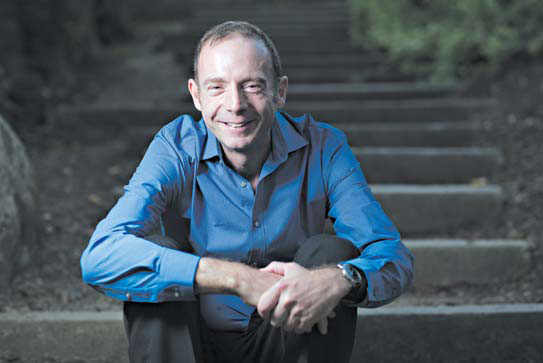
Timothy Ray Brown is free of AIDS after treatment. H.I.V. splices a copy of itself into the genes of certain white blood cells, adding permanent rungs to each cell's DNA ladder. Heidi Schumann for The New York Times |
What to make of recent "cured of AIDS" headlines? An American in Berlin, a baby in Mississippi and 14 patients in France are all alive without treatment.
Is a cure near? No. But some people seem able, with temporary help from antiretroviral drugs, to kill the virus before it can sink into reservoirs deep in their bodies - or to at least force it to remain outside their cells.
"I'm excited about this," said Dr. Anthony S. Fauci, the director of the National Institute of Allergy and Infectious Diseases in Maryland. "Things are falling into place that tell us what goes into the process of infection. So we're learning whom we can potentially take off treatment."
There is no way to tell which patient might get lucky, and a vast majority will not.
But several experts say the reported cures - if confirmed - do suggest that some policies should change. Patients who are treated as early as possible may live longer, may be 96 percent less likely to infect others and may turn out to be among the few who can stop treatment.
"We should seek out, test and get people into treatment as soon as we possibly can," Dr. Fauci said. That would put patients in a situation similar to those studied in France.
H.I.V. doesn't just hide behind cell walls. It splices a copy of itself into the genes of certain white blood cells, adding new rungs to each cell's DNA ladder. Later, it does the same to cells in the bone marrow, lymph nodes, nerves and organs. Scientists now can biopsy various cells and prove that they are infected.
"There are still arguments among scientists about whether there are places deep in the tissues that treatment doesn't reach, and whether or not virus is still replicating there," said Jerome Zack, an immunologist at the University of California, Los Angeles.
Timothy Ray Brown, 47, is in his own category. A Seattle native formerly living in Berlin, he had been on H.I.V. drugs for 11 years when he developed unrelated leukemia. In 2006, his doctors wiped out his bone marrow and gave him marrow from a donor who also had a rare mutation that makes CD4 cells, the virus's favorite target, impervious to H.I.V.
In April, doctors at the University of Minnesota performed the procedure on a 12-year-old boy with H.I.V. and leukemia, using umbilical cord blood from a newborn with the mutation. It will be months before they know the outcome.
Typical patients can't follow Mr. Brown's lead. Wiping out bone marrow normally carries a 40 percent risk of death, and he had to have it done twice.
The Mississippi baby was put on full antiretroviral treatment, rather than just a typical lower-dose prophylactic regimen, just 30 hours after the baby was born about three years ago, and stayed on it for 18 months before the mother stopped it for five months. At the next doctor's appointment, the baby appeared cured. Later, Dr. Deborah Persaud of Johns Hopkins Children's Center in Maryland could not find any viral RNA.
If the baby's experience is repeated it may become routine for babies in such cases to get an aggressive drug regimen.
The French patients went on treatment soon after infection and stayed on for a year or more. Later, about 15 percent of them were able to stop their drugs.
But not all patients get the first signs of H.I.V. infection. Fever, sore throat, swollen glands and a rash resemble other illnesses, said Dr. Eric S. Rosenberg, a researcher at Massachusetts General Hospital.
Dr. Mike McCune, chief of experimental medicine at the University of California, San Francisco, speculated that some people might have an "imbalanced" immune response that defeats the wily virus: They produce antibodies that neutralize H.I.V., but don't get inflammation, which increases CD4 cells.
Another hypothesis, Dr. McCune said, is that some patients got weaker virus. In monkeys, it has been shown that less-robust strains are controllable with drugs. "But," he said, "as you can imagine, no one wants to do that study in humans."
The New York Times















