Partnerships in nanotech, stem-cell research pondered
|
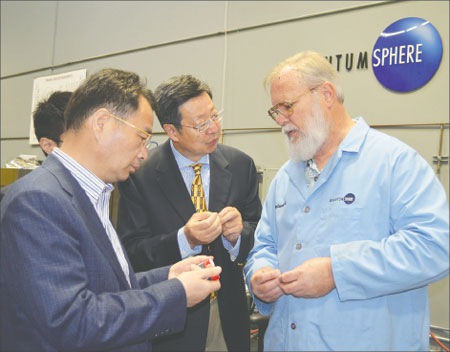
Xu Guanju (left), chairman and president of Chinese conglomerate Transfar Group, and Robert Sun, chairman of the US-China CEO organization, listen to Doug Carpenter, CTO of Quantum Sphere, describe the company's products. Wang Jun / China Daily |
Nanotechnologies and stem-cell technology are areas in which Chinese and US companies can have significant cooperation, a delegation of business executives from China and their American hosts agreed.
Quantum Sphere Inc, a Santa Ana, California, maker of nano-scale catalysts for chemical reactions, sees China as its biggest potential market.
"We focus on China," said Kevin Maloney, the company's president and CEO. Quantum Sphere recently signed a contract with a Beijing-based distributor through which it can explore the Chinese market for technology used in energy storage, ammonia production and other applications.
China produces 53 million metric tons of ammonia each year, accounting for 43 percent of world production. In three years, the country will be able to produce 97 million tons annually by building more plants.
Across industries, the key to nanotechnology - manipulating materials on an atomic or molecular scale to make equally small products - is increasing the surface work area.
"It's like you put ping-pong balls all around a football," said Doug Carpenter, chief technology officer and a co-founder of privately held Quantum Sphere. "So the surface area is largely increased."
That means increased productivity, reduced energy consumption and less pollution.
The six-member Chinese delegation was led by Xu Guanju, vice-chairman of the All-China Federation of Industry and Commerce, which represents private enterprises in China. The visitors were encouraged by their hosts' willingness to form partnerships.
Xu is also chairman of Transfar Group, a privately held conglomerate with businesses in chemicals, logistics, agriculture and investment that generated 24.9 billion yuan ($4 billion) in revenue last year. Impressed by the market-ready technology he saw on Monday, he invited Quantum Sphere executives to visit his company in Hangzhou, in eastern China's Zhejiang province.
"I'd like to either introduce potential business partners in China for you, or utilize your technology in my own company," he said.
Xu also suggested that Quantum Sphere consider setting up a research operation in a technology park he helped build in China.
The Chinese businessman also made a pitch to California Stem Cell Inc, which investigates human stem-cell lines for potential use in treating cancer and other diseases. Xu offered to help connect the Irvine-based company with hospitals in his hometown as well as Zhejiang University as possible research partners.
California Stem Cell is preparing a melanoma treatment for a third and final phase of testing under guidelines set by the US Food and Drug Administration, said Michael McClurg, the company's vice-president of business development.
To complete the testing, CSC needs $60 million to $100 million in new investment. Xu said Transfar would consider that, saying that stem-cell research and applications is a potentially lucrative business and that much of the research and development into melanoma medications could be applied toward finding treatments for other cancers.
The Chinese market has already drawn interest from CSC in the form of a joint venture to develop a liver-cancer medication with a company in Shanghai. Joint testing of the medication on eight patients is being arranged.
"This is a breakthrough in cancer treatment," McClurg said.
By sending medical doctors to Shanghai, the company is trying to comply with Chinese and US regulations. That could slow down R&D somewhat, but the results could be applied to both markets, CSC says.