


Fixing the environment is in our hands
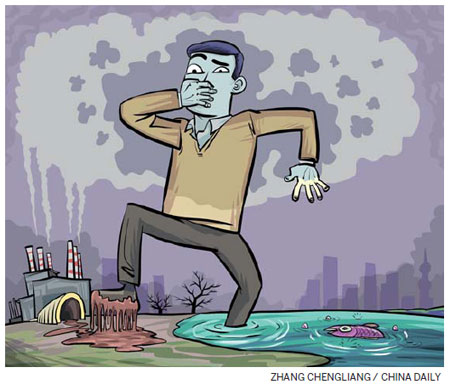
China's air pollution is a reminder of how urgent the task is
China's environmental problems were propelled to the forefront of national consciousness at the start of the year, highlighted by smog in Beijing that prompted the city to issue the first-ever orange fog alert, indicating that visibility fell below 200 meters.
The PM2.5 levels for big Chinese cities, an indicator of the air's content of the most dangerous size of particles that can be inhaled and enter the human bloodstream, showed that China's air quality was consistently at very dangerous levels, significantly elevating the risk for heart, brain and respiratory diseases.
With growing environmental awareness, China's new leadership will be under pressure to continue to take action to improve things. In recent years, China has exhibited signs of shifting its focus more toward quality of growth; including environmental protection in local government performance evaluations will support such efforts.
But air pollution is not the only issue in China. Water pollution has aroused serious concerns. Industrial accidents, irresponsible waste disposal procedures, and household pollution have led to significant water pollution of rivers, lakes, and oceans.
Soil erosion is another worry that has plagued China for the past few decades, and many experts are quoted as saying that China has the worst soil erosion problem in the world.
Given the enormous environmental challenges that China faces in the years to come, the question turns to what can reasonably be done to improve things. Tackling environmental concerns will undoubtedly be costly, and more stringent environmental standards will probably be reflected in lower GDP growth; various organizations including the International Fund for China's Environment have estimated the cost to be about 2 to 4 percent of GDP a year. While this may be undesirable in the short run, it is ultimately more important to China to focus on the long-term quality of growth.
The first step is obvious: to address the damage already done. Given the state of China's environment, it is important to note that environmental challenges will take a long time and great effort to overcome, and with the current dangerous levels of pollution the process needs to be sped up.
Many important measures have already been announced. China will spend 4 trillion yuan ($647 billion; 495 billion euros) in 2011-20 on rural water projects, and a minimum of 200 billion yuan on other cleanup projects. In addition, the Ministry of Environmental Protection pledged to spend 350 billion yuan to build 13,369 projects to control emissions and reduce PM2.5. In 2011 government spending on environmental protection was 419 billion yuan, or about 0.9 percent of GDP; while this is a significant level, it is still below the 2 to 4 percent estimated spending required to adequately deal with environmental damage.
China has been at the forefront in spending on clean energy, particularly since 2006. According to the Pew Charitable Trusts' annual report Who's Winning the Clean Energy Race? in the years 2006-2011 China was the country that had the highest growth in renewable energy capacity at 92 percent. At the end of 2011 China was a close second to the US for total clean energy investment after taking first place in 2009 and 2010, with $45.5 billion of clean energy investments made, marginally behind the US investment of $48.1 billion.
According to China's official breakdown of energy use, at the end of 2011 use of alternative energy sources such as hydro, wind, solar, and nuclear combined was 8 percent. This was down from the high of 8.6 percent in 2010, and was possibly related to caution over nuclear power plants following the Fukushima Daiichi nuclear disaster in Japan after the earthquake in March 2011. Compared with a country such as the US, we can see that China's use of renewable energy is significantly smaller, at 8 percent compared with 18 percent for the US.
To compound the problem, China is not only highly dependent on fossil fuels, but the portion of fossil fuel use is also heavily skewed toward coal, which is the dirtiest of these fuels, creating the most emissions. Coal is perhaps the biggest culprit contributing to China's struggles with smog and air pollution. The US Energy Information Administration data shows that China accounted for almost 47 percent of total coal use in the world in 2011. Furthermore, studies have shown PM2.5 is most prevalent in the combustion of coal; given the particularly salient nature of these PM2.5 emissions, coal use is an important area to look at.
A long-term goal would be to wean China off its coal dependency, but this is not feasible in the short run because there is a lack of viable alternatives. In the meantime, China can try to make its coal consumption cleaner; this can be done in a variety of ways, including removing the sulfur from the coal before firing it in power plants, and by limiting nitrogen oxide emissions by using methods such as staged combustion. While these methods will add costs to the final price for producing energy, implementing stricter regulation will blunt the environmental impact that it will have.
In the longer term, continuing efforts to develop and encourage use of cleaner energy sources is needed. As discussed here, China has been a world leader in investing in clean energy, and this trend must continue. In November last year China also announced subsidies for promoting the development of shale gas, which, even though a fossil fuel, has significantly lower emissions than coal.
Another way of reducing environmental damage is by simply making energy consumption more efficient. Last year total electricity consumption was 4.96 trillion kilowatts, and of this, 4.33 trillion kilowatts was from industrial use, while 622 billion kilowatts was from residential use, rising 5.5 percent, 5.1 percent, and 10.3 percent year-on-year respectively. Unsurprisingly, industrial electricity consumption accounts for the lion's share of electricity use, but household electricity use is growing, and sales of appliances are likely to have a larger impact on total electricity use down the line.
A way of improving energy efficiency is by using more energy-efficient consumer products. Over the past few years China has announced varying subsidies for energy-efficient household appliances to support the sales of green products. Measures were announced in May and September last year. In May a 26.5 billion yuan program subsidizing air conditioners, flat-panel television sets, refrigerators, washing machines and water heaters that meet energy-saving standards was announced. Additionally, the government allocated 2.2 billion yuan promoting the consumption of energy-saving light bulbs and LEDs, as well as 6 billion yuan subsidizing purchases of vehicles with engine sizes below 1.6 liters. In September a further 14 billion yuan subsidy was announced for energy-saving desktop computers, air-conditioners, fans, water pumps, compressors and transformers.
These policies should be continued because they will not only bolster consumption but also reduce China's carbon footprint over the long term; it is particularly important to encourage green household appliances, as appliances such as microwaves, refrigerators, washing machines, driers, and stoves have average life spans between 11 and 19 years, according to consumer studies, and improving the efficiency of these appliances could have a noticeable impact on a macro level.
China's tax policies have predominantly focused on macroeconomic control rather than raising revenue. Taxes to discourage pollution and excessive use of resources can be made to properly align incentives and encourage sustainable behavior to prevent China from irrevocably damaging its environment and depleting its resources.
The author is head of research and chief economist of Haitong International Securities based in Hong Kong. The views do not necessarily reflect those of China Daily.
(China Daily 04/26/2013 page8)















