


Middle class key to better health
|
Laurie Garrett says environmental and human behavioral trends are the main contributors to most of the emerging diseases. Provided to China Daily |

Concerted action will help find fixes to most problems including air pollution, health expert says
Balancing prosperity and health will be a major challenge for policy makers in China, especially if the nation wants to capitalize on its economic gains, says a leading US expert on global health.
Laurie Garrett, currently the senior fellow of the Global Health Program at the Council on Foreign Relations, a think tank specializing in US foreign policy and international affairs, says that the task appears to be daunting considering that sectors like finance and energy hold more sway in government corridors, rather than health.
"It is important for the government to realize that prosperity with poor health is not prosperity at all. Rather, it is like the money in a bank account that is used for cancer treatment," she says.
Talking about the current challenges for China, Garrett says the government must take immediate steps to prevent the air quality from deteriorating further.
"It is not good for people's health, and it makes people feel depressed that they cannot see the sun at all," Garrett says referring to the air quality in Beijing. "It is also really bad that the poor air quality will lead to diseases like cancer."
Though cleaning up the air is a pressing problem for Chinese policymakers, people should not be disheartened as these challenges are not new or unique to China, she says.
"Every country in the world goes through these development phases, involving pollution. The US faced a similar situation in the 1950s, when pollution peaked in cities like Los Angeles. I remember when I was a child in LA, the city was teeming with freeways and highways. Population skyrocketed and there were millions of cars on the roads. The air quality was so bad that schools had to be suspended," Garrett says.
Concerted action by the officials and all the stakeholders have helped improve the air quality in most of the US cities like Los Angeles, she says.
"As far as China is concerned, it is the middle-class that needs to take the lead in fixing pollution-related problems," Garrett says.
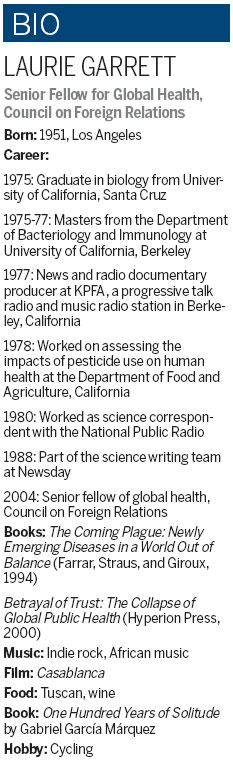
In her second book, Betrayal of Trust: The Collapse of Global Public Health, Garrett dwells at length on public health in various countries. Using case studies from different regions, Garrett points out that the most effective cases of public health have come from countries where the middle class has a strong demand for better health conditions.
"The rich will not have a stake in fixing public problems. If the air is too bad, they will install an air filter in their home and if the water is not clean, they will source clean water from other locations."
The air pollution in China is an accumulated effect and can be fixed only through dedicated steps by all the stakeholders over the next five to 10 years, she says.
Garrett also sounds a note of caution when she says that major epidemics or health crisis could strike any time and that most of the nations are unprepared to tackle the problem.
Quoting from her experiences in dealing with the SARS outbreak in Guangdong province during 2003, Garrett says such diseases can occur in China again, and it is important for the authorities to end most of its live animal markets.
"Though the local center for disease control is working toward these goals, it is also important for the government to encourage people to look for other ways for the meat," she says.
Environmental and human behavioral trends are the main contributors for most of the emerging diseases, she says.
Citing SARS as an example, Garrett says that the disease originated from a vegetarian bat that lived in the rainforests. Because of climate change and trees being cut for timber, the natural environment of the bat was disturbed. This in turn, led to the SARS virus finding its way to humans.
Health is often a subject that gets the short thrift from policymakers in most nations, Garrett says.
"It is important to understand that health is important or in some cases even more important than climate change. There are some exceptions though as in some nations like the US, health figures prominently in national security and foreign policy."
Infection control is another major sector that China must pay attention to if it wants to sustain its economic growth. Garrett says there have been several recent instances of dirty needles and dirty blood injections leading to outbreaks, she says.
"Many dangerous viruses can be delivered during the dirty blood injections, and they in turn will lead to diseases or in some cases even cancer. China needs to think more aggressively about what is going on in its hospitals and make sure that it is clean and safe."
Infection control is not a problem that is only for China but something that everyone must be aware of, she says.
"Doctors or nurses tend to get tired after spending long hours in the field or in the hospital. So it is important that we have people on the ground who are vigilant about infection control, and remind the doctors and nurses to change gloves and ensure no needles are reused and so on," Garrett says.
Before becoming a scholar at the US think tank, Garrett used to be a science journalist and was a Pulitzer Prize winner for explanatory journalism in 1996.
"I love journalism! There is nothing as terrific as the environment of a newsroom," Garrett says.
"You are surrounded by smart colleagues, who constantly inform each other about what is happening in the world. To me it felt like I was at the center of the universe. It was also amazing to be paid to be curious and to ask questions."
Though she has left active journalism for the corridors of research, Garrett says her work often ends up as a mixture of both.
"I still consider my work is for the everyday person, who sits in the bus on his or her way to work, and not just for the US president or some high-ranking officials," she says.
"In most of the cases, I am still trying the find the original source even as I am conducting the research."
Garrett is currently working on ensuring drug safety and has been trying to increase the transparency of information between countries as well as increasing international cooperation in this field.
"Because of globalization and more steps being added into the drug supply chain, people often find that most of the drugs do not have the ingredients they claim to possess. In many cases, they often have the wrong ingredients," she says.
Garrett says the problem is more acute in Africa where most of the drugs are sugar pills without any effective ingredients. In countries like China, drug regulatory agencies need more support from the government, she says.
"They need to be bigger and also get more financial support from the government so that they can keep a tight leash," Garrett says.
Contact the writer at liaoxue@chinadaily.com.cn.















