


Vietnam's buried history
|
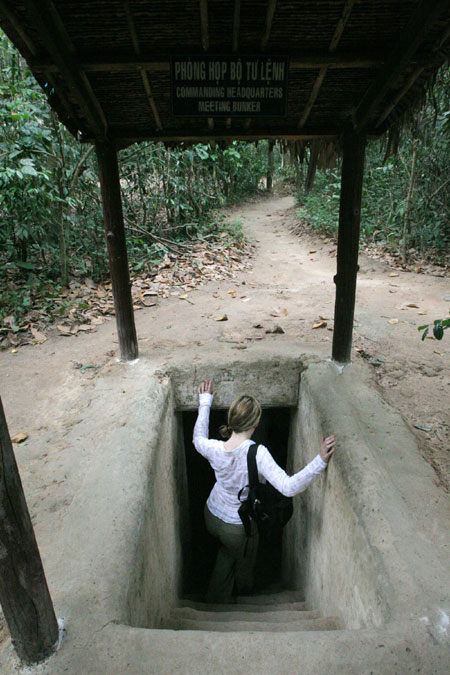 The Cu Chi tunnels, a 75-mile-long underground maze where thousands of Viet Cong fighters and villagers hid, are at the top of the list of tourist spots for Ho Chi Minh City. Provided to China Daily |
Death from above meant life underground for the fighters and farmers who dug the Cu Chi tunnels.
As US bombers blasted the earth into a moonscape, Viet Cong guerillas and refugees burrowed into the terrain to survive.
The tunnels they bored through the earth formed a three-tiered complex that spans more than 250 kilometers from Saigon to the Cambodian border, with hospitals, schools, command centers and a glut of booby-traps for "tunnel rats" - a name for foreign ground troops, whose small statures designated them as the ones to wriggle through the "dark echo" as the complex was called.
Actually, the network was expanded from those built during the resistance to French occupation in the 1940s. And the Americans had no idea of its extensiveness until after the war.
Today, armies of tourists march through the tunnels to understand their legacy.
A couple of passageways have been widened and lit, so visitors can slither through them to get some kind of feel for how the North Vietnamese and refugees lived. Visitors can even don guerilla attire to make the experience more authentic - for a fee.
It's not for the claustrophobic. Many plop out at the first exit.
But the Vietnamese had no choice during the war. They settled in the burrows, sometimes slipping out at night to tend crops and stage ambushes in something like a lethal whack-a-mole game. They haunted the forests from the tunnels, appearing and vanishing like ghosts, to US soldiers' terror.
The US military tried bombing, flooding, bulldozing and gassing the tunnels. Vietnam's government estimates more than 15,000 died underground - not only from US attacks but also from disease and venomous creepy-crawlies. Nevertheless, the tunnels proved instrumental in the communist victory.
The GIs spent years unable to clear this formicary of fire ants, without an inkling of its complexity.
While certainly low-tech - villagers used hand tools and their actual hands to excavate the chambers - Cu Chi's tunnels are far from primitive.
They were linked to the nearby rivers so that the water the Americans poured into them flowed directly into the watercourses.
Trap doors were set above pits of sharpened bamboo that skewered tunnel rats. Containers of venomous snakes, scorpions and other poisonous bugs were also rigged.
Some of these surface traps can still be seen, and diagrams show the mechanics of those buried, replete with illustrations of screaming GIs tumbling to their demises.
Finding the entrances or ventilation openings was no easy task. Many were initially camouflaged as termite mounds.
The US brought in dogs. So, the guerillas started peppering the holes with crushed chilies to numb the canines' olfactory senses. The Americans, in turn, trained the dogs to hunt for the aroma of chili. The Vietnamese then started covering their scent with GIs' clothing, so the dogs would smell their handlers.
The tunnels proved effective until the area was defoliated.
Many tours of the Cu Chi also stop at nearby handicraft workshops employed by the decedents of the tunnels' occupants, born with severe developmental disabilities because of the use of such defoliants as Agent Orange. The studios are run by NGOs to provide these people with livelihoods, and revenues fund programs that improve their lives.
These are included in many tour packages and even more often for those for American veterans of the war, who return to the tunnels to seek closure.
Tours start with the viewing of a propaganda video exalting the resistance's tenacity. It celebrates in particular an 8-year-old local girl, who won a national award for killing many US troops. The scenes flicker between those of her studying as an adorable schoolgirl and those of her picking off GIs with a rifle.
In addition to the tunnels, most of which remain inaccessible, visitors can enter a reconstructed command post, view bomb craters and scuttle atop the husk of a US tank disabled by a landmine.
They can also fire heavy artillery - AK-47s and M-16s - at the National Defense Sports Shooting Range.
Venders pedal wartime memorabilia and such bric-a-brac as tank statues made from bullet shells or sandals hacked from tires, as the guerillas cleaved them from destroyed US military vehicles during the war. They can also sample the wartime staple of mashed rice and sesame.
Wax figures recreate scenes of guerillas making weapons, planning attacks and resting.
It strikes many as peculiar to make a place where such horrors occurred like an amusement park. Many returning American vets report feeling especially unsettled by the staccatos of the firing range.
But, ultimately, the tunnels' tourism pull is bringing new prosperity to residents, whose economic progress was, literally, blown away.
While it's unlikely what wartime US president Lyndon B. Johnson meant when he famously talked about the "light at the end of the tunnel" in Vietnam, Cu Chi's current reality is essentially that.















