


Tackle challenges in farming sector
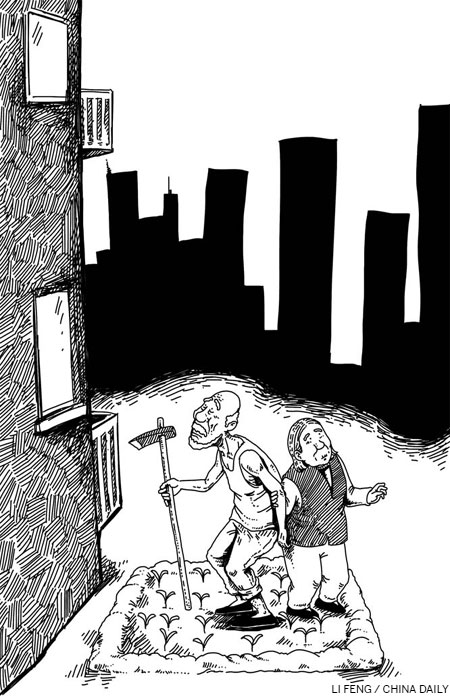
The agricultural and rural transformation in China has been remarkable in the last few decades. The impressive growth in the agricultural and rural sector and significant reduction in poverty have been accompanied by a large decline in the agricultural labor force, with agriculture's share in total employment falling from 71 percent in 1978 to about 40 percent in 2008.
While China has made tremendous progress in the farming sector, it still faces some real challenges. The country's aging population will contribute to a shrinking rural labor force and put immense pressure on its social safety net system. China already has about 120 million elderly people (those ages 65 and over). The percentage of elderly people in the country is projected to triple from 8 percent to 24 percent between 2006 and 2050, to reach 322 million.
Urbanization, too, is adding to the declining labor force in the farming sector, and it is accompanied by an exodus of the young rural workforce. Between 2010 and 2050, China's urban population is expected to increase more than twofold.
Increasing farmers' incomes remains a difficult proposition. And other significant problems continue to plague the rural land system, particularly rural land contracts. Problems relating to land requisition are also on the rise because of growing urbanization.
This is a critical juncture for China. These challenges also offer opportunities to further reduce poverty and improve food security. Research conducted by the International Food Policy Research Institute shows that migration from rural to urban areas and from the agricultural sector to the non-agricultural sector have been the most effective way of substantially reducing poverty and hunger.
There is also scope to increase the incomes of the remaining farmers if they are able to successfully increase the size of their operation and productivity. In the future, a more modern farming sector could have a larger operational area and higher labor productivity, and will be able to produce high-value crops as well as use more modern machinery for production.
All this will depend highly on institutional innovations. The institutional reform in the late 1970s and early 1980s increased Chinese agricultural production and productivity (and therefore reduced the number of poor) at a rate that has never been observed in human history. But, China needs another round of institutional innovations to further transform its farming sector.
The most critical is land policy reform. A new policy should allow farmers to rent land or lease land rights and to increase their farm size. Related legal framework to ensure the enforcement of rural land contracts must be in place. Also, farmers and rural people should be compensated adequately for land requisitions. Related to this, policy is needed to establish social safety nets to protect the farmers and rural migrants in cities who are willing to give up their lands.
During this transformation process, farming models such as cooperatives, enterprises, individual family farms will coexist for some time. Of crucial importance is the need to create an enabling environment to allow these different models to compete, so that the entire agricultural sector can become more efficient and profitable. Since there will be regional differences in the way agriculture is organized, the government should try to support innovation and avoid promoting one-size-fits-all and top-down models.
There is a great potential for the private sector to invest in the farming sector. To encourage private investment in agriculture, policies such as tax concessions will be critical. Sound government regulation and careful monitoring are important to ensure that private capital actually moves into the farming sector.
The government should continue to improve its provision of rural infrastructure, market information, and financial and insurance services. The development of appropriate equipment and strategies to facilitate their use by farmers is also important.
China has the rare opportunity to transform its farming sector to ensure food security and safety, increase farmers' income, and consolidate rural-urban linkages for overall economic growth. This opportunity must be seized now.
The author is director general of International Food Policy Research Institute.















