


Taxi shortage means passengers are fare game
|
Attempting to hail a taxi in Beijing, especially during rush hour, can be an exercise in frustration. Zou Hong / China Daily |
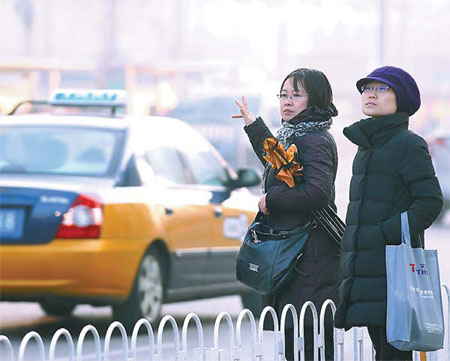
It is becoming harder to hail a cab during busy periods in the capital, as Hu Yongqi and Zhang Yuchen report from Beijing.
For many potential rush-hour passengers on Beijing's streets it has become an all-too-familiar sight.
A taxi slows down, pulls alongside, but then speeds up before disappearing into traffic, leaving the would-be fare disgruntled and frustrated by the roadside.
And the jury is still out on how to resolve the problem, with experts calling for an end to heavy traffic congestion and a change in the way people travel, while taxi drivers bemoan "crippling" monthly franchise fees and rising fuel costs.
Foreigners frequently feel they are being singled out for such treatment.
Thomas Bork, country director of America's Development Foundation in China, has been traveling back and forth to the country since the early 1990s.
His memory of Beijing's taxis dates to 1996, the second time he arrived in the capital. Yellow vans operating as taxis were running throughout the city but taxi drivers, like many today, did not speak English. There was far less congestion and it was much easier to hail a cab than nowadays.
When Bork arrived in the capital for the fifth time, at the end of 2011, he found taking a taxi required luck and that this - just like the cab - rarely arrived.
"During the past three weeks in the area I live - Weigongcun in Haidian district - the number of taxis passing by has been zero," said Bork. "Even if I do manage to stop one, I have usually been rejected for various reasons: A couple of miles is not far enough, or the driver is going for a break."
Once Bork argued with a cabbie after the driver told him to get out. Unable to reach an agreement, he recorded the number of the car and called the taxi company, with the driver liable to a three-day suspension for breaching regulations.
"But I don't complain about the drivers when it comes to severely congested roads in bad weather or in rush hours," he said. "A few times, the driver has even suggested I take the subway even though I was in his car."
Bork said one last resort was to take an illegal taxi charging fares that were twice the going rate.
A PE teacher at an international school in Beijing, who gave his name only as David, said arguing with a taxi driver only made him angrier. The US citizen, who has been in the city for two years, said he had been rejected by a cabbie nearly every day, sometimes merely for standing on the wrong side of the road.
From Dec 28, taxi drivers who fail to pick up passengers face suspension from work for one to three years, being blacklisted and never working in the industry again, according to the Beijing Municipal Transportation Administration Bureau.
Although 66,000 taxis ply the capital's roads, many people like Bork still find they are unable to hire a cab during rush hours or in extreme weather conditions such as torrential rain or on snowy days. The number of cabs in Beijing has not changed for more than a decade and the current fleet is unable to meet the demands of an increasing population.
It is estimated that about 10,000 taxis suspend their service during rush hours, making it more difficult to find a cab, according to a report by People's Daily. Experts suggest that competition should be introduced to the industry to provide better service.
Expensive franchise fee
In most cities in China, taxis are run by franchised companies or private owners. After former Chinese leader Deng Xiaoping visited Shenzhen in Guangdong province in 1992, companies and individuals in Beijing were encouraged to run taxis. This situation changed in 2002 when new taxis were placed in the hands of local governments.
At least 98 percent of Beijing cabs are under the control of taxi companies. For these cabs, drivers pay a franchise fee every month, ranging from 4,500 yuan ($714) to 7,000 yuan or more, depending on the car. Most cabs have two drivers who rotate days and nights, said Wang Keqin, a researcher on taxi reform for the Development Research Center of the State Council in 2007.
Drivers have complained they work really hard but earn as little as 4,000 yuan a month. For Zhou Quanyi, a cabbie in his 40s, the monthly franchise fee of 4,500 yuan he pays the taxi company has proved a heavy burden.
"It means even if I go to the hospital or get sick and stay at home for one day, I still owe the company 150 yuan," he said.
The diesel he buys each day costs 200 yuan, meaning he must earn at least 10,500 yuan a month to make a profit. Zhou says the diesel price has risen constantly over the past five years, further cutting his profit margin.
Zhou is on the road for at least 12 hours, starting from 7 am. He rests for an hour to have lunch and take a nap in his car. He needs to take about 30 passengers to make 500 yuan but the franchise fee has forced him to cover longer distances and work less crowded areas.
He calculates that taking a passenger from Beijing Railway Station to Beijing West Railway Station brings him about 25 yuan. However, the fuel he uses will cost at least 20 yuan if his car is stuck in traffic for about an hour.
"If cab drivers could choose, they would like to put their foot on the accelerator and rarely brake the car. That's most desirable for me. Traffic jams in the rush hour won't bring me any profit but will waste my time and fuel, so why can't I find somewhere to take a break?"
Another driver, Wang Peng, 50, is on his way home before 5 pm to avoid congestion after a 10-hour stint on Beijing's major roads. "In winter, people don't spend much time outdoors, and I see many fellow drivers looking for passengers at night. Then, I choose to go home and have some rest," he said.
Four new subway lines and extensions that opened in Beijing at the end of last year were more attractive than taxis, Wang said. "More residents take the faster and cheaper subway, so we are seeing fewer and fewer potential customers. So I usually don't go to areas near subways.
"All those factors work together and force many drivers like me to search for passengers on streets that are not crowded," Wang added.
Beijing's major railway stations and airport are no strangers to crowds. On Dec 20, the line of passengers waiting for taxis at Beijing West Railway Station stretched for about 300 meters. Taxi management said no cabs were arriving because the snow-covered streets were too dangerous. Then, illegal cabs showed up and the drivers asked for at least 200 yuan to go to the fourth ring road, a fare that usually costs 50 yuan.
Change urged
Unlike Zhou and Wang, the 1,200 private taxi drivers don't have to worry about the costly franchise fee.
In Beijing's Shijingshan district, Mo Shilan, 46, started her career as a private cab driver when she obtained a taxi license 17 years ago. Like Zhou, Mo also starts work at 7 am but returns home at about 11:30 am to make lunch for her husband and child. After an hour's nap, she drives for another three hours in the afternoon. After returning home, her husband takes the wheel for a night shift. The self-reliant business has brought the family an apartment and a luxury car.
However, Mo only pays the traffic authority 800 yuan each month. "I will continue to be a private taxi driver, and so will my husband, because we don't have much pressure," she said.
Beijing ranks highest nationwide in number of taxis per person, with 31 cabs for every 10,000 people, but there is still a shortage of taxis, according to Wang Keqin, the researcher, who has investigated the taxi industry in more than 200 cities in the past 10 years.
Wang says the fundamental problem for China's taxi industry stems from the franchised system and price control by the government. "Like any other businesses, taxis should be cultivated in free competition to get better service."
Wang Jun, professor in law at China University of Political Science and Law, said the difficulty in finding a taxi is closely related to the city's transport system, and the problem won't be solved as long as there is heavy congestion during rush hours.
Mo Yuchuan, a law professor at Renmin University of China, said major cities should change the way people travel in town by increasing public transport efficiency through strengthening the development of subways and buses.
For now, with the taxi problem unresolved, a growing number of people seem destined to remain disgruntled, frustrated and in search of a cab at the roadside.
Jiang Xueqing contributed to this story.
Contact the reporters at huyongqi@chinadaily.com.cn and zhangyuchen@chinadaily.com.cn















