


Debate gets hot on issue of heating South China
|
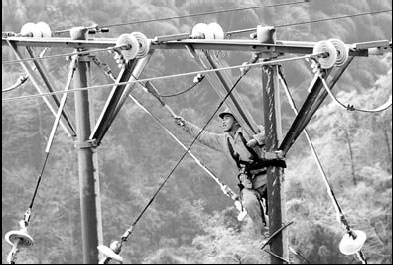
A worker clears ice off power lines in South China's Guangxi Zhuang autonomous region on Sunday. Tan Kaixing / for China Daily |
In ravaging cold, when Chinese people living in northern cities are enjoying indoor warmth, southerners wonder how long they will have to wait for before the government decides to install a public heating network.
The problem is that they are below a line drawn by late premier Zhou Enlai six decades ago.
The line, which stands between 32 and 34 degrees north latitude, almost along the Huaihe River and Qinling Mountains, not only defines China's northern and southern parts, but also determines different winters for the people.
Cities to the north of the line have public heating that circulates hot water generated by government heating stations through pipelines and radiators inside almost every residential building and public facility.
Room temperatures in the north could be more than 20 C.
However, people living in cities to the south of the line, including Shanghai, Chongqing, and Wuhan in Hubei province, have to use various private and individual heating devices to warm their freezing and humid homes.
Southerners plagued by the winter chill have been complaining, especially after cold weather hit southern provinces such as Hunan and Guangdong.
Dai Tongtong, a college freshman studying in Central China's Wuhan, is a northerner. She said the cold mixed with moisture in the south affects her no matter how thick her clothes are.
To get away from the cold in their dormitories, she and her fellow students cram into libraries and public reading rooms to share the warmth generated by air conditioners.
In an opinion poll conducted by qq.com on Thursday, 88 percent of 104,618 respondents voted to install a collective public heating network in the south.
Some local governments in the south have started to build trial heating networks in urban communities, while national legislators and political advisers have called on the central government to give local governments the option to construct citywide public heating networks.
Zhang Xiaomei, a member of the Chinese People's Political Consultative Conference, the top political advisory body, said pushing the line southward would also expand domestic demand and increase employment.
But Han Xiaoping from energy information website china5e.com said: "It is definitely not economical in terms of energy efficiency to install public heating in the south."
"The coldest time in the south may not exceed 60 days in each year, compared with 120 to 180 days in the north," Han told China National Radio. "Therefore it does not make sense to build a complicated heating network from scratch".
He added that the problem in the south also lies in insufficient heat insulation designs in architecture, which sees single-layer window glass installed in homes, making it difficult to keep warm.
Studies by Professor Jiang Yi from Tsinghua University estimated that if the government builds public heating networks in the south, it will increase the energy consumption of the nation's urban buildings by 4 percent.
Those who favor the construction of public heating in the south warned that electricity-powered devices may not ease the concerns about energy efficiency.
According to a report by China Academy of Building Research, 10 major provinces in the south have witnessed a big surge in power consumption for heating with electric devices, from less than 100 million kWh in 1996 to 39 billion kWh in 2010.
Netizens even criticized Shen Herong, an expert living in Jiangsu province, who said people in the south are used to wet winters and might not adapt themselves to indoor radiators which often make the air dry.
Qiu Baoxing, vice-minister of housing and urban-rural development, has expressed concern that providing public heating services in the south may jeopardize China's energy supply.















