


Eco-cities the next big thing
|
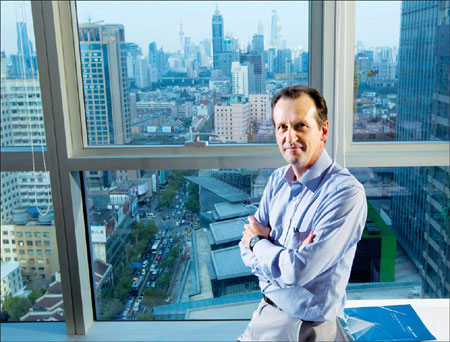
Chris Twinn, senior sustainability consultant, says it's a challenge to make eco-cities desirable places for people to live in. Gao Erqiang / China Daily |
China aims to take a global lead in the creation of eco-cities to minimize the environmental impact of its march toward urbanization.
The Tianjin Eco-city is set to be the largest in the world and when completed in the early part of the next decade will be the home to some 350,000 people.
The new city, which is 40 kilometers from the center of Tianjin and is a joint venture between the Chinese and Singaporean governments, could be one of around 100 eco-cities eventually established around China.
Others in development around the world include Masdar City in Abu Dhabi and PlanIT Valley in northern Portugal.
Chris Twinn, senior sustainability consultant and a director of UK engineering giant Arup, based in Shanghai, says Tianjin looks set to achieve a 10 to 15 percent energy saving on a conventional city.
"Tianjin is the most developed and successful eco-city project, particularly since it has attracted all the major Western commercial and business enterprises who want to be associated with a green development."
The challenge is making the new eco-cities desirable places for people to live and not end up like China's so-called ghost towns such as Kangbashi in the Inner Mongolia autonomous region.
They are designed to be zero carbon and rely on residents recycling their rubbish so it can be used as fuel and for people to use public transport and cycle rather than drive cars.
Penny Lewis, master's course leader at the Scott Sutherland School of Architecture at Robert Gordon University in Aberdeen, says there is a danger of them being cities without the advantages of cities.
"It is really the antithesis of the city without the good qualities of urbanity. Many of them are, in fact, suburban. People move to cities because they want to be where all the attractions are, the shops and the art galleries etc," she says.
"I think recycling waste and bicycling to the local shopping center is a Western pre-occupation exported to China that is not terribly useful."
Eco-cities certainly need a lot of investment and support from developers. The Shanghai Industrial Investment Corp hired Arup to design China's first eco-city at Dongtan, an island next to Shanghai in 2005 but it has yet to be started.
Twinn, who was the energy management masterplanner of Dongtan, says the key to eco-cities eventually working is achieving greater energy efficiency.
"If in Tianjin you are achieving 15 percent energy saving on a conventional city you have to factor in that energy consumption is rising all the time so you need that saving just to stay where you are," he says.
Michael Owens, director of Michael Owens Associates, a regeneration consultancy based in Kingston upon Thames, Surrey, and a former head of development policy at the London Development Agency, says it is still difficult to define what is meant by an eco-city and sustainable development.
"Sustainable development is a term used in a lazy way. If it means building better insulated housing so you don't need your central heating on all the time then that is more tangible than some of the other concepts associated with it," he says.
Austin Williams, who lectures on architecture at Xi'an Jiaotong-Liverpool University in Suzhou, believes eco-cities are not the right model for China's rapid urbanization.
"I saw one consultant giving a lecture in China recently which was clearly designed for the chattering classes in London. It inevitably showed a blue planet seen from the moon and with 20 or so graphs aimed to show that China with its population growth was destroying the planet," he says.
"The idea he thought he had the moral authority to deliver that and not get sent packing is unbelievable."















