


EU debt crisis is a snake with nine heads
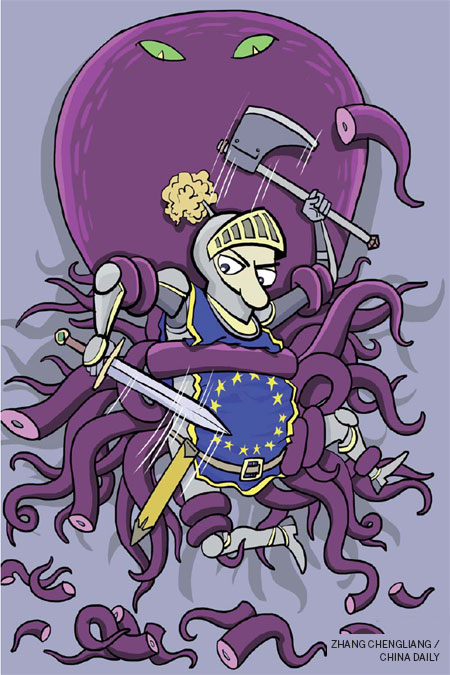
The mess that Europe finds itself in is extraordinarily complicated
The financial crises in Latin America and East Asia 15 or so years ago were essentially resolved within a year or two, but the European debt crisis set off in Greece has already lasted more than two years, and no end is in sight.
The unresolved crisis has not only damaged the international status and credibility of the European Union and the euro, but has exacerbated social problems in Greece and elsewhere. It may even have hindered the recovery of the world economy, too. Little surprise then that leaders at the G20 summit in Los Cabos, Mexico, in June asked the EU to step up its response to the crisis.
Why the European debt distress defies a quick resolution is clear.
First, the effects of the crisis are extensive. The era of financial globalization and the information explosion has introduced a new word to the financial lexicon: contagion. The European debt crisis began in Greece, Ireland and Portugal, three countries that in the great scheme of things have limited economic power, but contagion saw to it that their woes were visited upon the eurozone's third and fourth-largest countries, Italy and Spain, and other countries, including France.
Second, the EU failed to nip the Greek crisis in the bud. The country's economic situation was at boiling point in October 2009, but the EU apparently saw no sign of the debt crisis. There was a consensus at certain levels of the EU: Greece should solve its debt problem itself, and helping it tackle its problems was laden with risks.
So it was not until April 2010, after Ireland and Portugal had been infected, that the EU and the International Monetary Fund started to work out a relief program for Greece.
Third, the crisis plan the EU originally developed was wrong-headed. In such circumstances the best medicine would have been economic development, but what the EU prescribed was fiscal austerity. Consequently, heavy investment in production was canceled and social welfare was cut. All that did was show that as a medicine fiscal austerity can have serious side effects. These include unnecessary government spending cuts and restraining domestic demand and economic development. Moreover, fiscal austerity comes at a high social cost.
Fourth, EU member states cannot expand exports by devaluing their currency. The euro is the product of European integration, the collective will of all Europeans. But expanding exports is one way a beleaguered country such as Greece could revive its economy. This is why many people encouraged Greece to leave the eurozone and readopt the drachma.
Fifth, the debt crisis damaged not only the real economy but the soundness of banks. They suffered huge losses because of write-downs of more than 70 percent of Greek bonds. In addition, the economic malaise undermined their profitability and viability. According to Reuters, the losses of the four major banks in Europe last year totaled 8 billion euros. In February Jean-Paul Chifflet, president of the French bank Credit Agricole, said it is now the most difficult time since 1929.
Sixth, the effect of bad-mouthing by the credit rating agencies Standard & Poor's, Moody's and Fitch does little to encourage renewed market confidence. It is clear that during the European debt crisis these three have played an extraordinarily interventionist role. Whenever they lower European countries' ratings, market confidence plummets and the cost of financing then rises.
Eighteen months ago The New York Times quoted Pierre Lellouche, the then secretary of state for European Affairs, as saying: "I'd be interested to know what these 30-year-old boys know about the disaster they are causing to people in Spain or Portugal. Where's the accountability?"
Seventh, at various points, efforts to tackle the debt crisis have been affected by raw politics. In some countries the differing stances of political parties on measures to deal with the crisis have resulted in shifting policy positions or snap elections. Some parties have used the crisis as a weapon to attack opponents, and some of the antics have come across as rank demagoguery, making the political conditions to solve the debt crisis even more fragile, Greece being a prime example.
Eighth, Germany has been unable to play a more important role. As one of the paramount EU nations, its role in the crisis is critical. It has, admittedly, funded many relief efforts, and seldom lets up on calling for European integration to be accelerated, but its practical measures have been wanting.
Among top European officials, perhaps the Polish Foreign Minister, Radoslaw Sikorski, has been the most outspoken about the German stance. He said in a speech in Berlin 11 months ago: "I demand of Germany that, for its own sake and for ours, it help the eurozone survive and prosper. Nobody else can do it. I will probably be the first Polish foreign minister in history to say this, but here it is: I fear German power less than I am beginning to fear its inactivity. You have become Europe's indispensable nation. You may not fail to lead: not dominate, but to lead in reform."
Ninth, the world economic recovery is weak. In fact the European debt crisis and the world's economic woes have become part of a vicious cycle. Delays in solving the debt crisis have constrained the recovery of the world economy. The US economic recovery is also weak, leaving the world economy sluggish, in turn making it harder for the EU to escape from its debt quagmire. Even as emerging economies continue to expand rapidly, that cannot make up for the lack of economic momentum elsewhere.
The author is deputy director of the Institute of European Studies, Chinese Academy of Social Sciences. The views do not necessarily reflect those of China Daily.















