


Far-reaching reforms strengthen banks
|
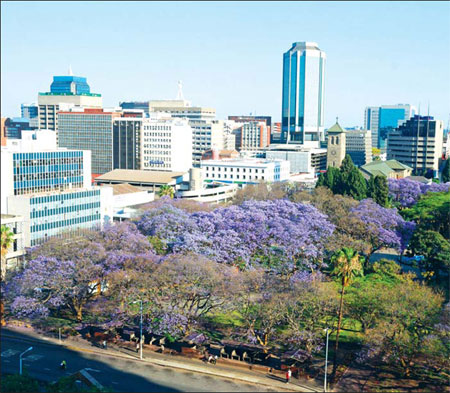
Harare, the capital: a hive of industry and business Provided to China Daily |
While the 2008 peace agreement has been instrumental in raising Zimbabwe's international standing and creating a new beginning, forward-thinking Minister of Finance Tendai Biti has been busy implementing the short-mid term economic recovery plan.
First came the multicurrency move, which has successfully paved the way for injections of foreign cash to help develop the country. Secondly, he adopted cash budgeting, to avoid a budget deficit.
"I created this phrase, 'eat what you kill', he says. "Failed economies have the common element of overspending, and you cannot live beyond your means. There is a problem of stagnant accumulation, so our policy in Zimbabwe is to eat only what we kill."
The third measure, he explained, was restoring a regime of positive interest rates.
"For the past 50 years, Zimbabwe has fostered low rates of interest in order to keep the cost of money low. We had no savings and it was a disaster. So I restored the regime, liberalizing the interest rates and pegging it to supply and demand. I also liberalized the capital markets and the current account, so now it is possible to take as much money as you want from Zimbabwe.
"It was a necessary element because our economy was stagnant due to excessive controls, but I created a surplus for the first time in years. I also reopened the Stock Exchange in February 2011 after three years.
"The greatest thing we have done for the Zimbabwean economy is to maintain policy consistency. Capitalism needs trust, so I restored our credibility. Now people trust us and the economy has been stable for the first time in 15 years.
"This is not enough however; our country is developing and we need to work hard.
"Jobs are the fundamental connections between growth and development. We are trying to do the best for our people."
By African standards, Zimbabwe's banking system is "fairly decent", according to Minister Biti. Far from the popular media image of Zimbabwe as having a shattered economy, Harare's financial district is bursting with activity as key players implement modern products and services.
"We are urging the banks to create products that will help consumers, such as debit cards and Internet banking," Minister Biti says. "We also need better technology. The logical thing is for the banks to reposition themselves to save a fast-growing economy so that they and their shareholders can respond to economic demands and invest in technology."
Creating synergies
"We also need legislative reform. The global economic crisis mainly involves the banking and financial services sectors so we need new regulations to strengthen those areas. I am therefore in the process of looking closely at amendments.
"We also need to create synergies with other regulators in the marketplace, in the insurance and securities sectors, for example. Connected with that, I am also trying to re-establish the cooperation between banking governments.
"We are trying to make the Victoria Falls area an offshore zone. It is important to attract capital and investors want guarantees on their capital funds. There are important financial reforms that will be put in place in the coming months."
The internationally lauded minister said he would be happy to see more mutually beneficial partnerships take place with China.
"Chinese capital is transforming African economies in terms of infrastructure and as minister of finance, I would like to see the same happen in Zimbabwe."
Mutually beneficial
With more than 15 million customers and approximately 55,000 employees, Old Mutual is one of Southern Africa's most impressive banks. Founded in 1845 in South Africa, and listed on the UK, South African and three other African stock exchanges, Old Mutual has expanded in the last decade through organic growth and strategic acquisitions to provide life assurance, asset management, banking and general insurance in 33 countries.
Luke Ngwerume, former CEO of Old Mutual Zimbabwe, discussed the government's new reforms within an historical context.
"It is reasonable to acknowledge where Zimbabwe was in the past, before the period of economic mayhem," he said. "It was a very sophisticated country, with a sophisticated economy that was performing quite well. The infrastructure was robust, and because of that, we were able to see a quick turnaround and the reinstatement of the country to where it was. The economy was supported by a regulatory framework so the pieces of legislation were there.
"We had always been adjusting our regulatory environment and keeping an eye on what is happening around the world.
"These days, more does need to be done. We are aware that our government is taking care of building a healthy system in conjunction with all sectorial associations, so the regulation is there and will be continuously reviewed to maintain economic growth.
"The policy consistency and the predictability that you put into the system are fundamental to attracting investment, because if people can understand how you are working now, and how you will behave in the future, it will create a much more stable environment for them to make long-term plans and make investments here."
Ngwerume pointed out that even during Zimbabwe's hyperinflation era, which peaked in 2008, when it was reported to be 231 million percent, both the economy and Old Mutual pulled through.
"Zimbabwe has the highest literary rate in Africa," he said. "If people can acquire information and process it, they can take reasonable decisions and they will.
"That situation helped people think and act creatively. Old Mutual was born more than 165 years ago, and has surpassed any number of tough periods, but we have continued to do our job and come out of these difficult situations."
He went on to state the importance of Zimbabwe becoming more competitive.
"We have to understand the core competences and what makes us unique. In effect, Zimbabwe has to rebrand. In the recent past, the world has been looking at us in the wrong way, but now we have to show the entire world who we are, and what we are becoming.
"I would love to see Chinese organizations dealing with Zimbabwean organizations, because at the moment, there are no real relationships between Chinese companies and local ones within this sector. I would like to see the fostering of serious relationships between businesses from both countries, because together we can achieve more mileage; we are closer to the ground and we know how to use resources.
"We are motivated to make profits, but we also know that we cannot make profits if society doesn't benefit. We understand the formula: as Old Mutual, we know that more jobs created in the system means more insurance, savings, mortgages and so forth. So, whatever we do has to create more capacity for demand of the products we supply. That is how I would like to see the Sino-Zimbabwean relationship unfold."
Old Mutual has played a key role in the development of the Zimbabwean economy by making capital available for companies to grow, investing in state enterprises and contributing to various sectors of the economy. With the bank's wealth of experience and assets, Ngwerume believes it should be performing on a higher level now.
"We need to be more macro," he said. "I would like to see big companies using us as a vehicle for their investments because we know where the money should be placed."
Formed in 1991 following the government's bailout of the Bank of Credit and Commerce International Holdings Ltd, the Commercial Bank of Zimbabwe is one of the four largest banks in the country.
A diversification drive in 1997 saw the government sell its shares in the bank in a bid to raise capital, and in 2004, the bank positioned itself to provide a one-stop shopping experience for financial services.
Intensive growth
When CBZ Holdings Limited started operations in June 2005, an intensive period of growth began. Five years later, it recorded an asset base in excess of $540 million, and shareholders' equity in excess of $43.3 million.
The bank is now proceeding to open a partnership with Bank of China, in a wider effort to promote trade between the two countries.
As John Mangudya, CEO of CBZ Holdings Limited, explained: "Our economy needs to be solidified by a relationship between Zimbabwean and Chinese banks. The financial sector is a pillar for business, so at CBZ, we are excellently placed to become an intermediary between the two countries."
The CEO is understandably upbeat about Zimbabwe's financial sector as a whole.
"When we moved from the Zimbabwean dollar to a multicurrency based economy, inflation went down overnight, from 231 million percent to 4.5 percent," he said.
"The environment is now quite good for businesses following the government's reforms. The multicurrency system is the best reform they made: the new reforms will improve things even more."
With the financial arena becoming increasingly competitive, CBZ has stood fast on its core business of providing financial solutions to customers, and was the first to offer products in a foreign currency to its customers.
"Customers associate our bank with an institution suited to their needs," he said. "While others said the system would not be sustainable, we took the risk. We are focusing on providing products that are compatible with the reforms, and our customers are happy and loyal to CBZ.
"We offer a complete service to our customers. Although the group has changed, our main focus is to maintain our leading position in the financial market place."
InFocus provided the story.















