Oil exec's rich experience fuels PetroChina in US
|
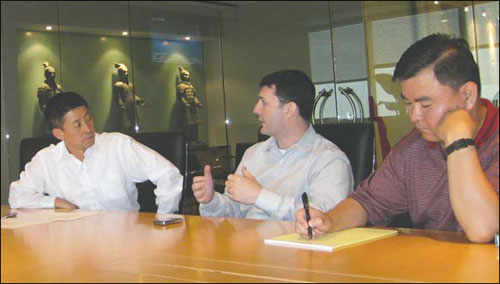
Li Shaolin (lef), president of PetroChina International (America), meets with employees at the energy company's Houston office soon after it opened in 2008. Li moved to the US in 2005. Provided to China Daily |
Li Shaolin has a reputation for being publicity-shy, but he opens up when asked what he's passionate about.
"Most of what you see in this room - the ink in pens, polyester in clothing, the plastic in a computer keyboard - came from petroleum," he points out.
Li, 47, has spent his career with PetroChina Co., the publicly traded arm of State-owned China National Petroleum Corp, which is the country's biggest oil producer by output. For the past seven years, he's been president of PetroChina International (America), one of the company's many overseas branches.
But he got his start working in an oil refinery, learning production inside and out.
Beijing-based PetroChina is the biggest exchange-listed producer of crude oil in the world. Its output of 2.42 million barrels per day in 2011 was about 100,000 barrels more than the daily total of US-based Exxon Mobil Corp. (Exxon still leads the petroleum industry in combined production of crude and natural gas.) At $230 billion in market capitalization, it's the third-most valuable company of any kind, surpassed only by tech giant Apple Inc and Exxon Mobil.
From its base in Jersey City, New Jersey, across the Hudson River from Manhattan, PetroChina International (America) has been engaged, through subcontractors, in refining and distribution of oil and oil products since late 2003. The company buys crude, has it refined into gasoline, diesel oil, fuel and other products, and transports these across the United States and to other countries.
Beyond New Jersey, PetroChina in 2008 opened an office in Houston where employees are mainly involved in buying and selling oil contracts daily. Between the traders in Texas and its headquarters staff in Jersey City, the US branch of PetroChina employs about 60 people.
Having a US presence is crucial to PetroChina's business due to the time difference with Asia. Li said 80 percent of the company's US work force is American. One of them, Vice President Jonathan Novitsky, has been with PetroChina International (America) for eight years.
"China is behind Western countries in going global by 50 to 60 years," Li said. "In the last 30 years, Chinese businesses began to go abroad, and during the last three decades, China has grown very quickly.
"We need to be close to our customers and competitors. The market changes over time. Our objective is to predict the future market. Of course, nobody can predict the future but we want to be as close to our predictions as possible."
While no prognosticator is perfect, Li says he isn't afraid of the unexpected. He has learned that success is about making the best out of whatever circumstances life presents.
Before arriving in the US in 2005, he had been living in Xinjiang, a sparsely populated autonomous region of northwestern China, where things were much different from his hometown in Xi'an. He didn't imagine he would one day be running PetroChina's US operation. In fact, when the English-literature major graduated from Xi'an International Studies University, he didn't have a clue what he would do.
As Li put it, it was a stroke of luck that he came to the oil company.
"I went to Xinjiang to avoid the fate of being a teacher. It just happened that way; I didn't see that going to Xinjiang would lead to all this," he recalled.
At the time Li graduated in the 1980s, young Chinese weren't allowed to choose a career but were assigned a job. When his university teachers suggested that he become a lecturer, the young man objected. His father and both grandfathers had been schoolteachers, and Li wanted to take a different path.
"You weren't supposed to say no, but as vice president of the student union, I was on good terms with my teachers. I told them I would be willing to do anything but be a teacher."
With all of his classmates already employed and Li waiting for a job to materialize, he was told that an oil refinery in Xinjiang needed help. At that time, the region was considered dangerous. Li didn't know the refinery was associated with PetroChina or what his prospects would be, but he packed his bags and prepared for his new life. He remembers bringing lots of candles with him, thinking electricity might be in short supply in the remote region.
Little did he realize he would stay on for 15 years in Xinjiang. Life wasn't easy. He worked long shifts and often traveled to neighboring Kazakhstan to sell polyethylene (the most common plastic used in packaging, bags and bottles) to local factories. During those trips east - beginning when Kazakhstan was part of the Soviet Union - he would stay two to three months, and eventually learned to speak Russian.
Nine years later, Li was promoted to general manager of the refinery's import-export company. He felt lucky. Most of his superiors had spent their careers at the refinery without a promotion, much less a chance to see life beyond Xinjiang. Five years after becoming general manager, the head of PetroChina International asked Li to go to the United States.
"I didn't plan it," he said. "If this thing hadn't happened, I would have had to spend the rest of my life in Xinjiang, but my personal wish is for my son to have a US education, and now it's been fulfilled." His son, who is 18, is enrolled at New York University this fall.
Li recalls that when he arrived in the US in February 2005, he set a goal for the new office: Plant a Chinese flag in the soil, symbolizing eventual ownership of a refinery or participation in a joint venture with a North American company.
"Having our own oil refinery will help us to plan things ahead. We won't have to keep looking for processing options in Los Angeles, Houston or elsewhere."
"I don't think we will face any constraints from the US government the way Huawei did - we are in a very different kind of business," he said. Huawei Technologies Co was blocked by US regulators in 2008 from taking over networking business 3Com Corp over concerns that the Chinese company was too close to China's military.
Another goal for Li is to increase PetroChina's US trading volume. Currently, its oil business represents a small fraction of Americans' oil consumption.
By March 2013, the company will add 12,500 square feet to its Houston offices and increase the number of traders there to about 40 from 15, said Li. He recalled that when the premises were opened in August 2008 there were only three employees - trader Chris Nelson, Novitsky and himself.
While it won't be easy to find a local partner with the same objectives, Li hopes to land the first US investment for PetroChina International (America) between the end of this year and December 2013.
Li, who doesn't seek the limelight, has a quiet confidence about him. He compares himself to an animal - one that might not instantly come to mind when describing a business executive's positive attributes but matches his birth year in the Chinese zodiac.
"A low-lying snake may be invisible to the eye, but it is always observing its surroundings quietly," he said. "Once it sees its opportunity, it launches into action immediately."
atung@chinadailyusa.com