


Photovoltaic industry powering ahead
|
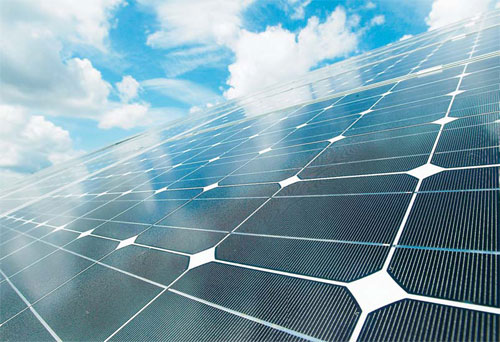
China controls 70 percent of the world's solar panel production and exports nearly 90 percent of its products to the eurozone and the United States. However, Chinese companies are starting to look to the domestic market as a result of the shrinking overseas markets. Provided to China Daily |
Just nine months after the United States initiated an investigation against China's solar panels industry, Europe - the largest buyer of Chinese solar products - is likely to start another round of a trade war with Chinese manufacturers.
German company SolarWorld AG has filed a petition with the European Union to request an anti-dumping investigation on solar products imported from China.
If the EU follows the US precedent and launches an anti-dumping investigation, the Chinese solar industry could suffer a serious blow, according to a joint statement issued by more than 30 Chinese companies.
The statement underlined the fact that the domestic market - despite its promising potential - is not an immediate alternative for local companies.
But things might change as the Chinese market develops.
The challenges faced by China's solar industry mirror the ones faced by Peng Xiaofeng, the founder of Jiangxi province-based LDK Solar.
The New York-listed company made Peng the fourth-richest man on China's Hurun Wealth List in 2008, when he was only 33 years old. LDK Solar used to be ranked No 1 in Asia for its wafer production capacity.
Today, the company is still No 1 in the industry, but now for the amount of debt it holds on its balance sheet. And bankruptcy rumors have plagued it recently.
Chinese manufacturers export nearly $2 billion worth of solar panels annually to the US. And nearly 60 percent of China's solar exports - which are worth $35.8 billion - were shipped to the European market in 2011.
While eurozone demand is shrinking due to the debt crisis and subsidy cuts, the US is imposing punitive tariffs, as high as 250 percent, which may block some Chinese companies from the market.
Weakening external demand and a small domestic market have left Chinese solar manufacturers struggling. Major players, including Suntech Power Holdings, LDK Solar and Yingli Green Energy Holding, all posted bigger-than-expected losses in the first quarter of the year.
But Chinese companies are starting to look to an expanding domestic market as a result of the shrinking overseas markets.
Promising market
According to an estimate by US-based researcher NPD Solarbuzz, only about 70 percent of China's solar modules production will be exported this year, down from 95 percent in 2010. Exports from Hebei province, one of the major solar manufacturing bases and the home of Yingli, decreased by one-fourth in the first half of the year.
A vast Chinese market is a vital source of demand for the country's makers of renewable-energy equipment.
"China will become the world's largest solar market in the next two to three years," said Wang Yiyu, Yingli's chief strategy officer.
Last year, China overtook Japan as Asia's biggest solar market, and its growth is likely to continue. Some 3,000 megawatts of solar facilities will be installed in China this year, up from about 800 mW in 2010, Bloomberg New Energy Finance reported.
NPD Solarbuzz is even more optimistic, predicting that the country will add about 5,000 mW of solar capacity in 2012. With European governments considering further cuts in subsidies, China might even finish the year as the world's largest solar market, ahead of today's leaders, Germany and Italy.
Industry targets have been laid down and subsidies splashed out.
The growth of the photovoltaic industry in China has been supported by a positive policy environment, which is now acting as a solid foundation for increased adoption of the photovoltaic technology.
Key incentive policies in China include both feed-in-tariff mechanism and government rebate programs.
FIT is a policy mechanism designed to accelerate investment in renewable energy technologies. It achieves this by offering long-term contracts to renewable energy producers, usually based on the cost of generation of each technology.
And the central government is continuing to work on new incentive schemes, such as the Renewable Portfolio Standard Management Measures and the Distributed Generation Management Measures, which could be rolled out during 2012, according to the research note by Ray Lian, senior analyst at Solarbuzz.
Since last year, China has started using FIT to guarantee the prices that utilities must pay solar power producers for their electricity. The program guarantees solar developers a payment of 1 yuan per kilowatt-hour, or 1.15 yuan per kWh in some cases depending on the timing and location of the project.
Ambitious targets
Meanwhile, the Golden Sun program was launched in 2009 to boost China's use of solar power. The country approved 1.7 gigawatts of Golden Sun projects this year, up from the 1 gW originally planned. The government is likely to add another 1.2 gW of projects under the program this year, in order to boost the domestic market, industry experts estimate.
The government also doubled surcharges on power sales to 0.008 yuan per kWh in order to subsidize renewable energy power generation.
The National Energy Administration has also decided to quadruple the country's 2015 solar energy target to 21 gW.
At the provincial level, many governments are accelerating solar installation projects. For example, Northwest China's Gansu province set the most ambitious target among all the regions, with 5,000 mW of solar capacity to be installed by 2015.
Boosted by the positive momentum, Yingli Solar said it plans to sell 2,500 mW to 2,600 mW of solar panels in 2012, including 900 mW in China. If the goal is met, China will become the company's largest market for the first time.
The company expects domestic sales to contribute 35 percent to revenues next year, up from 6 percent in 2010.
Solar panels makers are also building solar farms since panel prices plunged recently. Running such operations has become more profitable than manufacturing the equipment.
Suntech Power Holdings plans to develop 100 mW of solar projects in Hainan province. Other companies that plan to build solar farms in China include Yingli, Canadian Solar, LDK Solar and JA Solar.
Chinese photovoltaic installed capacity is still quite small compared with wind power development, which is the largest in the world with 62.7 gW of installed capacity as of 2011, or 25 percent of the world's total.
China's installed solar capacity was about 3 gW in 2011, according to figures from the NEA, which is 10 percent of the world's total.
The development of the wind industry may provide a template for how large-scale solar development may unfold in China.
As the wind industry process showed, the Chinese government is prepared to scale renewable development aggressively once the technology reaches a price point that it considers appropriate, and when local manufacturers and developers can competently fulfill the government's growth targets.
Overcapacity looming
After the central government asked local governments to save energy, reduce carbon emissions and develop high-tech industries, the local governments have been eager to develop the solar industry in their regions in the past few years. The photovoltaic industry happens to meet all those requirements.
More than 300 Chinese cities are making efforts to develop the solar photovoltaic industry, mostly driven by short-term interest, leading to the issue of overcapacity in the sector, said an official from the NEA who declined to be named.
Overcapacity in the polysilicon sector - a key material in the production of solar panels - led to 80 percent of the plants shutting down this year.
"There are more than 2,000 companies in the country's photovoltaic industry, half of which are focusing on producing solar products," according to Shi Lishan, deputy director of the New Energy and Renewable Energy Department with the NEA.
China controls nearly 70 percent of the world's solar panel production capacity and exports almost 90 percent of its output to Europe and the US. In comparison, Chinese companies only account for about 8 to 10 percent of the global solar products value chain.
Over the past eight years, the price of solar products has significantly dropped due to the development of solar technology in China. The cost of solar modules has been lowered to $1 per watt. The solar cells conversion rate has continued to increase, rising from 14 percent to 19 percent.
The investment return of downstream businesses - solar farms - is around 8 percent now, which is relatively good, industry players said.
Challenges ahead
Meanwhile, the challenges the wind power industry now faces could be the next hurdle for solar power development.
Roughly 25 percent of China's wind power isn't connected to the power grid due to limitations in the grids' capacity to transmit power from the distant regions where the power is generated to the power consuming areas. Also, local grids lack the ability to absorb wind-generated power, which can be quite unstable.
The less populated western part of China - which has more sunshine hours per year than other regions in the country - is the major destination for large-scale solar power projects.
In terms of installed capacity, China's top 10 solar power producers are: Qinghai, Ningxia, Gansu, Shandong, Jiangsu, Hebei and Shaanxi provinces and the Inner Mongolia, the Xinjiang Uygur and the Tibet autonomous regions. Those provinces and regions account for almost 90 percent of the country's output. Seven of those provinces and regions are in western China.
Located in Northwest China's Qinghai province, Golmud has been labeled the Photovoltaic Capital of China due to a series of large projects. One example is a 200 mW project by CPI Huanghe Hydropower Development Corp.
The province vowed to approve 1 gW of solar farms this year - one-third of the country's newly added capacity, an aggressive target that has raised concerns.
Solar power rationing has happened twice over the past year in Golmud, partly because the local grid was unable to absorb the solar-generated power, causing millions of yuan in losses for local solar farm developers.
In 2011, China's connected solar capacity was 2.12 gW, or nearly 70 percent of the installed capacity, according to the China Electricity Council.
"The grid infrastructure in the western regions is not adequate to support solar connections," said Zhang Qian, a senior official at Canadian Solar. "More transmission lines need to be built."
Electricity needs to be transmitted to the grid before being distributed, which requires companies to convert solar power into high-voltage electricity.
"This process adds more costs," said Lian of Solarbuzz.
Therefore, electrical grid companies are reluctant to connect solar power into their systems.
The central government started subsidizing grid companies in 2012 in an effort to encourage them to bring more renewable energy into the country's power system.
However, the subsidies only cover part of the costs, according to Jiang Liping, deputy director of the Energy Research Institute, which is affiliated with State Grid.
More costs may occur as local governments start to tax the land for the projects, and getting the limited approvals is becoming expensive.
Most developers are State-owned power companies, such as China Huaneng Group, China Huadian Corp, Datang International Power Generation Co, and China Power Investment Corp.
A few private developers such as Hanergy and Astronergy are also involved in the business.
For now, the issues do not seem urgent as installed capacity is still limited, but they might hamper the development of the solar sector in the future.
Solar power integration could become a more serious issue that it was for the wind power industry when applications scale up because solar power requires more flexible technology, according to Bai Jianhua, chief economist of the Energy Research Institute.
Another 35 gW of solar projects are in the pipeline, according to Solarbuzz's estimate.
But China wants solar power to be a real alternative to traditional power plants by 2015, which means that the price of solar power can be comparable to traditional power sources.
And despite a recent adjustment in renewable energy policies, the country is still committed to develop clean energy, with unprecedented investment flowing into the sector.
In the second quarter of the year, the country led clean energy investment with $18.3 billion, a 92 percent increase compared to the first quarter of last year. The largest Chinese PV project financed recently was the Shanlu & Shengyu Bayannur Wuyuan plant, with $316 million, Chinese media reported.
liuyiyu@chinadaily.com.cn















