


Covering your tracks for internet privacy
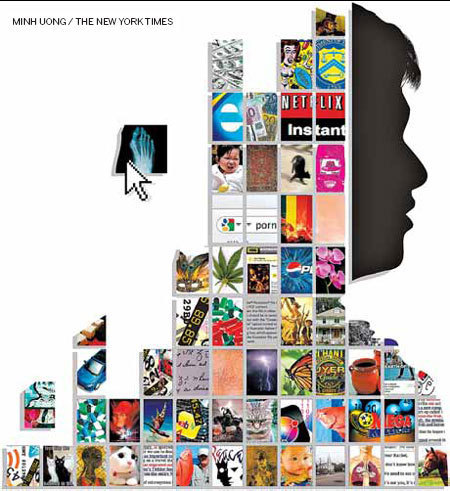
While it's probably impossible to cloak your online activities fully, you can take steps to ensure more privacy. The trick is to find the right balance between cost and convenience.
There are hackers hanging around Wi-Fi hot spots, to be sure. But security experts and privacy advocates said more worrisome were Internet service providers, search engine operators, e-mail suppliers and Web site administrators.
And if a single entity acts in more than one capacity, like Google, Yahoo, Facebook and AOL, they can easily match your e-mails with your browsing history, as well as figure out your location and identify the devices you use to connect.
"The worst part is they sell this extremely creepy intrusion as a great boon to your life because they can tailor services to your needs," said Paul Ohm, an associate professor at the University of Colorado Law School in Boulder who specializes in information privacy and computer crime. "But do most people want to give that much away? No."
He advised logging off sites like Google and Facebook as soon as practicably possible and not using the same provider for multiple functions. "If you search on Google, maybe you don't want to use Gmail for your e-mail," he said.
If you do not want the content of your e-mail messages examined or analyzed at all, you may want to consider lesser-known free services like HushMail, RiseUp and Zoho, which promote no-snooping policies.
Or you can forgo trusting others with your e-mail correspondence altogether and set up your own mail server. It is an option that is not just for the paranoid, according to Sam Harrelson, a middle-school teacher in Ashville, North Carolina, who switched to using his own mail server this year using a $49.99 OS X Server and $30 SpamSieve software to eliminate junk mail.
"The topic of privacy policies and what lies ahead for our digital footprints is especially fascinating and pertinent for me, since I work with 13- and 14-year-olds who are just beginning to dabble with services such as Gmail and all of Google's apps, as well as Facebook, Instagram, social gaming," he said. "I have nothing to hide, but I'm uncomfortable with what we give away."
But even with your own mail server, Google will still have the e-mails you exchange with friends or colleagues with Gmail accounts, said Peter Eckersley of the Electronic Frontier Foundation, a digital rights advocacy group in San Francisco.
"You're less exposed," he said. "But you can't totally escape."
Another shrouding tactic is to use the search engine DuckDuckGo, which distinguishes itself with a "We do not track or bubble you!" policy. Bubbling is the filtering of search results based on your search history.
Regardless of which search engine you use, security experts recommend that you turn on your browser's "private mode," usually found under Preferences, Tools or Settings. When activated, it ensures that tracking cookies are deleted once you close your browser, clearing your history.
However, that private mode does not conceal your internet protocol address, which identifies your access point to the Internet, probably letting Web sites know who you are, where you are and when and how long you viewed their pages.
Shielding your I.P. address is possible by connecting to what is called a virtual private network, or V.P.N., such as those offered by WiTopia, PrivateVPN and StrongVPN. These services, whose prices range from $40 to $90 a year, route your data stream to what is called a proxy server, where it is stripped of your I.P. address before it is sent on to its destination.
There is also Tor, a free service with 36 million users. Tor encrypts data and bounces it through a series of proxy servers so no single entity knows the source of the data. The only drawback is that with all that bouncing around, it is very slow.
"Companies like Google are creating these enormous databases using your personal information," said Paul Hill, senior consultant with SystemExperts, a network security company in Sudbury, Massachusetts. "They may have the best of intentions now, but who knows what they will look like 20 years from now, and by then it will be too late to take it all back."
The New York Times















