


A business lesson from the dairy factory
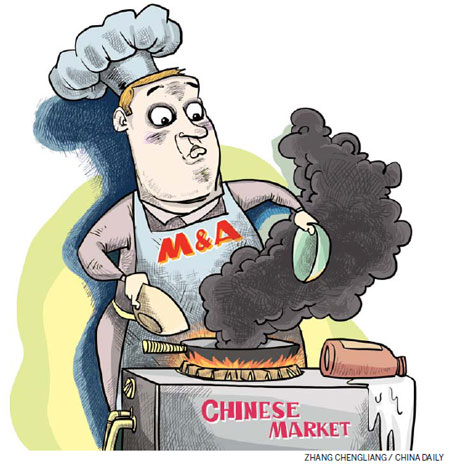
The French food products company Danone recently closed its Shanghai plant, one of its two yogurt factories in China. It represented another failure for the company in China after its failed attempt to build joint ventures with the Chinese dairy and soft drink manufacturers Mengniu, Bright Dairy and Wahaha.
The Shanghai closure shows that the French food giant's plan to operate in the Chinese market as a wholly foreign funded company is not viable and its China adventure serves as a lesson for multinational food makers that rely solely on expansion. They need to rethink their strategies.
The strategies Danone adopted in its global expansion were clearly ineffective in China. By mergers and acquisitions, and equity investments in local companies, Danone transformed itself into a leading global food producer having been a glassmaker. Formerly named BSN, the Danone name comes from one of the companies it bought. Danone now occupies the No 1 spot for fresh dairy products and the No 2 spot for soft drinks.
After entering the Chinese market in 1987 it planned to increase its share in China's food and soft drinks market with the same strategies: mergers and acquisitions and equity investment. But things did not turn out as it had expected. It set up a joint venture with Bright Dairy in 1992, and managed to increase its stake in Bright Dairy from 5 percent to 20.01 percent, and became the latter's third largest shareholder.
Yet its plan of becoming Bright Dairy's largest shareholder was thwarted, as a result of the alarm it incurred in Bright Dairy and in setting up the New Bright Dairy Food Group. The two parted ways in 2007.
Danone began working with Wahaha in 1996. In 2007 the two became embroiled in a trademark dispute, and they parted ways in 2009.
Other partners were Mengniu and Huiyuan, with which Danone worked for one year and three years respectively.
To avert partnership problems with local firms Danone first tested independent operations on its yogurt product line. However, because of poor sales figures it recently closed the Shanghai yogurt factory, one of its two yogurt factories in China, picked up when it bought Miaoshi Dairy in 2007. The acquisition was once regarded as a sign that Danone would go it alone. The company says the closure of the Shanghai plant is an adjustment of its China strategy and that in future it will focus its operation on several key cities.
Danone is not the only multinational corporation that has experienced bottlenecks in developing in China. In November Pepsi sold the shares in its 24 bottling plants to Tingyi, a Taiwan food manufacturer. Pepsi's bottling industry on the Chinese mainland has been underperforming, reporting a $45.5 million post-tax loss in 2009, and $175.6 million in 2010. In December Nestle closed its Shanghai factory, one of its three ice-cream plants in China.
Danone's strategy in China, reliant on the traditional method of capital investment, has proven ineffective. That method has helped it win in many other markets, but it ignored the changing demands of Chinese consumers and the nationalistic pulse. This is why it has encountered obstacles in its merger and acquisitions operations.
For Chinese companies seeking partnership with foreign ones, capital is no longer the determining factor; the major considerations are technological innovation, management and marketing experience. Foreign companies need to understand that Chinese companies hope to retain their original brand and operational independence after they are acquired or merged.
Danone's past behavior in China not only cost it its most important partners in the country, but also tarnished its image, which will impede its future partnerships with Chinese companies. When Mengniu discovered that Danone wanted capital control, it immediately decided that the partnership was over.
Moreover, Danone neither met local companies' expectations for technological innovation and brand upgrading, nor facilitated their development. Robust, a Chinese soft drinks company, fared no better on the market after Danone bought it, and Yili and Shanghai Maling Aquarius faded from the market after Danone bought them.
Danone's localization in China has been incomplete, especially in areas such as human resources, research and development and marketing. Its management members are mainly French who fail to fully understand the tastes and habits of Chinese consumers.
It failed to invest in more research and development in China after setting up a dairy products research center in Shanghai. It took no part in the marketing operations of its local partners, and when partnerships broke up Danone was left high and dry.
Its limited product range, which now consists of four product lines, means it is over-reliant on a few products, whereas its competitor Nestle has 10 product lines covering a wide range of food products.
Furthermore, foreign companies have lost the competitive edge they used to have over their Chinese competitors after changes to investment policies that have stripped them of the preferential treatment that gave them tax discounts and better access to land and capital. Since 2007 foreign companies have been required to pay the same rate of income tax as Chinese companies, and from December 2010, they were asked to pay urban maintenance and construction tax as well as educational surtax. Because of the difficulty in obtaining land, it has been hard for Danone and Nestle to carry out their plans to build new plants to expand their production capacity.
At the same time, Chinese companies, with the advantages they enjoy because of better access to materials and in lower transport costs, have improved their own competitiveness. Mengniu and Bright Dairy all have their own pastures, so it costs Danone a lot more to obtain milk.
Danone's failure in China provides food for thought for other foreign food manufacturers who are pinning their hopes on the same methods to expand. The improved competitiveness of Chinese food manufacturers has made it difficult to acquire or merge with them. What local companies increasingly value are partnerships in technology, marketing and sales channels.
Faced with such changes, it may be helpful for foreign companies to develop a new management model in China and a more diversified, multi-channel expansion. They may need to consider readjusting their product positioning, optimize their product range, or move their factories to second- and third-tier cities with lower costs. Meanwhile, they may keep looking for mergers and acquisitions opportunities with local companies that have better sales channels.
A good example is Nestle, which acquired Hsu Fu Chi, a Chinese sweets company, and successfully expanded into second- and third-tier Chinese cities through the latter's channels. Hsu Fu Chi now has four large production plants and 129 sales outlets throughout the country.
While foreign companies are looking for deals in China, Chinese companies are also looking for opportunities to go international. In August last year Bright Dairy bought a 75 percent of the shares of Manassen Foods, an Australian company, for 397.5 million Australian dollars. COFCO, China's largest food manufacturer and trader, bought wine chateaux in France and Chile, and nearly 99 percent of Tully Sugar, an Australian sugar manufacturer, last July.
The author is a technology and industry analyst at Samsung Economic Research Institute, China. The views do not necessarily reflect those of China Daily.















