


Military spending a necessity
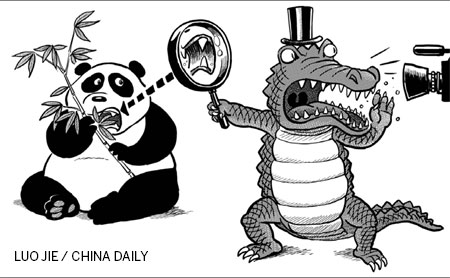
The Western media have already played up China's defense budget growth even before the convening of the annual sessions of the National People's Congress and the Chinese People's Political Consultative Conference.
Jane's Defence Weekly has reportedly claimed that China will spend $120 billion on defense this year and predicts it will soar to $238 billion in 2015, indicating a combined annual increase of 18.75 percent. The report, which says "China's defense spending to double" has drawn worldwide attention amid the changing global balance of power. However, the reports have not mentioned the sources of the data, which downgrades their credibility.
China put its 2011 defense budget at about 601 billion yuan ($95 billion). Were the latest reports right about military spending this year, then the defense budget for 2012 would have increased by more than 26 percent. However, according to China Statistical Yearbook, military spending growth has slowed down in recent years and the growth rate dropped to 7.5 percent in 2010, the smallest rise over the past two decades. The nation may register double-digit annual growth, but the increase is unlikely to exceed the reported combined annual growth of 18.5 percent in the years ahead.
The United States has ushered in a new round of strategic contractions and is rebalancing toward Asia. Some US scholars are so eager to carve out a niche for the US' return to Asia that they accuse China of understating its defense spending, stir up tensions with neighboring countries and drum up the "China threat". They intend to justify the US' return, lobby other countries in the region and draw China into an arms race.
The approach also seeks to find excuses for the Pentagon to maintain high defense spending and help US arms dealers enter the Asian market, since the Pentagon is facing budget cuts as wars in Afghanistan and Iraq and the global financial crisis have sapped national strength.
Despite its economic boom, Asia remains sluggish in building up a solid regional security mechanism, and an effective mediation system to resolve the complex territorial, border and maritime disputes. External forces have stepped in and stoked up an arms buying spree in Asia, and India's planned purchase of 126 French-made combat aircraft is a case in point. The escalation of the arms race will jeopardize unity, mutual trust and the interests of Asian countries.
China, as the region's largest economy, has seen its military development attract regional and international attention.
As the world's third largest country in terms of area, covering 9.6 million square kilometers, 22,000 kilometers of land borders and 18,000 kilometers of continental coastlines, China has plenty of reasons to develop its defense capabilities.
The improved livelihoods of soldiers, diversified military operations at home and abroad and regeneration of equipment are key factors for military spending growth.
Chinese people can share the fruit of economic development and its 2.3 million soldiers should be no exception. The defense budget should cover expenses such as pay increases and training and the army would benefit from a fast-developing social security system.
Besides with more international responsibilities, the army should conduct diversified military operations, including joint military drills aimed at anti-terrorism and other non-war military operations such as rescues during natural disasters and escort missions in the Gulf of Aden and off the coast of Somalia. All missions at home and abroad come at a high cost.
Weaponry regeneration also inflates military spending. The Chinese army is advancing military modernization, along with research and development of heavy weapons such as the fifth-generation fighter and aircraft carrier, which is time-consuming and expensive.
However, the Western media focus on weaponry developments, while ignoring two other factors. China has many soldiers that even a slight pay increase will cause bulging defense spending. The West should stop over-painting defense budget increases and making a fuss over "China's military expansion".
China has shown restraint in not developing tactical nuclear weapons and pursuing a doctrine of minimal nuclear deterrence. The country issued a white paper, China's National Defense in 2010, pledging that, "China pursues a national defense policy which is defensive in nature" and "will never seek hegemony, nor will it adopt the approach of military expansion now or in the future, no matter how its economy develops". The nation will never follow the path of Soviet Unions and the US to involve itself in any kind of arms race.
Nevertheless, we should admit that published figures concerning the defense budget is not detailed enough. The country is pressing on with a campaign to make public san gong expenses, namely money spent on overseas trips, receptions and vehicle purchases and maintenance by government officials. It is an irreversible trend that the country will tighten supervision over military spending, too.
The international community should keep patient and realize that progress takes time and China should phase in bolder measures to ensure military transparency to crush rumors circulating about its defense spending.
The author is secretary-general of the China Arms Control and Disarmament Association.















