


Bloated forex reserves drag on economy
Nation must foster more competitive, creative private enterprises, consider appreciating the yuan
| ?
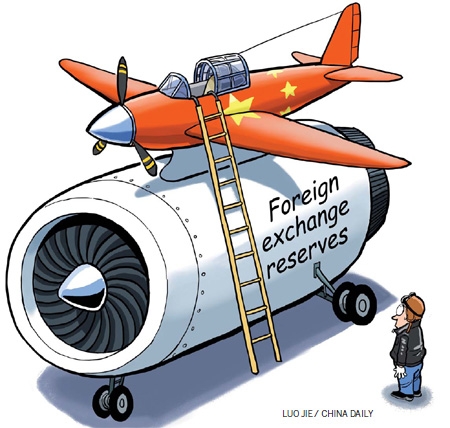 |
China has been facing growing challenges in managing its huge foreign exchange reserves, estimated at around $2.8 trillion (1.96 trillion euros) by the end of last year.
With forex reserves up over $3.2 trillion by the end of June this year, policymakers have to figure out how to effectively manage it.
Between 2001 and 2010, foreign exchange entered China largely by way of direct investment and in the form of trade surplus since the economy was largely reliant on foreign trade. The foreign trade to gross domestic product (GDP) ratio rose from 38 percent in 2001 to nearly 63 percent in 2010.
One reason why China's forex reserves have grown so rapidly is the fact that China is situated at the bottom of the "smile curve" of industrial chains.
What this means is that as long as China is able to maintain a relatively low cost manufacturing model, it will continue to create additional foreign exchange reserves.
Foreign investors will continue to bring in large amounts of foreign direct investments and foreign companies in China will continue to have trade surplus.
But the flip side of this is that if China continues to be weak in the industrial chain, apart from manufacturing, it will lack the ability to deploy its huge foreign exchange reserves effectively. The most efficient and effective use of foreign exchange reserves is to use it as direct investments outside the country.
Unfortunately, it seems that China will continue to remain at the bottom of the "smile curve" of industrial chains for some time, thereby making foreign exchange reserves management a tough task.
Since the 1990s, China has put forward economic transformation as a prominent task in every five-year plan. But there has not been any reform in the management of forex while China has embraced foreign investment wholeheartedly. This has worked against private enterprises.
Being situated at the bottom of the "smile curve" of industrial chains, the foreign investment has not brought much advanced technology or mature management experiences.
This pattern of the economy, driven mainly by foreign trade and government investment, is strengthening year after year, as witnessed in the continuous decrease of the China consumption-GDP ratio, which declined from 45 percent in 2001 to less than 34 percent in 2010.
The burgeoning foreign exchange reserves are also based on high pollution, high labor intensity, low-production technology and low-margin production. China has paid a heavy price for it, and hence needs to make good use of it.
Although this situation is expected to continue for some time, China must soon start to make improvements to the existing pattern.
What this has also indicated is that China is not efficient in using its money, be it foreign exchange reserves or the renminbi. This inability to use money efficiently also explains many of the current problems.
For example, it explains why China, despite its huge forex reserves needs considerable foreign direct investment every year. The inefficient management of forex reserves has also led to foreign investors occupying the most profitable parts of the industrial chain and having only their manufacturing in China.
Currently the Chinese government has to invest most of its foreign exchange reserves in low-yielding foreign debt purchases that have huge devaluation risks. In contrast, foreign companies can invest their funds in China thereby earning higher returns, illustrating further the embarrassing situation of China's forex reserves management.
State-owned enterprises can play a key role in effectively utilizing the forex reserves by cashing in on the demand for infrastructure construction, especially in Africa. State-owned enterprises should have the confidence to invest hundreds of billions of dollars in Africa to help lift the Chinese industry.
China also needs to develop private companies that are competitive as they are more creative and dynamic in using the foreign exchange reserves in the long run.
To liberate the productive forces of private companies, the State-owned enterprises should withdraw from the competitive fields of industries and the government should give more incentives to private companies.
Of course, for those private companies which are mature enough and have the confidence to go out, the government should encourage them to go abroad to invest.
China should also transfer from an externally dependent economy to an internally dependent one. To stimulate the transition, China should discuss the possibility of accelerating the pace of currency appreciation to give export-oriented enterprises more external pressures.
The central government should also support industrial transfer from eastern China to central and western regions.
Finally, China needs to continue to improve its sovereign fund management. For many reasons, a government should hold a proper amount of foreign exchange reserves, but it is a challenge to both make considerable gains and keep market risk and liquidity risk under control. There are experiences of other countries China can refer to, such as about how to increase transparency, and about how to have more legislation.
The author is a research fellow at the China Europe International
Business School Lujiazui International Finance Research Center. The opinions expressed in the article do not necessarily reflect those of China Daily.















