


How did China get into this local debt problem?
|
 |
To tackle the effects of the 2008 global financial crisis, China announced a 4-trillion-yuan economic stimulus package (432 billion euros) but as we have now learned, the final scale of the stimulus package went far beyond that. Chinese banks issued a record 17.5 trillion yuan in loans from 2009 to 2010, most of which went to local governments.
After 2008, when local government debt stood at 2 trillion yuan, the total amount of local debt increased by 5 trillion yuan by 2009. According to the National Audit Office (NAO), at the end of last year, the balance of local government debt nationwide stood at 10.7 trillion yuan.
Worries over the amount of local government debt are fueling speculation that the Chinese economy will fall into a recession or hard landing. On June 22, Zhu Xialian, senior director with Fitch Ratings (Beijing), said that the worst-case scenario is that the ratio of bad loans from banks will climb to 15 percent.
But how did China get into this mess? There are several reasons for the huge amount of local government debt.
First of all, we're not even sure what the total amount of local government debt really is. It is difficult to get accurate statistics about local government debt and about local financing platforms, or products. According to the NAO, only loans that are directly related to government debts should be audited.
The Ministry of Finance, the National Development and Reform Commission, the People's Bank of China and the China Banking Regulatory Commission jointly issued a notice in 2010 to define local financing products as economic entities established by local governments and their departments by way of financial allocation or contribution of lands, equities or other assets. These financial products fund projects invested by the local governments.
In my opinion, the NAO's definition of local financial products is narrow. Enterprises that are not guaranteed by local governments but controlled by them should also be included.
According to the NAO, by the end of last year there were 6,576 local financing products while the central bank's report shows that there are more than 10,000, up by 25 percent compared to 2008 totals. Financing products in counties (including county-level cities) take up about 70 percent of the total.
Second, loans of these local financing platforms are very risky. These financial resources are mostly owned by local governments and are not real commercial organizations. They are not managed well and the people who work for these resources or entities have a poor sense of risk and responsibility. Local governments are also not held responsible if these financial resources default. What's worse is that these entities say they have the backing of the local government but are vague about details. Many local governments also don't have any safety nets for bankruptcy issues, so it is difficult for creditors to recover their loans through legal channels.
Liu Mingkang, chairman of the regulatory commission, says that at the county level, a large number of loans are not properly handled.
The commission's statistics show that in 2010, of the 7.66-trillion-yuan balance of local government debt, a score of loans that amount to 2 trillion yuan are rife with problems, such as unclear debtors, difficulties in repayment and capital embezzlement. The cash flow of another 4 trillion yuan is insufficient to cover the principal and interest.
Third, if local banks stop lending, bad debts occur. If they continue lending, the scale of future bad debts will likely grow.
The NAO's report shows that there is 8 billion yuan in overdue debt for 148 financing companies set up by local governments, more than 5 percent of which are refinancing loans.
Fourth, paying off these loans through land sales or transfers poses a great risk. The NAO report indicates that there is 2.55 trillion yuan in debt that is supposed to be repaid by revenues from land transfers. But there is no way that the total revenue from land transfers in 2009 and 2010 can pay off all these loans and the logic that banking on rising property prices to pay off the debt is flawed.
In the late 1990s, the rate of bad debt in Chinese banks reached 30 percent. The argument that "China will soon collapse" was rampant. To rescue the banking system, in 1998 China issued 270 billion yuan in special government bonds to supplement capital funds of State-owned commercial banks; in 1999 and 2000, four asset management companies were established and 1.4 trillion yuan in nonperforming assets were stripped from the four State-owned banks. By 2006, the accumulated amount of nonperforming loans had reached 2.8 trillion yuan. Even now, the four asset management companies have yet to clear all of their nonperforming assets.
The main reason for the nonperforming assets in the 1990s was the government's intervention into banks and confusion over the banks' policy-related businesses and commercial businesses. To resolve this problem, the central bank vigorously promoted the reform of the banking system, introduced strategic investors and listed banks successfully.
The recent nonperforming assets crisis indicates that the Chinese banking system still needs to be reformed.
It is up to the government to effectively decide the assignments of top Chinese banking officials. China's bankers are essentially quasi-officials. They not only have administrative rank, but also change roles frequently between managing commercial banks as well as government departments.
Local governments are strongly going after both vanity projects and GDP growth. In the past they had to work hard to get permission for large-scale projects, but now the stimulus plan has provided a good opportunity for them to launch such projects.
Past experiences indicate that large projects have a risk of developing into the tools for officials to seek benefits. Some government officials are corrupt. The NAO report also says that 351 billion yuan in local government debt has flowed into either the stock market, real estate or other large projects.
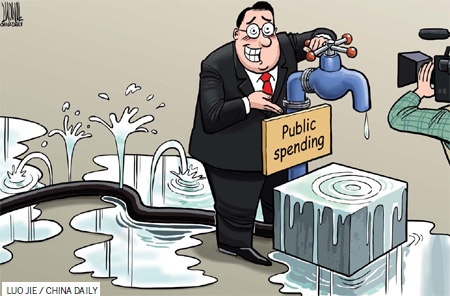
The root cause of the massive local government debt is the local governments' impulse to spend money without restraint. Under the current system, the local people's congresses cannot prevent local governments from spending money frivolously. We should learn from the US model of "small government, big market" where politicians vigorously advocate cuts in taxes and government spending.
Efficient public supervision is also not enough in China because of the lack of financial transparency. In the United Kingdom, lawmakers and officials would get into trouble, and likely be forced to resign, if they wrongly claim even small amounts of personal spending.
Large-scale local debt is the price that we are paying for the economic stimulus measures and it reveals two major problems: Most banks still need further reform; and local governments should control their desire to spend. Otherwise, the 4-trillion-yuan package will be in vain and local governments will get into bigger trouble.
The author is deputy director of China Europe International Business School Lujiazui International Finance Research Center. The opinions expressed in the article do not necessarily reflect those of China Daily.















