


Accelerate balanced development
Government should make more efforts to reduce the gap between rural areas and cities in education
|
 |
Balanced development of compulsory education is an integral part of the education reform and development plan made by China in 2000. Though great progress has been made in this regard since 2006 when the Compulsory Education Law was amended, a lot of problems remain to be resolved.
The compulsory education law is based on three globally recognized principles - mandatory, free and non-discriminative. Currently, there are more than 170 countries that have adapted the compulsory education system, free of charge to all children.
Free compulsory education was adapted by China in 1986 with the passing of the Compulsory Education Law. But primary and secondary schools were allowed to charge some fees, considering the then domestic situation - government grants were not enough to cover the cost of public schools. The revised Compulsory Education Law in 2006, however, forbade any charges in public schools.
The 150 million primary and secondary students in rural areas began to enjoy complete free compulsory education from 2007. The system has been expanded from western to eastern areas, and from rural to urban centers.
Of the countries providing compulsory education, only 20 or so provide free textbooks. China ranks among the countries with high levels of compulsory education.
However, a more complicated issue is the development mode of compulsory education. One mode is welfare-orientated public schools, which are popular in most European and Arabian countries. The government covers all the expenses of public schools. It is rare to see a private primary or secondary school in those countries. Free education in those countries even covers preschool and college education.
The second mode is a combination of public and private schools to meet different people's needs. For instance, in the United States, governments first secure adequate public education services by tax revenues and then allow private schools to meet the demands of people in different classes.
No matter which mode a country adopts, the balanced development of compulsory education is directly related to the policy to promote equality. A common characteristic of the policies in different countries is that governments cover all the expenses of public schools, offering compulsory education that is free on different levels, and guaranteeing equal education opportunity to all children. Meanwhile, some countries also give people of higher income other choices to pay extra money to go to private schools.
The government revenue covers all the expenses of compulsory education in China, according the newly revised Compulsory Education Law. Children from poor families in rural areas can get extra financial assistance during their primary and secondary years.
The implementation of the new policy has resulted in different attitudes among people in rural areas and cities.
A recent survey indicates that the policy has found favor with farmers from the western region. Originally, farmers with low income had to tighten their belts to pay their children's textbooks and tuition fees. Now the policy eliminates this burden. Although the school conditions and the quality of teachers in rural areas lag far behind those in cities, farmers are happy with the policy.
In urban areas, however, high-quality education resources are centralized in several public schools. Although the compulsory education policy allows children to go to the school in the region where their hukou (household registration) are registered for free, many of their parents hope their children can go to better ones, which usually charge more than 10,000 yuan (1,100 euros) for school selection fees. For urban parents, the better thing than saving several hundred yuan for textbooks and tuition fees is the lowering of school selection fees.
The school selection issue was in the spotlight in 2009 when the Ministry of Education sought public opinion for the 2020 national education reform and development plan.
As President Hu Jintao once said, education is important for each family and it will benefit future generations. It represents the important principle that development is for the people, by the people and with the people in sharing its fruits. High-quality education is one of the most important and most urgent issues, for which people need solutions.
Since the adoption of the reform and opening-up policies, China's education has made great achievements. Opportunities for school-age population to go to school have grown rapidly. The national compulsory education policy has achieved ground-breaking progress, especially since the beginning of the 21st century.
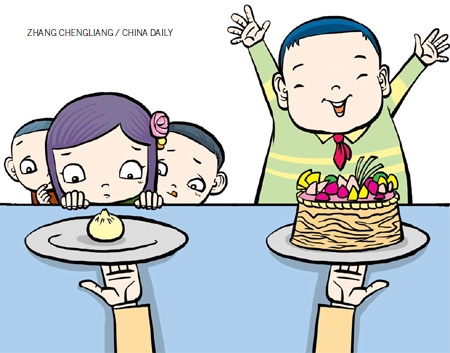
However, from an overall perspective, high-quality education resources are still far from satisfying the demand. There exists a large gap between rural areas and cities in the quality of teachers and school conditions. It still lacks effective regulations on the allocation and use of public education resources. School selection problem is always one of the major complaints about the inequality in education.
Therefore, to advance the balanced development of education, including finding an effective solution to public school selection problem, has become increasingly important for the scientific development of education. The government should fulfill its obligations and responsibilities, making the promotion of education equality as a basic national education policy.
At present, the education authorities should speed up closing the gap between public schools in cities and the countryside. This will involve a series of policy problems, such as ensuring that the government funds are granted in full and on time, solidifying the present achievements of free education, standardizing the construction of public schools, quickening the reconstruction of weak public schools, canceling what is called key schools or key classes, planning public schools scientifically based on the progress of urbanization, increasing the teaching aids for urban teachers at rural schools, training quality teachers and trying the mechanism for headmasters and teachers in different areas to communicate periodically.
In the long run, teachers in public schools are supposed to be managed in the way of managing civil servants, whose performance will be taken as a yardstick for their pay rise and promotion. As for school selection problem, each place needs to make overall planning based on local situation.
As a mater of fact, there is no shortage in the number of policies related to the balanced development of compulsory education. The key thing is whether governments and education departments on different levels are serious about carrying out these policies.
In recent years, some provinces and cities have made preliminary achievements in promoting balanced development of compulsory education within the regions. Beside the measures mentioned above, there are other policies to meet local demands, including forming cooperation relationships between quality public schools and weak schools.
In November 2009, the Ministry of Education held a national conference on advancing balanced development of compulsory education, and giving proposals to the making of the outline for 2020 education reform and development.
State Councilor Liu Yandong delivered a speech on optimizing resources, promoting equality and accelerating the balanced development of compulsory education. She marked the advancement of the balanced development of compulsory education as a strategic task that will meet people's demand for equal opportunities to high-quality education and the demand of national modernization.
To achieve a balanced development of compulsory education, China should explore its own ways of development while taking as references international practices. The country should also use the chance of drafting the 2020 education reform and development plan to promote compulsory education.
The author is head of the National Center of Education Development and Research under the Ministry of Education.















