-
News >World

Higher radiation found outside Japan nuke plant
2011-03-31 13:16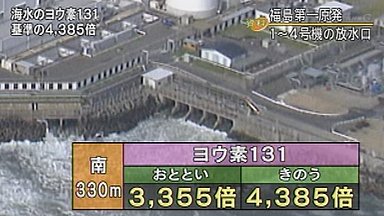
Japan's Nuclear and Industrial Safety Agency says 180 becquerels per cubic centimeter of radioactive iodine-131 has been detected in seawater sampled on Wednesday at a location 330 meters south of the troubled Fukushima Daiichi nuclear plant.The level is 4,385 times higher than the legal standard, and far above the 3,355-times level detected on Tuesday.[Photo/Agencies]
TOKYO -- New readings show radiation levels continue to rise in the ocean outside a leaking nuclear plant in Japan's northeast, officials said Thursday, as they debated whether to broaden the evacuation zone around the tsunami-damaged facility.Japan's Nuclear and Industrial Safety Agency said it was looking into a report from the UN tomic agency about high levels of radiation in the village of Iitate, 25 miles (40 kilometers) from the plant in Fukushima prefecture.
The International Atomic Energy Agency said the level in one spot tested in Iitate was twice its suggested threshold for evacuation.
NISA spokesman Hidehiko Nishiyama said officials were checking radiation levels in the village, which lies outside even a voluntary evacuation area 19 miles (30 kilometers) from the plant. He said most residents have left, but about 100 have chosen to stay.
"We take it seriously," he said Thursday. "We may consider asking these people to evacuate. But we need more time to study the situation." People in a 12-mile (20-kilometer) radius around the plant have already been ordered to leave their homes.
Experts say the spike does not pose an immediate danger to human health, but evacuation recommendations tend to be conservative to prevent longterm exposure to any elevation in radiation levels.
Operations continued Thursday to cool down the dangerously overheated Fukushima Dai-ichi nuclear plant, which has leaked radiation after being damaged in the March 11 quake and tsunami.The mission to stabilize the plant, 140 miles (220 kilometers) northeast of Tokyo, has become more complicated since the discovery a week ago that radioactive water is pooling inside, restricting the areas in which crews can work.
It also puts emergency crews in the uncomfortable position of having to pump in more water to continue cooling the reactor while simultaneously pumping out contaminated water.
French nuclear officials who are experts of the removal of such radiation have recently arrived to help out, and the IAEA is also sending experts. On Thursday, President Nicolas Sarkooperator Tokyo Electric Power Co. said.
Experts say the radioactive particles are unlikely to build up significantly in fish, but the seafood concerns in the country that gave the world sushi are yet another blemish for Brand Japan.
Radioactive iodine is short-lived, with a half-life of just eight days, and in any case was expected to dissipate quickly in the vast Pacific Ocean. It does not tend to accumulate in shellfish.
Other radioactive particles have been detected in the waters near the plant, and some have made their way into fish. Trace amounts of radioactive cesium-137 have been found in anchovies as far afield as Chiba, near Tokyo, but at less than 1 percent of acceptable levels.
"We have repeatedly told consumers that it is perfectly safe to eat fish," said Shoichi Takayama, an official with Japan's fishery agency.
Citing dilution in the ocean, the US Food and Drug Administration has played down the reassure costumers about the safety of our food."
Domestic consumption, however, is far more important to Japan, which imports far more seafood than it exports. According to the fisheries agency, the domestic catch typically totals around 5.5 million tons. Less than a million of that gets exported, while another nearly 3 million tons are imported.
In stores near Tokyo's famed Tsukiji fish market, fresh fish was selling poorly.
Instead, customers are stockpiling frozen fish, in the hopes it was caught before radiation began to climb, said Hideo Otsubo, who works at a seafood company near the market.
Tourism to Japan has fallen sharply since the disaster, and sushi chef Akira Ogimoto blamed that drop-off for a 30 to 40 percent decline in customers at his restaurant near the market, where the daily tuna auction is a big draw for foreigners.
Add on the radiation fears, and fishermen are worried their livelihoods will be threatened just when they need to rebuild their homes.
"I worry we won't be able to sell our seaweed. If the radiation ruins our fishing, we are lost," said Toshiaki Kikuchi, a 63-year-old innkeeper and seaweed farmer in Soma, a city near the troubled plant.
In Iitate, radiation in the village's tap water spiked about 10 days ago but remained well below levels that would pose an immediate health risk, the IAEA said. The latest reading came between March 18 and March 26, when a series of samples were taken from a wide area, according to a report on the agency's website. Both iodine-131 and cesium-137 were found in the samples.
The agency's evacuation limits are "intended to be extremely conservative," and even the highest levels fell well below the radiation contained in a heart scan, said Richard Morin, a medical physicist with the American College of Radiology.
TEPCO, which owns the Fukushima plant, has come under growing criticism for its handling of the nuclear crisis. The nuclear safety agency ordered plant operators nationwide on Wednesday to review their emergency procedures. The agency told utilities they must have on hand mobile backup generators and fire engines, which have been used at Fukushima to cool the reactors.
Meanwhile, the beleaguered utility announced that its president had been hospitalized due to dizziness and high blood pressure.
Masataka Shimizu, 66, has not been seen since a news conference two days after the March 11 quake that spawned the destructive wave. His absence fueled speculation that he had suffered a breakdown.