A decade of caring and sharing
Updated: 2017-10-27 06:01
(HK Edition)
|
|||||||


In 10 years Hong Kong Heritage Project has gone from catering to the curious to promoting a culture of proactive heritage consciousness. Chitralekha Basu reports.
School visits have turned out to be particularly delightful for Chan Shing-wai in the last few months. Lately, Chan, assistant director (heritage and museums) with Hong Kong's Leisure and Cultural Services Department (LCSD), has been to quite a few newly-set up student-run school museums. Chan says he was moved by "the thoughtfulness and tireless efforts" spent by school authorities, alumni and students toward "conserving objects pertaining to their school's collections". To think that his department had a role in turning school children into budding conservationists felt highly rewarding.

If the camera pulled back from this particularly happy scene in which young people were applying skills learnt from professionals of the government department, the quiet presence of another entity in the picture becomes visible. The initiative to make schoolchildren actively care for the city's past was in fact launched by Hong Kong Heritage Project (HKHP) who approached LCSD to lend their support to the drive. That the young conservationists and museum curators at Diocesan Boys' School, Munsang College and Ju Ching Chu Secondary School have done a decent job of showcasing their schools' collection is only one of the manifestations of HKHP's attempts to start a culture of heritage literacy, especially among the city's young people.
Chronicler by default
HKHP was started 10 years ago, when Michael Kadoorie, one among the city's leading entrepreneurs, had thought of archiving the documents related to the history of the city businesses owned by his family - China Light and Power and the Peninsula Hotel, among others.
The Kadoorie family arrived in Hong Kong from Baghdad (via Mumbai, India) way back in 1880. The story of how they built a business empire from scratch, losing and re-building their assets a few times in between, might be read as a metaphor, reflecting the flow and ebb in Hong Kong's fortunes in the last 140 years. This may not be a total coincidence though, since the Kadoorie family contributed to the rise of Hong Kong's metropolitan aspirations even as they were injecting new life into their businesses, made defunct in the wake of the Japanese occupation from 1941 to 1945. Michael Kadoorie's father Lawrence Kadoorie played a significant role in helping to revive a largely burnt-down Hong Kong, devastated by the Japanese soldiers, often mixing entrepreneurial savvy with altruistic intentions.
A compulsive photographer, Lawrence Kadoorie was keen to capture the story of a changing Hong Kong. From the 1950s to the mid-1970s, he took several hundred photographs of a city emerging from the shadows of foreign occupation and shaping up into a fine, thriving, bustling metropolis, confident of the sustainability of its own resources. The two milestones of this dramatic growth seem to have been emblematized by the images of the reconstruction of Hok Un Power Station, which re-opened in 1966 and the Tai Lam Chung Reservoir becoming functional in 1957. These and numerous other photos of street life, wet markets, the harborfront dotted with the iconic junk boats were shot on an 8mm Minox camera Lawrence carried at all times. Although he did not quite set out to be one, Lawrence had become a chronicler of the growth story of Hong Kong, by default, creating a collection of photos with historical value. Or, as his son Michael puts it, "those pictures are of Hong Kong in a different frame."
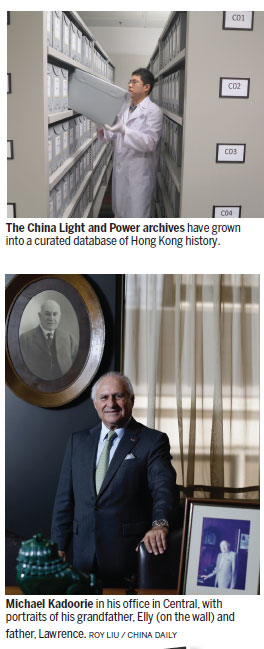
These images and documents related to the history of Kadoorie family holdings were too precious to be archived and kept in company vaults. Michael Kadoorie employed a highly-qualified historian to lead a small team to process and preserve the company resources with a view to ultimately opening the collection to public access.
And then the initiative seemed to assume a life of its own. Soon enough, the team was "filming with a little handycam, interviewing people from all walks of life because electricity is everybody's business," says Michael Kadoorie, referring to what would develop into a humongous body of recollections by people associated with Hong Kong's industrial history.
"So they went to the New Territories, where a man, age 92, had first seen and used electricity in the 1930s. At the other end of the spectrum there was the (former) governor of Hong Kong, David Wilson," he says, adding, "We have more than 500 interviews of people drawn from all walks of life. I think it's a great thing for Hong Kong because people are drawing on it all the time."
Giving back to the city
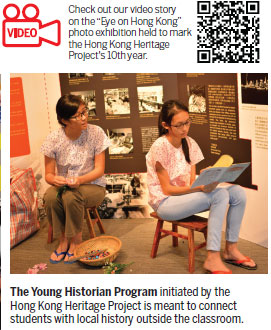
Over the last decade HKHP has diversified into facilitating heritage education. Its young historian program allows school and university students to connect with local history outside the prescribed syllabus. HKHP has widened its audience base, maintaining a record of the history of Jewish migration to different parts of Asia. It has reached out to an audience beyond Hong Kong, bringing them stories of the city's ethno-cultural particularities through the "Hong Kong DNA" series of documentaries.
The team of four who flagged off HKHP's journey a decade ago has not grown by much though. It's by forging meaningful, symbiotic relationships with other entities - public, private, individuals - HKHP has managed to establish itself as a bankable resource center.
Fanny Iu, executive director of the HKHP, sounds pleased with playing facilitators in promoting and popularizing Hong Kong history. HKHP's most important contribution to society, she says, is in "building a platform for organizations from different sections of society to come together to collaborate in a creative and innovative manner".
Michael Kadoorie, on his part, would give the credit to Hong Kong's people - a large section of whom have traditionally cared for the city's history.
Looking out the window of his well-appointed office on the top-floor of St George's Building in Central, on a patch of land reclaimed from the sea, he remembers "the initial spark" that had set him off on the path to creating an archive that might eventually serve the public. It was in 2007, the day he saw people outraged by the proposed demolition of Queen's Pier demonstrating through his window.
That's when he realized the people of Hong Kong cared for its past. "It showed that young people were not looking at any particular heritage (British colonial heritage in this case), that it did not matter whether it was pre-colonial, post-colonial or belonged in their own times," says Kadoorie.
HKHP was started to cater to the city people's fascination with their heritage. Ten years on, even people who do not belong here seem quite fascinated by that story.

(HK Edition 10/27/2017 page10)