Merchants' machinery taps into feelings
Updated: 2017-03-10 08:00
By Oswald Chan in Hong Kong(HK Edition)
|
|||||||


Facing intense competition, retailers use AI to engage with customers on an emotional level
As more and more business functions become digitized and consumer spending patterns change, retailers will have to use tools such as artificial intelligence (AI) to engage with customers on an emotional level.
French luxury cosmetics brand Lancome has created a customer loyalty program that engages its clients in a two-way conversation. The program also lets members earn points if they share product rankings, give feedback, provide information about themselves, connect with other members in different places and engage with their beauty advisers.
The cosmetics retailer even invites loyalty members to visit its production laboratory in France; members can create their own beauty products in the laboratory.
By tapping emotional elements in its promotion, Lancome can build up its brand value and unique selling position based on intimacy, passion and commitment.
United Kingdom-based retailer Marks & Spencer also creates a loyalty membership club based on a social awareness community, as well as the traditional product and service reliability and quality.
According to the program, customers could opt for a portion of the money they spend at Marks & Spencer's outlets to go to the charities of their choice. The retailer would engage customers in a conversation on the charities they want to support. The relationship between the shoppers and retailer would then be not just transactional but much more personal.
Instead of just earning redemption points, the points Marks & Spencer's customers earn could take them to the next level, where they are given different rewards and offers, depending on their positions on the loyalty program ladder.
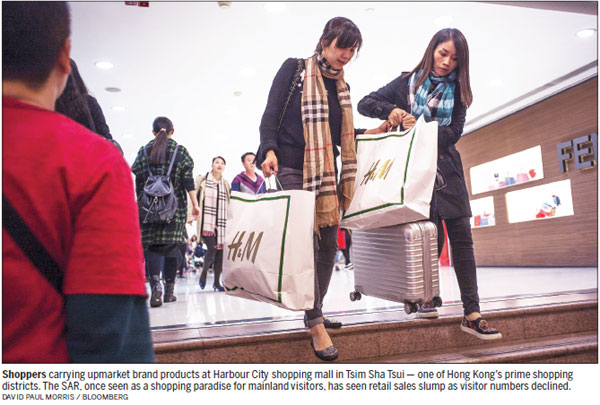
These novel ways of engaging customers come as the transaction-based model of marketing loses its glamor and consumers become more tight-fisted amid growing uncertainties in Hong Kong's economy. Retailers have to find new ways to bolster sales.
The value of retail sales in Hong Kong dived 8.1 percent to HK$436.6 billion last year following a 3.7-percent decline in 2015 and a 0.2-percent drop in 2014, Census and Statistics Department data showed.
"Consumers will have to tighten their belts again after a few years of plenty. The combination of higher inflation, rising debt-servicing costs and a slowdown in job creation across the globe is curbing global spending power which will grow at the weakest rate in eight years in 2017," predicted Tom Rogers, associate director at economics think-tank Oxford Economics.
The percentage change in per capita consumer spending power in Hong Kong would be 2 percent and 1.6 percent this year and next year, respectively, lower than the annual growth rate of 2.5 percent from 2007 to 2013, and 2 percent in the period between 2014 and last year, according to Oxford Economics.
Global customer loyalty marketing agency Collinson Group's subsidiary ICLP has found that most Hong Kong consumers are less committed to their favorite retailers than ever. In a survey interviewing 750 consumers in Hong Kong, just 1 percent were devoted to preferred retail brands.
The marketing agency emphasized that brand loyalty was based on an inclusive approach that valued human relationships, passion, intimacy and commitment. Understanding these was essential to brand building.
"Loyalty programs have to be inclusive, more experience-oriented, reward-recurring and community-related to elicit customers' long-term participation," ICLP General Manager Mary English told China Daily.
Traditional customer loyalty programs were essentially exclusive in nature, where consumers had to pay first to have a place in the programs. In reality, customers did not want to pay first because they did not know how they would be treated before joining the program.
"When brands' revenues are going down and there is huge competition from other players, retailers need to embrace psychologically based marketing to retain customers," English said.
Brands also needed to retain customers over a long time in order to derive value, she said.
Deloitte's Global Powers of Retailing 2017 Report said: "Customers are defining themselves less by how many things they own and more by how curated their lives are in terms of possessions and experiences."
"Customers are seeking experiences and products that reflect the personal brand they promote on social media."
However, retail brands in Hong Kong seldom devote resources to creating emotional elements in their brand building exercises because of cultural differences and budget constraints.
ICLP believed that besides the emotional element of marketing, real-time intelligence would be a significant factor to consider when devising a loyalty strategy.
"Retailers need to use customer data, not just transactional data, but also social data to understand customers' social behavior. The data will then be segregated into different segments whereas retailers can leverage customer data in different ways to advocate brand awareness," said English.
A survey by global technology service provider NTT Communications, which last year interviewed 300 large retail, manufacturing and wholesale enterprises on the Chinese mainland and in Hong Kong and Singapore, revealed that 58 percent of them had adopted extensive big data analytics to accelerate digital transformation and boost competitiveness.
"Exponential technologies like artificial intelligence, robotics and virtual reality are changing how we live and how we will shop," Deloitte said.
oswald@chinadailyhk.com
(HK Edition 03/10/2017 page8)