SAR 'well poised' to be Belt and Road fundraiser
Updated: 2016-09-13 07:16
By Cherry Lin in Hong Kong(HK Edition)
|
|||||||


|
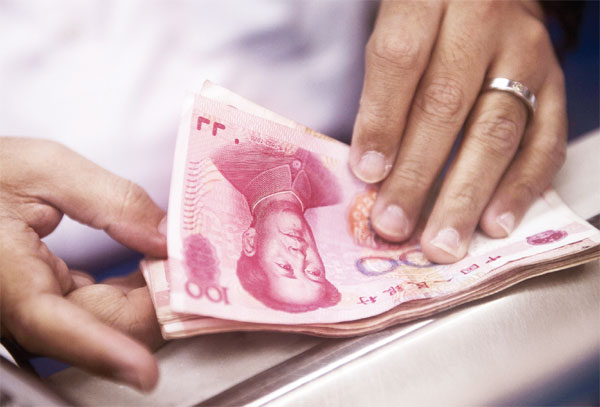
An employee at a currency exchange store in Hong Kong counts yuan banknotes. The SAR is expected to play a crucial role in the Belt and Road Initiative in fundraising and boosting internationalization of the renminbi. Xaume Olleros / Bloomberg |
Hong Kong is eager to act as a fundraiser to finance infrastructure projects in the Belt and Road countries and its presence along the route could alleviate investment risks and lift the renminbi's global stature, market gurus told the recent Treasury Markets Summit 2016, jointly organized by Hong Kong Monetary Authority (HKMA) and the Treasury Markets Association (TMA).
The Belt and Road Initiative - the land-based Silk Road Economic Belt and the oceangoing 21st-century Maritime Silk Road - is a development strategy proposed by President Xi Jinping in 2013 to build roads, railways, ports and other infrastructure projects from Asia to Europe, linking China with the rest of Eurasia.
"There are 60 countries involved in the Belt and Road Initiative, and they are diverse in terms of stages of economic and infrastructure development, so policy inconsistency, corruption in certain countries, and currency exchange rates would all pose significant risks for investors," warned Julian Vella, head of KPMG's Global Infrastructure for the Asia Pacific.
"But the good news is Hong Kong's involvement in the initiative," he told the summit. "As Hong Kong is a global financial center, a number of institutions with international experience in the city are providing very professional financial services. They could assist governments and investors from the private sector to understand the risks associated with the projects."
He urged Hong Kong's financial institutions to support capacity building in less developed economies and help those markets develop their own banking systems, which is also important in facilitating financing infrastructure projects.

Besides being an adviser and mentor, Hong Kong is also an affluent place to raise money. "Hong Kong is well positioned to aggregate capital and allocate capital to support the financing of the infrastructure across the very risky economies," said Standard Chartered Bank Managing Director Peter Burnett.
According to Asian Development Bank estimates, funding needs for infrastructure investment in Asia would be around $8 trillion between 2010 and 2020, which is massive and requires a long-term tenor, say, about 20 to 30 years, beyond the capacity of governments and multilateral institutes, so experts agreed that it's critical for the private sector to be brought in to support the financing of infrastructures through the issuing of project bonds.
Recent moves by the HKSAR government to boost the city's role as a key infrastructure financing hub include the setting up of the Infrastructure Financing Facilitation Office (IFFO).
The first workshop of IFFO will be launched in the fourth quarter of this year to study whether Hong Kong can develop the business of issuing infrastructure project bonds, and how to enhance the credit quality of these bond issuers to ensure cash flows of the infrastructure projects can be securitized.
Currently, infrastructure projects in Asia tend to be funded by governments or by a combination of loans advanced by multilateral institutions and commercial bank debt lenders.
HKMA Chief Executive Norman Chan Tak-lam called on Hong Kong's financial sector to build up a "Hong Kong brand" for financial services. He emphasized at the summit that the enhancement of quality has become more important in capturing opportunities arising from the mainland-led Belt and Road strategy.
In its goal to become an infrastructure financing hub, Hong Kong could also speed up renminbi internationalization and promote the yuan as a global reserve currency.
"It's inevitable for renminbi to go out," Citibank Managing Director Yang Ji pointed out at the summit.

"We can see that overseas direct investment by Chinese enterprises is growing very rapidly, and the onshore window guidance has also squeezed some capital flow from the mainland to Hong Kong, for example, Chinese companies are encouraged to pay renminbi dividends in Hong Kong."
Yang acknowledged that through the issuance of renminbi project bonds, with the SDR (special drawing rights) inclusion next month, and the planned launch of the Shenzhen-Hong Kong Stock Connect, the Chinese currency's exchange rate will be more market driven and get more international attention.
Ju Wang, senior foreign exchange strategist at HSBC, told China Daily that the SDR inclusion of renminbi represents a "quality assurance" by the International Monetary Fund (IMF) and the World Bank for the Chinese currency to potentially become the next reserve currency, which will also encourage sovereign investors who are not allowed to participate in the mainland's interbank bond market to buy yuan assets.
The IMF's new SDR basket, which includes the yuan, will take effect on Oct 1, and the weight of yuan will be 10.92 percent, leading to an estimated capital flow of $31 billion for direct SDR allocation.
Data suggest that central banks around the world might have already started to re-allocate reserves. Cumulative foreign institutional flows into yuan-denominated treasury bonds reached an all-time high of 321.9 billion yuan in July this year - up 28 percent from January.
The Monetary Authority of Singapore has announced that yuan assets have been included as part of its official foreign reserves since June.
cherrylin@chinadailyhk.com
(HK Edition 09/13/2016 page10)