Starving at the banquet
Updated: 2016-07-19 07:28
By Wang Yuke(HK Edition)
|
|||||||


People still go hungry in HK while nearly 4,000 tons of surplus food goes into landfills. Much of the city's hunger could be eliminated with an effective distribution system, say experts. Wang Yuke reports.
We throw away 3,648 tons of food every day. Meanwhile, hundreds of thousands of people who can't afford daily necessities go hungry.
There's enough food to go around, argues Jonathan Wong Woon-chung, a biology professor at Hong Kong Baptist University. One of his fields of interest is waste management. He contends there's enough food going to waste to feed the needy and reduce pressure on the city's nearly overflowing landfills.
The challenge is to distribute the food efficiently, says Wong. A management system is needed. He thinks a cloud-based system would be the best solution, probably a mobile app. "A complete database is the best vehicle to match food donors with charity recipients," he notes.
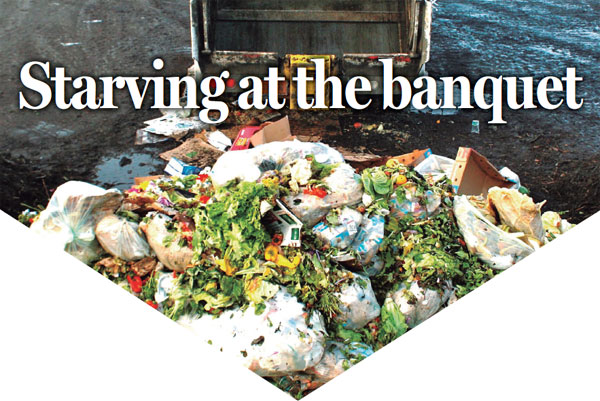
The commercial and industrial sectors produce about a third of the city's food waste every day. The Environmental Protection Department says household waste accounts for the remainder. The total from the commercial and industrial sector, which would provide the most viable resource, exploded from 400 tons a day in 2002 to 1,003 tons in 2013.
While all that food is loaded onto truck and carted off to the dumps every day, many people in Hong Kong go hungry. Some 960,000 residents lived in poverty in 2014, Commission on Poverty figures showed.
Wong reckons a good database would allow charitable organizations to collect edible food, otherwise headed for the dump, and distribute it quickly to people in need, taking account of nutritional requirements. Delivery needs of perishable food needs to be quick and efficient - a challenge exacerbated by the city's hot and humid climate. "When I worked for a food bank in America in the 1990s, mobile applications were already in use. They'd established an efficient distribution system based on data from food donors and the potential recipients," recalls Wong. He regrets that we are yet to develop an app to manage redistribution of surplus food, lagging far behind other economies.
Bitter memory of hunger
Lan Ying-ying, a single mother, and her 8-year-old son live on donated food that otherwise would be buried to rot in the one of the city's stinking landfills. "You won't know how much a bowl of rice means, if you've never experienced food insecurity and constant hunger," said Lan.
Lan's ex-husband was a gambler. He didn't work but managed to deplete the family savings nourishing his addictions. After their son was born, Lan went to work, at two housekeeping jobs so she could feed the boy. "My husband would take away half my salary. I used what was left to buy formula for my baby." When she got too hungry herself, she'd grab some dried, pickled radish from her hometown of Guangdong, and down it with a bland congee. She barely had three good meals a day but would walk to the market at sunset to buy vegetables that were reduced in price just before closing time.
She has bitter memories of getting home from work one day, when her little boy Hsuan-hsuan threw his arms around her and cried uncontrollably, telling her, "Mom, I'm so hungry. Dad didn't cook anything." Lan left her husband after that.
She and her son depend on food distributed by the community service organization, Christian Action - rice, noodles, vegetables, meat and canned foods. "I count on rice most. We can hardly get by without it." Her son devours every mouthful and picks up every grain of rice that falls on the table. Food is that precious. It breaks Lan's heart and makes her feel guilty when she sees that.
Christian Action is one of 64 charity partners affiliated with Feeding Hong Kong, an umbrella group that collects surplus food donated by local producers, shops and supermarkets and distributes it to local charities for the needy.
Much of what is turned over is close to the sell-by date and about to be tossed out. Much doesn't meet the aesthetic standards demanded by typical Hong Kong shoppers, says Gabrielle Kirstein, executive director of Feeding Hong Kong.
Most of the vegetables Lan gets have yellow leaves. Some show evidence of worms. Some are wilted. The flavor is the same after she cuts out the bad parts and cooks the vegetables.
For Lan, a sack of rice, a piece of meat, a loaf of days-old bread, and some canned fishare treasures.
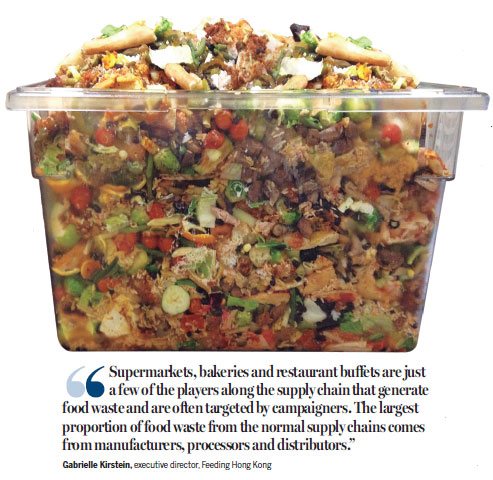
"Supermarkets, bakeries and restaurant buffets are just a few of the players along the supply chain that generate food waste and are often targeted by campaigners," remarks Kirstein. "Supermarkets throw away food, but they are not the biggest culprits. The largest proportion of food waste from the normal supply chains comes from manufacturers, processors and distributors."
The price of aestheticism
They throw away food for various reasons: over orders, cancelled orders, limited storage space, discontinued products and recipe variation, says Kirstein.
She says sometimes the reason is in response to consumer habits and ideas of perfection, for example, aesthetically "unattractive" fruits with scars and blemishes, misshapen vegetables, damaged packaging, even though they are nutritious and suitable for human consumption.
A survey by Oxfam Hong Kong to assess surplus food handling and donations in 2014 found more than 60 percent of manufacturers and distributors surveyed reported discarding vegetables and frozen meat that didn't look perfect. Almost 90 percent of wholesalers said they discarded vegetables and 65 percent would throw away fruits that looked unappealing.
Shoppers avoid flawed pieces - so those pieces go unsold, and accumulate only to be discarded. Customer preference forces retailers to take heed of aesthetics when they order supplies.
Frequently there are packages of fresh produce that have been damaged during transport, says Kirstein.
She remembers rescuing 2,000 bottles of cooking oil which became covered with grease when about 50 bottles of the shipment had been damaged during transportation. There was nothing wrong with the intact bottles but they would have been thrown away. Kirstein assembled some volunteers and cleaned the bottles.
Another bonanza was 30,000 cans of soup from a manufacturer that had updated its recipe, and added new labeling. The company put out the word that it would give away its large stock of unsold older products. Feeding Hong Kong reached out, got the surplus products and donated them to charities.
Lan still works part time as a housekeeper. She uses the money she earns to supplement her son's diet with food high in nutritional value, like fish and pork ribs.
She didn't realize how wasteful people are, until she got a cleaning job in a private home. She was working for a young couple who seemed to treat food indifferently. The woman of the house loved making cakes. "She would bin her cake every time she was dissatisfied with it, without blinking an eye. It made me cringe," complained Lan. She finally summoned her courage, and asked her employer if she could take a cake home. Cake was a once-a-year indulgence for Hsuan-hsuan. Lan would collect bakery coupons handed out at her son's school, so she could buy him a cake for his birthday.
"Their refrigerator was teeming with food. Some of it looked expensive but it would lie there for weeks untouched," said Lan. Occasionally she was bold enough to inquire the mistress if she could take the yellow wrinkled vegetables home right before she tossed them in the garbage. "They would give me their unused vegetables and fruits if they were going for a trip."
Reduce waste at source
Tsang Yiu-fai, professor from the Education University of Hong Kong who teaches solid waste management, thinks food waste in Hong Kong is more of a cultural issue. He points out that Hong Kong people value hospitality and generosity. There's a culture that dictates, when you treat friends to a meal a lavish banquet is expected. In cha chaan ting, diners are served generous portions of rice. Cost effectiveness is an important consideration when people eat out, he said.
Ubiquitous convenience store and supermarkets means people can access food easily, said Tsang. Hong Kong people, especially younger people are strangers to food deficiency. They are unaware of the struggle of a billion people in poor regions around the world to get something to eat.
Food waste in Hong Kong is aggravated by a shift in shopping patterns over the years, reckoned Professor Wong Woon-chung. In the past, buying fresh ingredients at the wet market was a daily routine. With the increased popularity of supermarkets, coupled with long working hours, people became more accustomed to buying in bulk for weekly and even monthly consumption.
There is a growing number of waste food rescue organizations as Feeding Hong Kong taking the lead in salvaging waste food and making the public aware of the problem. Their efforts have borne fruit. Kirstein says the food Feeding Hong Kong collected from supply chain last year was channeled to 25,000 people, providing an estimated 978,207 meals. A social worker at Christian Action, Carol Lee, says the organization frequently gets calls from companies wanting to donate excess food or offer free snacks to poor children. Every week, Maxim's bakery delivers roughly 120 loaves of bread unsold the previous day. Feeding Hong Kong delivers donated food to the charity four times a month. Each trip can include 100 kilograms of rice, 30 packs of noodles, and 30 to 50 bottles of canned products, as well as boxes of fruits and vegetables.
The challenge is, according to Lee, "we don't have enough refrigerators to store the food. We need better cooling systems to extend the food's life, as more donated food flows in."
The government has made continuous efforts in launching food waste reduction and recycling initiatives including the setup of organic waste treatment plants and composting plants and food recycling partnership scheme, but they are all unsustainable and passive strategies, argues Tsang. He insists food waste should be reduced first, at the consumers' level.
Contact the writer at
jenny@chinadailyhk.com
(HK Edition 07/19/2016 page8)