Record spread in SAR-mainland yuan deposit rates
Updated: 2015-01-30 06:48
By Celia chen in Hong Kong(HK Edition)
|
|||||||


HK-Shanghai stock trading link, increased RMB products lift premiums
Hong Kong banks are paying record premiums for renminbi (RMB) deposits compared with Chinese mainland lenders as a stock cross-trading link between the SAR and Shanghai sees funds being diverted from savings accounts to mainland equities.
Bloomberg data show a record gap has emerged between one-year deposit rates in Hong Kong and the mainland.
Hong Kong's 12-month renminbi deposit rate has already exceeded 4 percent, while the People's Bank of China kept the savings-rate ceiling at 3.3 percent in November last year when the central bank cut benchmark borrowing costs for the first time in two years.
Dariusz Kowalczyk, a senior economist and strategist at Crdit Agricole CIB in Hong Kong, expects the city's renminbi deposit rate to remain high as renminbi products are piling up, but offshore renminbi supply has not gone up significantly.
"The Shanghai-Hong Kong Stock Connect program is one of the key factors pushing up Hong Kong's renminbi deposit rates," said Kowalczyk.
It's estimated that 65.8 billion yuan ($10.5 billion) - equivalent to 7 percent of Hong Kong's renminbi savings - has gone into mainland equities since the Shanghai-Hong Kong stock program's launch in November last year, according to Standard Chartered Plc.
Global investors had used about 31 percent of the total quota for the cross-trading program to buy Shanghai-listed stocks, while only about 9.2 percent of the quota had been used by mainland investors to purchase stocks in Hong Kong as of Jan 29.
Becky Liu, a Hong Kong-based rates strategist at Standard Chartered, expects offshore renminbi liquidity conditions to remain tighter than those onshore for an extended period.
A similar cross-trading link between the Hong Kong and Shenzhen bourses is expected to start in the second half of this year.
The percentage of Hong Kong's renminbi deposits being drained by equities could rise to 10 percent when the Shenzhen-Hong Kong link is launched, according to Woody Chan, Standard Chartered's Hong Kong head of financial markets.
Savings in the Chinese currency in Hong Kong hit a record 974 billion yuan as of Nov 30, according to the Hong Kong Monetary Authority.
Liu said the continued opening up of the mainland's domestic market will remain a major factor in draining liquidity from the offshore renminbi funding pool. Meanwhile, cross-border renminbi loans are also likely to become more common, she added.
"The business of cross-border renminbi loans will expand largely with greater promotion of offshore renminbi investments," said Wilson Chan Fung-cheung, adjunct professor at the City University of Hong Kong.
"But I believe renminbi deposit rates in Hong Kong and the mainland should be on the same level in future," he said.
With the internationalization of renminbi, the Chinese currency has overtaken the Australian and Canadian dollars as the world's fifth-biggest payment currency since November, but its global market share remains small compared with the US dollar.
"The renminbi is increasingly becoming the currency of choice for international payments. Moving from 13th place to the fifth spot in just two years is phenomenal progress. We expect the rapid uptake of the renminbi to continue in 2015 and beyond," said Vina Cheung, global head of renminbi internationalization for payments and cash management at HSBC.
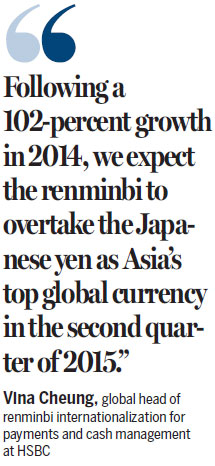
"Following a 102-percent growth in 2014, we expect the renminbi to overtake the Japanese yen as Asia's top global currency in the second quarter of 2015," she said.
Bloomberg contributed to this story.
celia@chinadailyhk.com
|
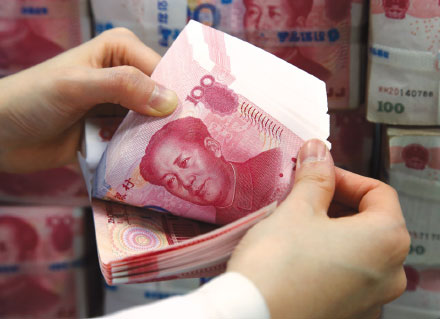
Renminbi has sailed past the Australian and Canadian dollars to become the world's fifth-most-used global payment currency. Cho Seong-Joon / Bloomberg |
(HK Edition 01/30/2015 page5)