Universal suffrage at the crossroads
Updated: 2013-10-18 08:38
By Joseph Li(HK Edition)
|
|||||||


Former constitutional under-secretary Adeline Wong backs early public consultation for the 2017 universal suffrage. Yet, she is unsure if the government can secure several votes from the opposition camp to carry the electoral reform, given a high threshold of two-thirds majority is needed, Joseph Li writes.
The SAR Government is staring at a tight schedule if it hopes to complete electoral reform, but thus far, it is yet to take the first step in the five-step process set out by the National People's Congress Standing Committee (NPCSC).
"Time is rather tight. Given that 2017 universal suffrage is very important, public consultation ought to begin as soon as possible," Adeline Wong Ching-man told China Daily.
While serving as under secretary for constitutional and mainland affairs, she was heavily involved in the electoral arrangements. The 2012 electoral reform was controversially passed amidst an intense political storm, in which the Democratic Party sided with the government on the reform package that the opposition tried everything to stop.

"When I became under secretary on November 1, 2009, we already had NPCSC consent. In the same month, we published a consultation paper relating to two electoral methods, one relating to electoral procedures for the Chief Executive election in 2012, 28 months away, and the other for the 2012 Legislative Council election, which was still 34 months away.
"From now, we have only 36 months and 42 months for the LegCo and the CE elections scheduled for September 2016 and March 2017. This time, not even the first step has been taken. It's not yet decided if the electoral methods will be changed."
Although there is not yet any published timetable for consultation, she believes the government must have undertaken internal research or sought legal opinion on whether certain proposals would comply with the Basic Law and the NPCSC decision on SAR elections.
Complicated legislation
Particularly, the government must have formed views on the key parts of Article 45 (stipulating that the chief executive shall be selected "by universal suffrage upon nomination by a broadly representative nominating committee in accordance with democratic procedures"), such as 'democratic procedure', 'broadly representative', the composition of the Nomination Committee, the nomination threshold and the number of candidates. Any change of the electoral methods involves amendment to Annex I and Annex II - which provide the mechanisms for selecting the CE and legislators - via amending Hong Kong's existing election laws, or local legislation, and that requires passage by a two-thirds majority in LegCo.
Local legislation this time will be more complicated than in 2010, when the Election Committee membership was increased from 800 to 1,200 but whose structure, comprising sectors and subsectors, remained unchanged.

"This time, the number of sectors and subsectors in the Nomination Committee, the number of members and the methods to return the members will require local legislation," she highlighted.
Whilst the minimum number of nominations required for anybody to qualify as a valid candidate must be written in statute, this nomination threshold may be linked to the number of candidates.
Without specific views on the threshold and the number of candidates, she feels too many candidates may make the election rather "cheap" and each candidate may only gain very few votes.
She suggests the threshold may remain 12.5 percent of the total number of Nomination Committee members. Alternatively, the top five participants returned by the Nomination Committee may become valid candidates.
"In a democratically mature country like the US, where there are no limits on the number of presidential candidates and campaign funds, there are always only two major candidates," she observed. "People would like to see the candidate from their own camp to win the election. If there are too many candidates, the votes would be rather divided."
Opposing 'Occupy Central'
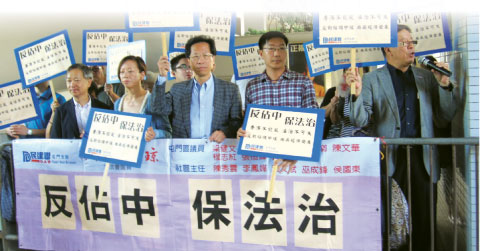
Wong, in her capacity as CEO of the Chinese Manufacturers' Association of Hong Kong, remains adamantly opposed to "Occupy Central," the downtown sit-in with which the opposition hopes to press its demands relating to the CE and LegCo election methods in future.
"I understand some people are using 'Occupy Central' as a stake to press the central and SAR authorities for what they call universal suffrage," she said. "As they know economy is very important to Hong Kong, the occupation will harm the city's economic veins. They know it is the Achilles heel of the central government."
She questions why opposition parties bundle universal suffrage with the occupation of the heart of the central business district.
'Civil nomination' beyond Basic Law
Adeline Wong holds the view that "civil nomination" of candidates, or letting all voters nominate candidates, for the 2017 universal suffrage of the Chief Executive election is an infringement of the Basic Law.
Wong contends that opening the selection of candidates for the 2017 chief executive election to nominees chosen by voters "at large," would be outside the terms of the Basic Law.
Opposition parties have advanced the argument that the Nomination Committee responsible for choosing the candidates should comprise the city's more than 3 million registered voters. And they contend that to be stipulated in the Basic Law.
Looking for space in the Basic Law, opposition parties argue that the Nomination Committee as specified in Article 45 shall comprise the over 3 million registered voters as members.
The opposition holds that when any person receiving a specified number of nominations, the Nomination Committee must endorse his or her candidacy for the CE election.
Wong's criticism echoes comments by political veterans, Basic Law experts and liaison office director Zhang Xiaoming that "civil nomination" violates or bypasses Hong Kong's mini-constitution.
President of Legislative Council Jasper Tsang Yok-sing also said "it's a bit strange" if all the registered voters are members of the Nomination Committee.
Wong thinks the opposition stand "does not seem to comply with the Basic Law".
"Qiao Xiaoyang, (chairman of the National People's Congress Law Committee) had explained that candidates should be nominated by the Nomination Committee (as a whole) but not by members of the committee. If all the registered voters can nominate candidates, there is no need to run the Nomination Committee."
The opposition always claims that genuine universal suffrage should include the pan-democrats, while civil nomination can prevent pan-democratic figures from being screened out.
Wong said: "Universal suffrage is all about being universal, equal and we should aim at a fair, objective electoral method, acceptable to the majority. How do we define pan-democrats? When we come up with an electoral approach, we hope it can be used for some years but can we still identify the pan-democrats 10 years from now?"
|
Members of the Democratic Alliance for the Betterment and Progress of Hong Kong protest against the "Occupy Central" plan, which Adeline Wong thinks would harm the city's economic veins. |
|
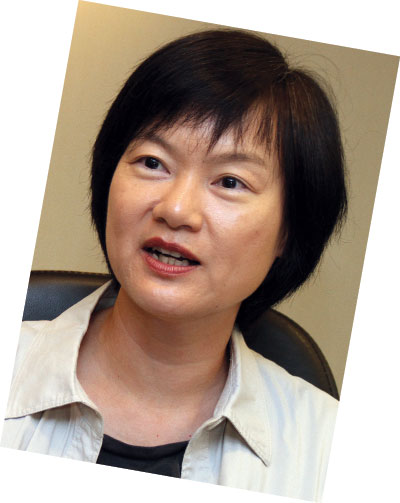
Adeline Wong reckons public consultation for the 2017 universal suffrage should begin as early as possible because time is rather tight. Constitutional development is a five-step process pursuant to the National People's Congress Standing Committee decision, but now not even the first step has been taken. Parker Zheng / China Daily |

(HK Edition 10/18/2013 page8)