Questions hang over ExCo role
Updated: 2013-06-14 07:34
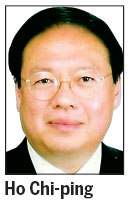
By Ho Chi-ping(HK Edition)
|
|||||||


It is no surprise to find that matters involving the role of the Executive Council (ExCo) and its membership are reaching boiling-point; the only surprise is that it has taken so long to bubble to the surface. Further, it is noteworthy that the subject has now embroiled no less a person than Legislative Council (LegCo) President Jasper Tsang Yok-sing, who was a member of our two preceding ExCos under inaugural Chief Executive Tung Chee-hwa and his successor Donald Tsang Yam-kuen.
The LegCo chief recently put into words what many in society were thinking when he said, "during British rule the ExCo was a body with actual power. (Its members) had a strong say in front of the governor; their words carried a lot of weight. There was a rule that if the governor reached a decision contrary to the majority view in ExCo, he needed to give specific reasons on record, which would be seen by the British Government. Today, we can't see the ExCo performing the same function."
This came on top of the resignation of CE Leung Chun-ying's top aide, Barry Cheung Chun-yuen, following the collapse on May 18 of the Hong Kong Mercantile Exchange which Cheung had founded. An earlier jolt that shook the ranks of ExCo's membership to the core was the case of Franklin Lam Fan-keung, who went on "indefinite leave" after graftbusters began investigating allegations that he used inside information when deciding to sell two Mid-Levels flats.
Meanwhile, veteran politician and Liberal Party founding member Allen Lee Peng-fei (who served on ExCo 1986-92) has claimed that under CY Leung's tenure ExCo has deteriorated into a platform for granting favors to his allies, since he appears to care little about the capabilities of those he has appointed.
I take no pleasure in pointing out that my misgivings about ExCo have long been on record. In April 2007, as the former secretary for home affairs, I was one of a handful of people who questioned the role ExCo was performing in post-handover Hong Kong. My "reward" was something of a barrage of criticism from various quarters.
My intention was to point out that ExCo should align with the changes of the time, and so should aim for greater effectiveness in administration. In particular I was concerned about the creation of a harmonious society plus other possible changes concerning such subjects as religious standards and cultural affairs. However, I never said that ExCo should be replaced or canceled, nor did I say it was unnecessary.

I had long believed the government needed to better align with public opinion, and that Hong Kong needed better administration, so that where necessary the system should be revised and improved. That is the message I was trying to convey. The main argument against retaining ExCo's previous functions was that its president, the CE, would no longer be a British governor who neither spoke Cantonese nor read Chinese. Instead, after the handover, our CE would be a chosen local person with his finger on the pulse of developments both here and on the mainland, a Chinese notable who could read the local newspapers, follow the news on radio and TV in the local lingo and understand all its political nuances, and have a complete grasp of our affairs and Hong Kong people's thinking. In other words, our CE would be a person of completely different qualities and values from a Briton transferred by London.
In colonial times a range of serious responsibilities affecting Hong Kong's future fell on the shoulders of executive councillors. All distinguished members of either the Chinese or expatriate communities, these members passed on their wisdom to one governor after another, but it can be assumed that their advice differed on many subjects. The role of the Chinese representatives was to gather public opinion to fulfill these two responsibilities: first, to ensure that policies also benefit the Chinese; and second, to ensure a balanced distribution of benefits.
Today ExCo's membership has expanded to 15 ex-officio members and (with Cheung's resignation) 14 non-officials. The bottom line is that the Basic Law states there must be an ExCo, but not that it should in some ways duplicate its former role in colonial times. Whether ExCo aligns with the present situation is what he has to consider. For that matter, society itself hasn't reached a consensus over the issue. Several years have passed since I last commented on the issue publicly. But perhaps it still isn't too late to introduce some adjustments.
The author is vice-chairman and secretary-general of the China Energy Fund Committee, an independent think tank on China and energy-related issues.
(HK Edition 06/14/2013 page9)