We're not doing enough to make world safer for mankind
Updated: 2013-01-30 05:31
By Ho Chi-ping(HK Edition)
|
|||||||


We continue to make remarkable progress in many fields, like information technology, producing trains nearly as fast as planes, self-steering autos and so on, but we're not coming to grips with the really big issues facing mankind today. These are primarily over-population, alternative forms of energy, health issues and particularly our ongoing abuse of the earth.
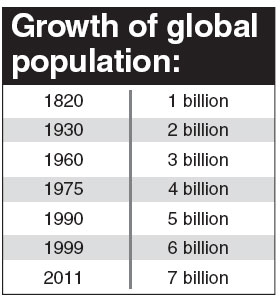
Let's first consider the global "over-crowding" that will soon reach the stage where the earth can no longer provide enough food for an over-swollen population. (see table)
Unless something drastic happens, the world's population is expected to rise to eight billion in the 2020s.
China set an example to the world when it formally launched its one-child policy in 1979, explaining it in these terms: "For a prosperous, powerful nation, and a happy family, please practice family planning."

The one-child rule is estimated to have reduced China's birthrate since 1979 by more than 400 million. Nevertheless, in the intervening 33 years, the country's population has grown from an estimated 975.4 million to the present 1.354 billion.
Alternative energy: The most obvious of these are solar energy, wind power and hydropower. And you may be surprised to learn that China is the world's leading country not only in leveraging these sources of energy for industrial and domestic use, but also as the global pacesetter in producing and exporting solar energy and wind-farm equipment.
Now, let us turn to alternative fuel sources: Surely more should be done to follow Brazil's example of developing ethanol from sugarcane which is then blended with gasoline and produces cleaner emissions. What ethanol-related research is being done in the sugar-producing countries of Asia (specially the Philippines)?
The bottom line is that the more alternative energy the world uses, the less pollution our exhaust pipes and smokestacks belch into the atmosphere, and the less dependent we will be on fossil fuels.
Health issues: Surely finding a cure for cancer must be at the top of the list - where it has now been for centuries! If we can put a man on the moon, invent the atomic bomb, develop jetliners and transform the world into a global village through IT, why can't we find a cure for cancer?
Why doesn't the United Nations organize and finance a Nobel Prize-style global competition for a cure and call it the UN World Health Prize? After cancer is conquered, the best medical scientists in the world can turn their attention to other unsolved medical mysteries, perhaps starting with a cure for AIDS.
Abuse of the earth: Mankind has willfully pumped filthy emissions into the atmosphere to such a grievous degree that Mother Earth is now retaliating with tsunamis, storms of unprecedented ferocity, increasingly devastating earthquakes, catastrophic rainstorms here, widespread drought there, plus the inconvenient truth of global warming and the melting of the polar ice-caps.
So what have we done to stop the pollution of our air, oceans and rivers, the endless gouging of the earth's crust by giant mining companies, and all the other crimes against our hostess, Mother Earth?
We have talked about it. We have acknowledged it. Big and small countries have pointed fingers at one another, thrown up their hands in despair - and done virtually nothing.
It would seem that the lesson of the 2004 Asian tsunami has been forgotten. A massive quake burst through the seabed off the west coast of Sumatra, Indonesia's biggest island, touching off a series of powerful tsunamis that smashed into the coastal areas of 14 countries and killed at least 230,000 people. Astonishingly, the tsunamis raced over the width of the Indian Ocean,reached as far west as the coast of Africa, and as far north in Africa as Somalia.
In March 2011, Japan suffered a very painful wake-up call when a tsunami and quake combined forces at Fukushima to kill about 20,000 people and trigger the partial meltdown of a nuclear power station.
The United States seems to have forgotten its own painful lesson from Nature in 1906, when a quake and three-day fire destroyed 80 percent of San Francisco, killing 3,000 and leaving 225,000 people homeless. The quake occurred on the San Andreas Fault, a fracture in the earth's surface that extends 600 miles from the State's north-west to the Bay of California.
Is anybody out there listening?
The author is deputy chairman and secretary general of China Energy Fund Committee, a think tank on energy and China-related issues.
(HK Edition 01/30/2013 page9)