Room for improvement
Updated: 2013-01-24 05:51
By Hazel Knowles(HK Edition)
|
|||||||


|
Studies show the benefits of small class wane as children get older and that teaching styles and strategies are more important. All Photos Provided to China Daily |
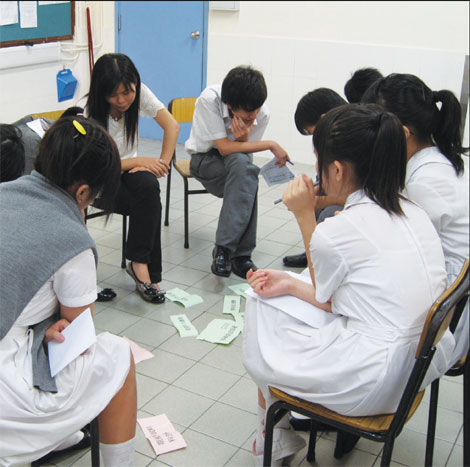
After persistent lobbying by teachers, the government has agreed to allow secondary schools to cut class sizes by up to four pupils. But is it enough to ensure the quality of education in Hong Kong, asks Hazel Knowles.
"Imagine an actor performing six or seven times every day, each time to a new and different audience, as well as spending the breaks in between learning lines for a new act or even to write a new play. It seems ridiculous, doesn't it? But sometime that's what my job feels like to me."
Gillian, a 38-year-old Hong Kong secondary school teacher, looks tired as she characterizes her working day.
"I feel like an over-worked performer. Standing in front of an audience of 35 to 40 teenagers hours every day, trying to keep them motivated and interested. It is hard work, mentally and physically draining," she says.
"I want to be a good teacher but with 35 and sometimes more in a class, it's not so simple. A class-size less than 30, ideally around 25, would be so much better.
Gillian, who has requested that we not use her real name, is reacting to the on-going debate over class sizes in Hong Kong. She claims her views are echoed by many of her colleagues who feel that the quality of education in Hong Kong's secondary schools is being compromised because there are too many pupils in classes, leaving overworked teachers little time to address the individual needs of students.
The Education Bureau says the current standard class size is 34, with two extra places allocated for students repeating years, bringing the total to 36. This is higher than class sizes in international schools, where 21 students per secondary school class is considered the norm.
In comparison, the Hong Kong International School and the Chinese International School claim an average of around 25 pupils per class, while the English Schools Foundation says its schools have maximum classes of 30.
Parents feel that 34 in a class is too many, according to a telephone survey conducted by the Hong Kong Institute of Family Education. The study revealed that 85 percent of respondents supported smaller classes.
According to the Hong Kong Professional Teachers Union (PTU), which claims to represent around 90 percent of all Hong Kong teachers, a class size of around 25 would be better for both teachers and pupils.
In recent months, the issue has become a hot topic as the government debated ways to address an expected drop of 11,000 pupil in the student population by 2016 brought about by a fall in birth rate at the beginning of this century.
Initially, the government attempted to solve the problem by suggesting schools cut the number of classes and offering 700 teachers voluntary retirement. It pointed out that smaller classes across all Hong Kong schools may leave fewer places at popular schools - which it said was a major concern of many parents who are already facing tremendous pressure over the shortage of secondary school places.
But with the population of students expected to creep back upwards from 2017 onwards, teachers and principals took to the streets, protesting that the government's plan would result in layoffs and setting off a brain-drain that would be impossible to reverse.
Educators pushed for smaller class sizes which they said would allow teachers to stay in their jobs while addressing the long-overdue issue of crowded classrooms.
In December, the Education Bureau announced a number of measures to solve the problem, including a deal which would allow secondary schools to cut class sizes by up to four places, down to 30 per class over three years.
But not everyone thought it went far enough. Following the announcement, PTU said that 91 of 110 headmasters the union had interviewed were not satisfied with the plan.
Supporters of small-classes argue that small is better in that it helps the students. Skeptics claim there are more cost-effective ways of improving the quality of education.
Two of the most comprehensive studies undertaken on class size, the STAR project in Tenessee, USA, and The Class Size Research project by the Institute of Education at the University of London, found that smaller classes resulted in more classroom engagement among pupils in addition to students receiving more and individual attention.
The director of the London study, Professor Peter Blatchford, later concluded in a subsequent paper that smaller classes at the secondary level were particularly beneficial to lower achieving students.
"This suggests that small classes can be a valuable educational initiative right through school, but could be particularly targeted, at secondary level, at lower attaining pupils," he said.
Those who are not convinced point to the fact that both the STAR and The Class Size Research project only looked at the effect on kindergarten and primary students and that other studies have shown the benefits wane as children get older and that teaching styles and strategies are more important.
Gary James Harfitt, assistant professor at the Faculty of Education at the Univeristy of Hong Kong, is a supporter of small-class after researching how it affects students in Hong Kong secondary schools.
"A small class allows the students to get more attention from their teacher and that is particularly good in language teaching. In English lessons where the class size has been reduced, students are much more likely to willingly participate.
"May be it is because they have to, but from my research and from talking to students, I know the students themselves think it very important.
"They say they feel more included in a small class; they feel part of the group and there is more of a sense of a community.
Harfitt believes the small classes better suit the recent curriculum reforms in Hong Kong which required students to be more creative and give more personal responses to more probing questions.
"It's logical that in a smaller class you can do that more easily. In a small class students are able to share, take risks and work together better than they would in a larger class," said Harfitt.
"We regularly hear the number 34 when talking about class sizes in Hong Kong, but I am not sure where this figure comes in. I have polled my masters class and they talk about class sizes of 38, 42 and upwards.
"Overseas studies have suggested the optimal class size is between 18 and 20. Now that is never going to happen in Hong Kong," he said.
Harfitt said although the government had taken on board research on small class teaching with young pupils at primary level, there was little initiative from the government over small-class in secondary schools. Some schools in Hong Kong had already adopted small-class policies, he said.
However, he stressed reducing class sizes would be beneficial only if teachers received appropriate training in small class teaching approaches, both at university and while in their jobs, and were given the opportunity to share and learn from each other.
"All the research that has been done suggests that teachers don't change their practices very much. That is why the government is wary about cutting classes, because the expense it will incur may not translate into results.
"I am all for small classes but it has to be done permanently and properly with everyone understanding what it means and not just cut class size because of demographic changes.
"This is a great opportunity to make classes smaller, but it's a move which requires more training, more professional development, more learning circles where teachers can sit and discuss and share their experiences."
Hau Kit-tai, professor of educational psychology at the Chinese University of Hong Kong, shares the view that to improve teaching quality, other factors such as reducing teaching load and raising teachers' salaries should also be considered as well as reducing class sizes.
Professor Hau pointed to the recent Programme for International Student Assessment (PISA), an international study by the Organisation for Economic Co-operation and Development (OECD) which compares the performance of the pupils aged 15 in schools in 70 countries across the world. It showed that in Asian countries and in Hong Kong, students were doing very well in general, he said.
However, Prof Hau pointed out that in the United States where class sizes were among the smallest, teachers' work loads were well above the OECD average, while salaries were below and fringe benefits were worse than the average.
"On the debate of class size, there are two schools of thought, equally quite vocal. One is that reduction of class size may not be the optimal way of using resources," he said.
"This means around the world, resources are limited, so you either put resources into reducing the class size, or you put it into improving teaching quality, for example by decreasing the number of lessons a teacher has to teach in a week, or with staff training, or increasing salary. In fact, research shows increasing salary is one of the most effective ways of improving teaching quality," he said.
Hau said in particular the study singled out Japan and the United States, both countries which are spending approximately the same amount of money on education per teacher-student ratio. But while the United States used the money to reduce class size, Japan used it to reduce the teacher's workload, he said, yet the report found that Japan was doing much better.
In a paper delivered to Legislative Council's Panel on Education in November last year, the Education Bureau stressed that effectiveness of small class room teaching (SCT) in secondary schools was in fact inconclusive from international studies.
"Besides, SCT is a method of teaching. Based on international studies, it is the most effective when students are small and its effectiveness tends to wane as students age. Celebrated educators have commented that the cost of SCT is high while its effectiveness is uncertain," it said.
"In considering whether to implement SCT in secondary schools, we must take into account the existing conditions of secondary schools, the teaching and learning environment as well as provision of support to secondary schools, overseas experience and resource allocation.
"We should also learn from the experience of SCT in primary schools and analyse whether secondary schools should, as in primary schools, reduce the class size across-the-board so as to make SCT practicable and sustainable in secondary schools."
Secondary school teacher Gillian does agree that addressing class size is not the one size fits all solution for Hong Kong schools but feels it would go some way to help her in her job and help her students.
"Yes, there are other things we can do to improve (our education system) but smaller classes would be one step in the right direction. I think I could do my job better with less pupils."
|
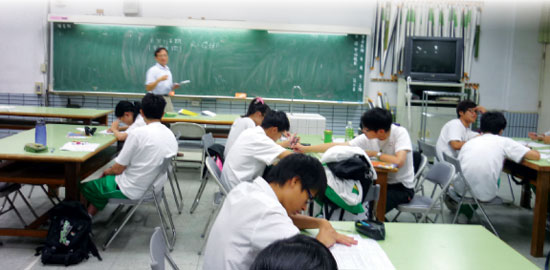
Some say reducing class sizes would be beneficial only if teachers received appropriate training in small class teaching approaches, both at university and while in their jobs, and were given the opportunity to share and learn from each other. |
(HK Edition 01/24/2013 page4)