Shaping Hong Kong's Olympic legacy
Updated: 2012-08-29 07:07
By Simon Parry(HK Edition)
|
|||||||


|
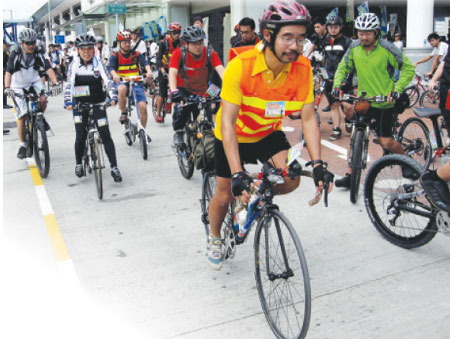
Hong Kong Cycling Alliance members say there are 1 million bicycles in the city |
|
Hildy Fong of the Chinese University of Hong Kong's School of Public Health and Primary Care All photos provided by Red Door News |

|
Cycling has boomed in popularity in Hong Kong in the past 15 years, says the Hong Kong Cycling Alliance |

|
Martin Turner of the Hong Kong Cycling Alliance |

The London Olympics captivated Hong Kong, winning the city its first medal in eight years as cyclist Sara Lee Wai-sze got a bronze and China's gold medalists greeted by huge crowds. But is the government doing enough to promote cycling and healthier lifestyles to ensure a golden future? Simon Parry reports.
For the members of the Hong Kong Cycling Alliance, there was a tinge of irony in seeing the government extend a hero's welcome to cyclist Sarah Lee Wai-sze as she returned victorious from the London Games with the city's first Olympic medal since 2004.
For years, the group has been pressing the government to do more for Hong Kong's cyclists and to make the city a bicycle-friendly place. According to Chairman Martin Turner, it has been an uphill struggle against a relentless headwind of apparent indifference.
"There are a million bicycles in Hong Kong," he said. "We promote cycling partly because so many people ride bikes and aren't well cared for, but more importantly because cycling has a lot to offer Hong Kong in terms of greater fitness, transport efficiency and environmental benefits.
"Cycling is good for Hong Kong. The government is holding us back. On the roads the government doesn't support cycling. It doesn't encourage cycling anywhere.
"For a long time, the government has held the position that cycling is a leisure activity in the fact of massive evidence to the contrary. They take that position and nothing in the real world is going to change their view."
Competitive cyclists like Ms Lee had to do most of their training on the mainland because of a lack of facilities in Hong Kong itself, Turner pointed out, while the few areas within Hong Kong were seized upon by cyclists. "Meanwhile there is nothing in the planning policies or any department policy to facilitate or encourage cycling," he said.
"We build roads and development areas but we don't recognise cycling - (or enable) the carriage (of bicycles) on trains, buses, and ferries, the design of roads and junctions. There is no education and training for motorists.
"We need to tell motorists that cycling is legitimate on roads and cyclists have a right to be there, because many of them simply don't know it. Many sane, educated motorists simply don't know how to drive in the vicinity of a cyclist."
Turner and his fellow cyclists hope that Lee's bronze medal at the London Olympics will help make the Hong Kong government more cyclist friendly and encourage them to recognise it not only as a leisure activity but as a healthy, environment-friendly mode of transport.
"There has been hugely increased cycling participation in the past 15 years," he said. "Another big medal win will boost interest but we are already on a massively increasing upward turn and so many people want the government to get involved by supporting and enabling cycling."
The reason for the inaction, Turner believes, is bureaucratic inertia. "Intransigence is widespread in the government," he said. "Once they have a plan, anything that differs from it is ignored. Cycling is a great unknown as far as they are concerned - but it shouldn't be with a million cyclists.
"Cycling takes a broad approach and you have to look at the benefits across health, environment and other area and we haven't got the capacity to do that yet. There isn't the flexibility for new ideas."
Citing the example of bicycles rounded up en masse and confiscated when they were found chained to railings outside MTR stations, Turner said: "They don't want to cater to the people who want to park their bikes and use public transport. They just see that things are on government land and they have to get rid of them."
Despite the frustrations of recent years, Turner and his members are confident that popular momentum is one their side, particularly with the help of the recent attention to cycling brought by Lee's Olympic success.
"In the medium to long term we are very optimistic," he said. "There is massive pressure and all the arguments are on our side. We firmly believe the move to increase support for cycling is unstoppable. It is like waiting for a volcanic eruption or an earthquake. You know the pressure is building but you don't know exactly when it's going to happen."
Hildy Fong of the School of Public Health and Primary Care at the Chinese University of Hong Kong, agreed that the Olympics should have a positive effect on sports and recreational exercise in Hong Kong.
"I certainly believe that the hype of the London Olympics will inspire people to do more exercise and sports, and it's a good thing for public health around the world. Physical activity, competitive or not, helps improve both physical and mental well-being," she said.
"Hopefully, the Olympics will inspire people of all ages to get out there and participate in sport. Maybe it's a young child who will convince a parent to enrol them in tennis lessons, or a novice runner who needs that push to train for a half marathon, or a young diver who will be inspired to become an Olympian one day."
She said: "The great thing about the Olympics is that it reminds us that if we dream big, and work hard and believe in ourselves, we can achieve something better. Olympians are great role models of optimum health, and can inspire many to take care of their bodies and appreciate good health. The inspiration spans further than sport itself - it's a universal drive that can inspire people to reach higher to achieve their goals.
"Not everyone will become an Olympian, but along the way, there are physical and mental health benefits from being physically active. Seeing good role models can ignite a spark in a former sports enthusiast to delve into a passion again, or get an inactive person off the couch and into some running shoes. The Hong Kong bronze in cycling will surely inspire more than a few girls to ask their parents to buy them a bike.
"Another good thing the Olympics shows us is the importance of camaraderie, and being open to the common language of sport, and connecting with people who enjoy the same activities as us. All of this is beneficial for health and the community, and tackles health challenges like non-communicable diseases and mental health in the society."
The government had a key role to play in capitalising on the Olympics legacy, Fong argued. "Any government that supports good public health should understand that the health of a society is a whole of parts," she said. "In public health we talk a lot about the social determinants of health which means that the health of a society encompasses the environments in which we are born, grow, live, work and age.
"To encourage healthier lifestyles in Hong Kong, the government and influencing bodies can support preventive policies for health such as protecting the environment we live in - the air we breathe, the water we drink, the food we eat. It is difficult to cycle, run and be physically active outside, if the levels of air pollution are toxic.
"They can focus more on addressing non-communicable diseases, mental health, and other public health issues by growing programs that make physical activity widely available, affordable, and accessible for all - especially hard-to-reach and low-income populations.
"Encouraging free, safe, and accessible facilities such as free training programs, bike lending programs, creating safe cycling and walking or running environments, and playgrounds or swimming pools - especially in poorer communities - will not only encourage competitive sport, it will be good for the physical and mental health of the whole society as well."
The implications of promoting healthier lifestyles impinged on the city's economic future as well as its general well-being, Fong pointed out.
"A healthy lifestyle requires integrated policies that support those who need it most. If people are worried about basic things like where to live, putting food on the table, or how to pay for medical treatment, they will not be prioritising sport or exercise," she said.
"Poor health has an economic toll on health systems, so Hong Kong should be very aware of recognizing health inequities. Promoting health, like sports development should be available to everyone irrespective of income level."
Fong added: "It's very difficult for policy makers to make balanced policy decisions when their interests are dipped in so many pots. However, if public health is important, an essential factor to prioritize is preventing disease by improving physical and mental well-being through sport and exercise that is available and accessible - especially to those who are most unable to afford it."
The Hong Kong Cycling Alliance is this week completing a survey of Legislative Council candidates which Turner said revealed there was "huge support" for cycling issues from both individuals and parties.
"The pressure is for the government to recognise cycling as transport," he said. "This is the key to it. Once it's recognised as transport and part of the system, all the planning regulations for roads and policies will have to consider cycling as part of their processes.
"Then we will start to move forward just as Singapore did in 2009 when the transport department there made a declaration that cycling had been considered leisure but was now part of the transportation system. That's what we want to hear."
One of the most persuasive arguments for such a change to be made, Turner believes, is the power of good cycling does for a city's health. "Seventy-eight percent of people don't take adequate exercise in Hong Kong," he said. "Cycling increases the quality of your life and adds years to your life.
"Moderate cycling adds three years to your life and gives you a better quality life - and you get around faster too. It reduces diabetes and heart disease. Around 4,500 people died of heart disease in Hong Kong. How much could we reduce that by if more people cycled?
"Hundreds of thousands of people could get an improved quality of life. On an individual level, anyone can say they will be a happier, healthier person if they ride a bike - but on an organisational level there are billions of Hong Kong dollars to be saved in health care costs by not having all these people with sedentary diseases."
That potential transformation in public health could yet be the most glittering of cyclist Sarah Lee Wai-sze's achievements if the opportunity is seized to transform her Olympic success into a lasting legacy.
(HK Edition 08/29/2012 page4)