Overseas acquisitions by Chinese companies offer rewards and risks
Updated: 2011-01-14 07:49
By Emma An(HK Edition)
|
|||||||


|
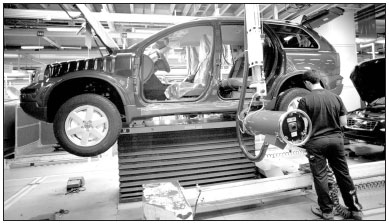
An employee works on a Volvo vehicle as it moves along the production line in Sweden. It faces integration challenges with parent firm Geely. Linus Hook / Bloomberg |
Domestic firms are reaping the benefits of M&A deals abroad, but regulatory hurdles abound. Emma An reports.
As we reported in the first installment of our two-part series Thursday, the past several years has seen China become increasingly active in securing resources assets abroad. According to Dealogic, China accounted for $17 billion or a hefty 22 percent of all cross-border mining merger and acquisition (M&A) deals last year.
However, M&A activity is not just about natural resources. And increasingly, it's not just for large state-owned enterprises either (SOEs). "More and more, we will see private-owned enterprises buy into overseas assets, mostly for brand ownership and access to advanced technological know-how," said Fang Fang, CEO of investment banking for China at JP Morgan.
One segment in which this is more likely to be apparent is the automotive industry, said Lawrence Chia, head of M&A services at Deloitte China.
This is due to the fact that Chinese manufacturers are seeking to "move up the value chain" and build themselves up to be viable competitors to the likes of Mercedes Benz and BMW "by acquiring reputable brand names and the rights to world-class technological processes".
Geely's bid for Volvo, Tengzhong Heavy Machinery's failed attempt to buy General Motors' Hummer brand, and Beijing West Industries' $100 million acquisition of bankrupt US firm Delphi Corporation's global suspension and brakes business, were all made by homegrown automotive players wishing to learn the tricks of the trade.
A review published in August by Deloitte of China's outbound automotive M&A activity shows that from the beginning of 2009 to the first half of 2010, Chinese automotive players conducted 11 acquisitions abroad, worth a cumulative $2.5 billion. This is significant growth compared with just 12 purchases worth $1.3 billion for the three years between 2005 and 2008.
"For technology companies who want to build global brands, they do have to go out," said Carlson Wen, a partner at international law firm Jones Day. Outbound investment still largely serves domestic companies who have an overcapacity problem at home, he noted, as it will help open up new markets for them.
Besides the automotive sector, equipment manufacturing, the high-tech industry and the consumer sector are all likely to see strong growth in China's outbound M&A activity, said JP Morgan's Fang.
Likewise, Managing Director and Head for M&A for China at UBS Securities Philip Partnow said that M&A activity will "spread beyond the natural resources sector" and into the industrial manufacturing sector.
"The appetite for outbound M&A in China's vast industrial manufacturing sector is on the increase and we expect to see a large number of medium to large-sized deals of between $300 million and $1 billion," said Partnow. He made special mention of the agricultural industry, which he expects will "heat up with the ongoing interest in fertilizers, crop protection, seeds and certain key soft commodities".
However, there will be hurdles to overcome before all these deals materialize.
For one thing, regulatory barriers are always hard to crack, particularly when the Chinese SOEs are on the buy side or the Central Government is involved. "Compared with private-owned enterprises, Chinese SOEs always face stricter regulations when bidding for overseas assets although their solid financials and government backing appeal to foreign regulators," said Fang.
A case in point is that of domestic telecommunications network provider Huawei. It failed in repeated attempts to secure deals in North America amid suspicions that the company was too closely aligned with the Central Government and its military.
For another, cultural differences may also get in the way, "particularly with regard to national labor laws and legal frameworks of the destination", Chia suggested. That may be made even more painful in the absence of qualified management able to operate efficiently on a global scale, according to Jones Day's Carlson Wen.
As global economies heal, investors worldwide have renewed their focus on striking M&A deals. This is reflected in the recent uptick of global M&A activity, which jumped 18 percent to $1.97 trillion during the first nine months of 2010 compared with a year earlier, according to data released by Dealogic. Meanwhile, the value of cross-border M&A activity as a whole surged 60 percent to $728.4 billion during the same period.
But for China's outbound M&A activity, post-merger integration is likely to pose a bigger challenge, an issue over which the Jones Day lawyer Wen and JP Morgan banker Partnow, both expressed their concerns.
"For the foreign acquisition to be really of use to the acquiring Chinese company, there has to be integration over a period of time," said Wen.
And as it turns out, a good many of those deals sealed by Chinese buyers are just not worth the money, Wen noted. He referred to the failed joint venture between TCL and Thomson in particular, calling it a "total disaster" due to bad integration.
Still, the few value-for-money purchases have only come to that "value" after those companies undergo an integration period that is strained and stressful, as in the case of Lenovo's initial marriage with IBM.
The ongoing debate between Geely and Sweden's Volvo could just be bickering rather than outright animosity. But the China-born carmaker must carefully handle and smartly execute its post-acquisition integration. And only then will it be able to compete on a global playing field, taking on the likes of Mercedes Benz and BMW.

(HK Edition 01/14/2011 page3)