Innovation the key to future success
Updated: 2010-11-03 07:10
By Joy Li(HK Edition)
|
|||||||


MIT professor says the patent issue is one of quality, not quantity
Long perceived as the "world's factory", the trump card for Chinese companies is price. This has worked for them both in the domestic market - where most consumers are still bargain hunters - and in overseas markets where the term "made in China" is often seen as a negative term for unfair competition.
However, as the country emerges relatively unscathed from the global financial crisis and is about to set the tone for its future development in the upcoming 12th Five-Year Plan, what will prompt Chinese firms to develop their brands and move forward?
"Surely it is innovation that will make it happen," said David C. Schmittlein, dean of the Sloan School of Management at the Massachusetts Institute of Technology, in an exclusive interview with China Daily.
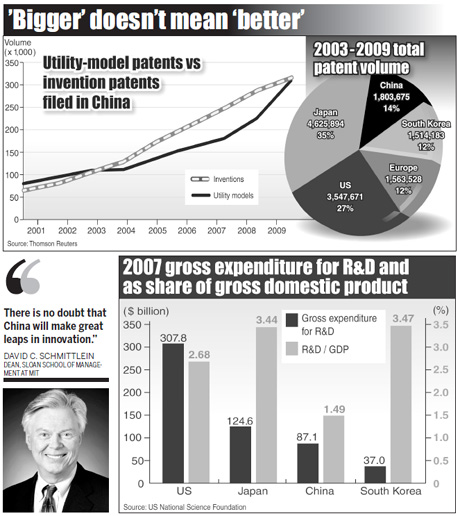
However, China is not exactly a fertile land for innovation. Thomson Reuters issued a report in August entitled "Patented in China."The data compiled showed that total patent volume in China was 1,803,675 from 2003 to 2009 - on a par with South Korea and Europe, half that of the US, and 40 percent that of Japan. The five markets account for 75 percent of all patents filed worldwide.
During the same period, the annual growth rate of patent filings in China averaged 26 percent, far ahead of the US (5 percent), South Korea (5 percent), Europe (4 percent) and Japan (1 percent).
Futhermore, according to a World Intellectual Property Organization (WIPO) report, Chinese company Huawei Technologies filed the most number of patents worldwide in 2008, the first time a mainland company has done so.
But there is another side to this story - quantity is not equal to quality. The Thomson Reuters report broke the filings down into "invention patents" and "utility-model patents". The former category measures whether a patent is really novel and worthy of protection of up to 20 years, while the latter is applied to upgrades or alterations in existing technology. They only receive 10 years of protection.
From 2003 through 2009, the numbers indicate there were almost as many of the latter patents filed as the former, indicating a watered down level of originality. And in 2009, according to statistics from China's State Intellectual Property Office, mainland firms filed 229,096 invention patents and 308,861 utility-model patents. Meanwhile, foreign firms filed 85,477 invention patents and 1,910 utility-model patents in China.
The innovation picture is still a bit fuzzy for the time being then, but what is the situation going forward? And will the picture become more clear?
According to the Ministry of Science and Technology, research and development input accounted for 1.52 percent of GDP in 2008, totaling 457 billion yuan. In the newly approved 12th Five-Year Plan, the Central Government has set a target of spending 2.2 percent of GDP on R&D by the year 2015. By global standard, 2 percent is seen as the benchmark to class a country as being innovation-oriented. Data compiled by the US National Science Foundation showed that in 2007, R&D spending as a percentage of GDP in the US and Japan was 2.68 percent and 3.44 percent respectively, while China was at 1.49 percent.
"The investment China has made in basic research has grown quickly, but also very recently. There is no doubt that China will make great leaps in innovation, but research can take a very long time," said Schmittlein. "It is too early to see the benefits of much of the research."
As a marketing professor and consultant for various multinational companies, Schmittlein said that in the future "most business leaders around the world expect to see more fundamental innovations coming out of China."
Currently, perceptions about Chinese products in the international market are divided. On the one side are comparatively cheaper consumer goods, which are ideal for households on tight budgets. But on the other side - and crucially moving up the added-value chain - is infrastructure equipment, which is highly favored by contractors for their reliability.
"If we talk about technology in large scale infrastructure projects, sometimes there is a perception of very good quality coming out of Chinese manufacturers," said Schmittlein.
Dong Fang Electric, a mainland-based and Hong Kong-listed power-generation equipment maker, is a case in point. Ranked in the Forbes Asia 50 list this year, the company has reaped the benefits of expanding beyond its home market. It has won overseas contracts by combining high quality with competitive prices. And it is also devoting some of its gains to researching new energy sources such as nuclear and wind power.
"Energy is one sector where China has made a large investment in technology, so if that investment results in better and more innovative products, as well as performance that in some way sets a new global standard, they will represent an opportunity for Chinese firms to enter global market not only on a price basis but also on the basis of technology," said Schmittlein.
Having visited several of China's top universities - and with MIT collaborating with others such as Tsinghua University and Fudan University - Schmittlein does have one piece of important advice when it comes to innovation.
"In general, the inventor, or the creator of the idea, overestimates how much anyone wants it. It is a problem for entrepreneurs who are successful initially, since they often believe they have the insights into what the world needs. Most often, the failure of innovation is not technical feasibility, not financing, not human capital - it is always the market," he said.
China Daily
(HK Edition 11/03/2010 page3)