Bubble tea entrepreneurs struggle to make a comeback
Updated: 2010-01-23 07:25
By Phoebe Cheng(HK Edition)
|
|||||||


HONG KONG: Bubble tea in all its cornucopia of flavors: strawberry, passion fruit, mango, lemon, chocolate, rose, ginger, lychee and so on is back, in shops blossoming all along a street in Mong Kok and in other parts of the city. Many purveyors of the novelty beverage are youthful entrepreneurs.
The quick-stop, take-away tapioca bubble infused teas were a part of Hong Kong culture before the turn of the millennium, then the wave broke and bubble tea seemed to fade from the scene.
"There were no takeaway beverage shops when I came back from Taiwan after university," said Ken Chan Chi-yeung, 28, founder of Hong Kong's first bubble tea brand Easy Drink Easy Go. "After evaluating the market we thought there would be a possible business opportunity," added Chan, who spent seven years in Taiwan studying landscape architecture. "We took a year to plan and prepare and opened the first shop in August, 2007," he said.
There are plenty of flavors, plenty of options for different drinks that range in price from HK$10 to HK$20 in Chan's shop. There's traditional bubble black tea, jasmine-infused green tea, chocolate milk tea - in all more than 70 different varieties of beverage are available.
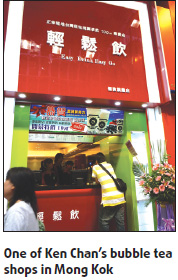
"Many university graduates in Taiwan open shops like this, instead of starting their careers in corporations," Chan said. "But there are fewer cases of this in Hong Kong."
Chan started his business with capital of HK$1 million with the help of his Taiwanese wife whose relatives are in the food and beverage industry in Taiwan.
He chose to open a small 50-square-foot shop on Dundas Street in Mong Kok. Most of Chan's initial capital was gobbled up by high rent, which was much higher than what he expected.
The rental fee of the shop is about HK$50,000 per month, which is about four times that in Taiwan.
Business wasn't bad at the start. The shop sold about 350 drinks a day and turned a meager profit of around HK$10,000 a month. Chan soldiered on. By 2008, sales had grown to about 1,800 drinks a day. Last May, Chan had made enough money to open a second shop in Mong Kok and another in Tsim Sha Tsui.
Business was blossoming and Chan had to train new staff.
"During the peak time, we have to work nonstop from noon to 2 am the next day," he said. "It takes about half a year to train a skilled drink maker."
Chan will open a new franchise shop in Wan Chai next month and plans still another before the end of the year.
Christopher Hung, a Form 6 student, holding a cup of pearl milk tea with two classmates observed, said, "I order a drink at these shops whenever I pass by. I am sick of buying coke in convenience stores."
He said he prefers pearl milk tea over other drinks and stops by two or three times a week.
Waiting for her HK$10 pearl milk tea at a Taiwanese franchise in Mong Kok, Nancy Chau, an auditor working in the district, said, "It tastes good and it's cheap."
"I think it is popular just because people are following others. So people are opening shops like this because they seem profitable. It may be just a trend that people will be tired of one day," she observed.
Chan worries that one day the bubble may burst. On the other hand, he thinks it is possible that the culture will flourish and achieve the popularity it enjoys in Taiwan.
Simon Wong Ka-wo, president of Hong Kong Federation of Restaurants and Related Trades, considers the explosion of tea shops a positive trend for Hong Kong. He believes it will continue.
"Now more television programs are promoting Taiwan and Hong Kong people know more about Taiwan food. They won't resist the new products," Wong said.
Wong pointed out that it is not easy for shops of this sort to survive in Hong Kong's market as competition is fierce.
"Besides these drinks from Taiwan, there are also eateries introduced from other regions like Europe and Japan, showing that Hong Kong's food and beverage market allows competition on a broad field. The variety of eateries proves Hong Kong has the capacity to create a market," he said.
Wong suggests shop owners be creative and bring in new ideas from time to time to keep attracting customers.
There were about 70 drinks available when Chan first started his shop in 2007, but in order to fit the taste of Hong Kong's market, he brought in fruit-flavor drinks to satisfy the preference of local people. He is even offering another new drink to help burn off excess fat during the summer months.
"I make the drinks with heart; people can distinguish between good and bad," Chan said. "I feel happy with what I'm doing."
(HK Edition 01/23/2010 page1)