New HKEx CEO faces tough challenges
Updated: 2010-01-16 07:35
(HK Edition)
|
|||||||


Aims to keep HK competitive with Shanghai, push yuan products
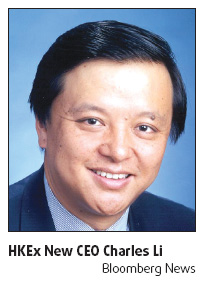
HONG KONG: Hong Kong Exchanges and Clearing (HKEx) officially hands over its helm - as well as some great challenges - on Saturday, to new CEO Charles Li, following the departure of Paul Chow, the Exhange's longest-serving chief in history during whose tenure the HKEx grew into one of the world's top exchanges.
Facing the looming challenges posed by a rising Shanghai, the board of the local bourse operator chose Li, a mainland-born investment banker, for the key post in the hope of helping grow its securities trading platform into one that will at least keep an equal footing with a full-fledged Shanghai market in the future.
The central government has unveiled a timetable that will see Shanghai become an international financial center in 2020, aside from its current role as a national financial center.
"Hong Kong's competitive edge over Shanghai will vanish when the yuan becomes fully convertible," said Peter Pak, Vice-president of BOCI Research Ltd.
The Hong Kong exchange has been benefiting from its competitive edges, including the freer flow of capital, as many foreign investors, who shun the mainland market because of the capital-flow restrictions there, have made the local bourse a proxy for investing in the promising mainland economy, evidenced in the fact that mainland companies now account for over half of the bourse's market capitalization now.
Currently, foreign investors are allowed to invest in the mainland securities market only under the so-called qualified foreign institutional investor (QDII) system, which set many restrictions, including quotas.
With full convertibility for the yuan - a prerequisite for Shanghai to become an international financial center, free flow of capital will be allowed, encouraging foreign investors to invest in the mainland market directly.
As a result, the Shanghai bourse, the mainland's key securities trading platform, will naturally become an international market, augmenting its current status as a national market.
This will put the HKEx in a tough position, since it lacks the status of a national market, in the sense that mainland individual investors still cannot trade Hong Kong stocks directly, while the Shanghai exchange will have the status of both a national and an international financial market by then.
To gain an equal footing, HKEx may wish to develop the local market into a national market as well before the Shanghai bourse becomes full-fledged.
With this in mind, the local bourse operator has been active in lobbying Beijing for support measures, including the launch of yuan products on the local exchange as well as implementing the so-called and now-abandoned "through-train" program, a channel that was to have allowed mainland individual investors to trade Hong Kong stocks directly instead of through currently authorized investment funds channels.
According to a statement by the country's foreign exchange regulator posted on its website on January 12, the "through train" program proposed by the regulator in August 2007 has "expired" and been officially dropped.
HKEx's board has pinned its hopes on Charles Li Xiaojia in appointing the Beijing-born CEO, many market experts believe.
"Charles will work on developing yuan products," Paul Chow, Li's predecessor, told reporters at his farewell party earlier this week.
However, many market participants warn against reading too much into Li's appointment.
"Li absolutely is a capable guy, considering his great success in his career, and his mainland background is a favorable factor for him as the HKEx CEO," said Steve Cheng, an associate director at brokerage house Shenyin Wanguo (HK) Ltd.
"However, I definitely don't believe any single person is capable of achieving something that involves national policies," he added.
The 48-year-old Li was previously China chairman for JP Morgan, which he joined in 2003 from Merrill Lynch, according to an HKEx statement.
Prior to his 20 years in investment banking and legal practice, Li worked as a journalist with China Daily in Beijing in the mid-1980s, and worked on an oil field in northern China's Bohai Bay in the late 1970s.
"As the testing ground for yuan internationalization, Hong Kong can only move in step with national policies. There is no way the city can push on unilaterally on financial initiatives such as the launch of yuan products and the implementation of the (now expired) 'through train'", Cheng said.
BOCI Research's Peter Pak agrees.
"I am not sure whether Li can help win the approval for yuan products ... although his mainland background and contacts may help make things a bit easier," the analyst said.
To strengthen the exchange's status as an international fund-raising and trading platform, HKEx's board also counts on the new CEO's strong experience and contacts in the global investment banking sector, hoping that he can help win more IPOs from multinational companies, another expectation that Li is fully aware of and keeping in mind.
He told participants at a forum last month that he would focus on lobbying for the "through train" and attracting more international firms to list their shares in Hong Kong.
However, the latter task is not going to be easy either, analysts said.
"HKEx faces strong competition from bourses in the Europe and the US in attracting IPOs by international firms," BOCI Research's Peter Pak said.
(HK Edition 01/16/2010 page2)